


“If you eat and sell, you will have to pay a loan”
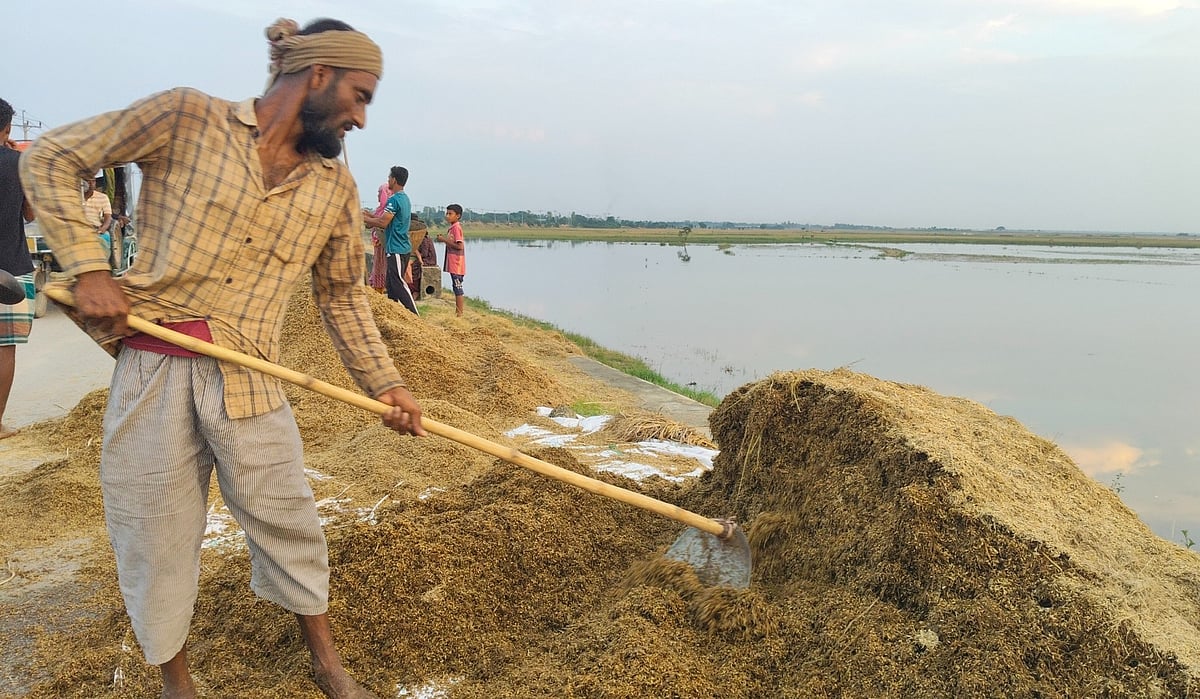
Photo Collected
“It’s all over for me, I’ve become a proletariat.” The trouble was, I didn’t go to get rice even in Khalat paddy. All the paddy fields have been destroyed.
This is how Faizul Islam, a farmer of Bajrpur Haor of Mithamain, Kishoreganj, was describing the situation. He cultivated paddy on five acres of land. Two acres of paddy are submerged in water. He cut three acres of rice. But that paddy has also been spoiled by sprouting seedlings. The amount of loss is 300 maunds of paddy.
Many farmers like Faizul are worried about taking loans from moneylenders at exorbitant interest rates. Faizul also said, ‘How can I give him this? If you give it, there is no point without selling the house, there is no speed. We think of an income in six months. In the month of Betainat Ento Katti, we pay the loan to Anna Darse and in the month of Baisakh we pay the loan to Ular, our food also goes away. Ibar to kistai (anything) naige, ehan khayam ki ar maznare ki dem?’
Among the four acres of land of Abu Taher, a farmer in the same area, half of the paddy land is submerged in water and half is floating. He said, ‘I did not travel to bring rice to eat rice by putting two thousand taka kamala. Kamla has arrived. Aya Khet Dekha is sharing the paddy with the fear of leeches. I know that there are clouds and rain at this time, but there is no such rain after the spring.
Abu Taher said about the burden of debt on his head and the care of his children, “The situation is like this, where I had 400-500 maunds of paddy, I would not have even 20 maunds of paddy.” This rice does not belong to Kamla. How do I pay this loan and where do I eat? There is no road except going to Dhaka. And if I go to Daha, I will either drive a rickshaw, or I will go to work as a daily wage worker. I’ll have to go for it, I’ll have to give the rice to the rice.’
Similarly, Alauddin, a farmer who cultivates boro paddy on about 14 acres of land in Bara Haor of Karimganj, spoke about the hardships. He said that he cultivated the land with an advance loan of six lakh taka from banks, moneylenders and artaddars. This time he could not bring home even a single paddy. He can’t sleep now because of the debt. He said that he took a loan of 350,000 taka from the moneylender for 1,000 taka at 500 taka interest. Now you are thinking about how to repay it. He said, “I was taking two and a half lakh taka from the artaddar to give rice.” I could not give even one kilogram of paddy. I can’t sleep with this thought. It seems that I will have to pay the loan if I sell the food. And to whom to eat? In the current situation, I don’t think anyone will show interest in farming in the future.
By the grace of Allah, I have been free for three days. But the river is wet. There is no place to dry rice. That’s why I’m drying the paddy within the fath.’ Kishani Rahima Begum said the words while stirring paddy on the Nikli-Karimganj road. After raining for 10 consecutive days since April 26, the farmers are feeling lively again as they got some sunshine for two days from last Tuesday. They are spending busy time in harvesting, threshing, drying, selling paddy in the field and making straw piles.
It can be seen on the ground yesterday in some areas of Karimganj, Nikoli, Itna, everyone is busy with rice everywhere on the roads. As there is still rainwater in many places of the ditches made for drying paddy, the work of threshing, threshing and straw drying is going on across the road.
Farmer Subhan Mia was threshing paddy on the Nikli road. He said that the farmers got a lot of relief as there was no rain for two days. In this way, if the sun shines for a few more days, the farmers will be saved from some damage.
Deputy Director of District Agriculture Extension Directorate. Sadiqur Rahman said that 13 thousand 479 hectares of paddy land in 13 upazilas of the district, including Kishoreganj’s Haur area, have been submerged under water so far. About 52,500 farmers have been affected. This has caused a crop loss of approximately 300 crore rupees in the district.
Local people claim that the actual damage amount is several times more than the official estimate. Many farmers complained that the initial survey did not reveal all the damage information. Unplanned construction of dams in Howar, blockage of drains and most of the sluice gates were useless, so the rainwater could not flow down. This resulted in waterlogging without flooding and submerged thousands of hectares of boro paddy.
0%
0%
0%
0%