



Pulse Production Reaches Historic Low in Chittagong as Climate Risks and Profit Motives Push Farmers Away
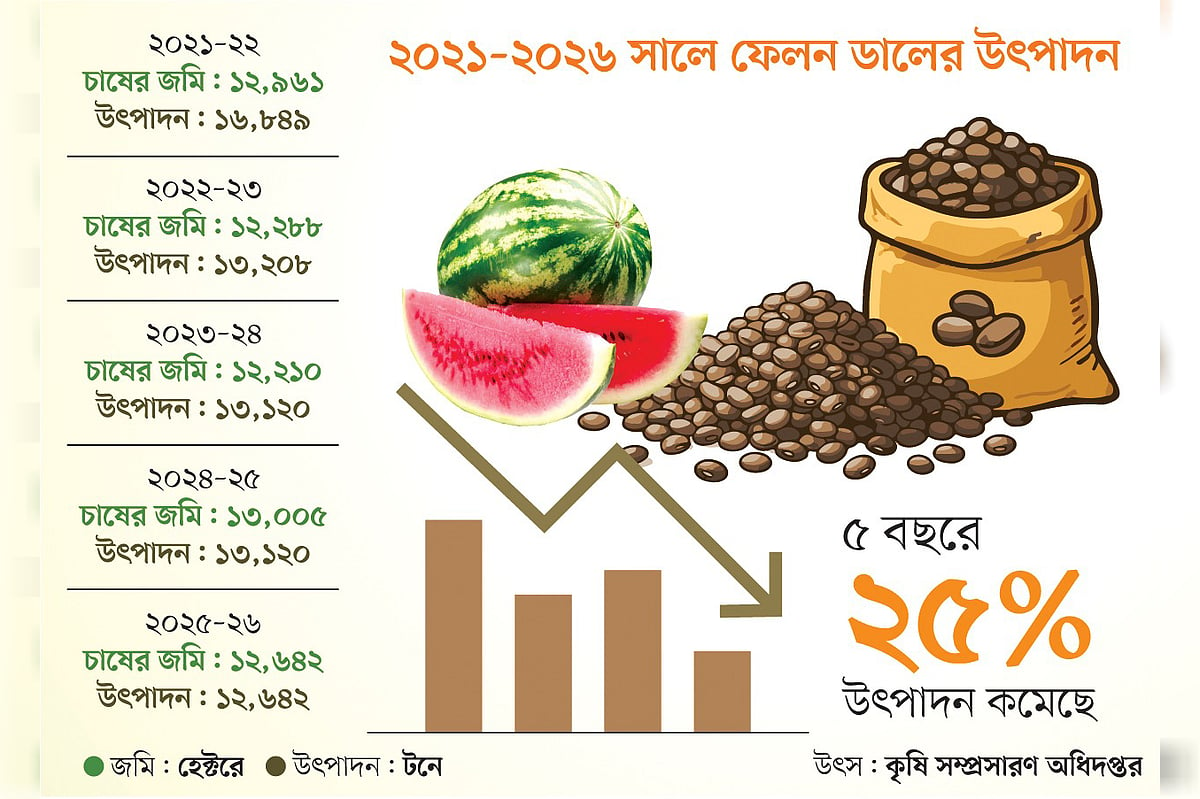
Photo Collected
CHITTAGONG, BANGLADESH — The long-standing tradition of pulse cultivation across the Chittagong district is facing a severe crisis, driven by deteriorating yields, rapid climate shifts, and an economic pivot toward more lucrative cash crops. Once a reliable winter staple for thousands of local growers, the regional output of pulses—particularly felon (cowpea)—has plummeted dramatically, leaving agricultural officials and local farmers deeply concerned.
For generations, farmers like Hannan from Chandanaish Upazila eagerly awaited the onset of winter to cast felon seeds across their fields immediately after harvesting their seasonal paddy. A light plowing was all it took to guarantee a bountiful return. However, Hannan has completely abandoned the crop for the last four years. He recalled that during his final harvest, the total revenue from selling the yield failed to even cover his basic production costs. He noted that while local seeds used to offer excellent returns, the plants now suffer from severe leaf rust and produce fewer flowers, making it impossible to break even.
This narrative of frustration echoes across various upazilas in the district, where hundreds of growers have either scaled back their acreage or ceased pulse farming altogether. According to official statistics from the Department of Agricultural Extension (DAE), pulse production in Chittagong has been on a continuous, unchecked downward spiral. In the 2021-22 fiscal year, the district recorded a total yield of 16,849 tons. By the 2024-25 fiscal year, that figure slid down to roughly 13,000 tons, before hitting a historic low of 12,642 tons in the 2025-26 fiscal year. This represents a staggering loss of 4,207 tons—amounting to a 25 percent contraction in output over a five-year span—while the broader district-wide pulse pool contracted by about 6,000 tons, affecting other varieties like lentil, khesari, mung bean, mashkalai, and peas.
Felon stands as the primary pulse variety grown in the Chittagong region. While areas like Fatikchari, Patiya, Mirsharai, and the offshore island of Sandwip have managed to maintain some level of output, upazilas such as Anwara, Karnaphuli, Banshkhali, and Chandanaish have witnessed consistent declines. Mohammad Abu Sayem, a farmer from Anwara, shared that he pulled the plug on felon farming a few years ago due to the sharp, unstoppable dip in yield that wiped out his initial profit margins.
Conversely, a few resilient farmers like Main Uddin from Sandwip’s Maitbhanga Union continue to push forward, having cultivated 40 decimals of land this season with a production cost of five to seven thousand Taka. Expecting a yield of about two maunds, Main Uddin stated that while current market rates of BDT 100 per kilogram offer a decent return if the market holds, there is no longer any absolute guarantee of a stable yield due to volatile weather patterns.
Agricultural experts and field officers pinpoint weather unpredictability as the most critical risk factor plaguing the sector. Sudden, unseasonal downpours at the tail end of winter or unexpected spikes in temperature cause blossoms to drop off prematurely. Even if the plants manage to survive, the seed pods fail to mature properly. Furthermore, the practice of recycling the exact same seed stocks year after year has dramatically increased the crop’s vulnerability to destructive diseases like leaf rust, which severely weakens the foliage and blocks flowering.
These field-level challenges are strongly corroborated by global scientific research. A study published in 2024 in the Asia-Pacific Journal of Regional Science, which evaluated regional climate and crop data spanning from 1972 to 2020, established that while balanced rainfall acts as a catalyst for pulse production, rising temperatures and surging humidity levels exert a severe negative impact, threatening the long-term stability of the sector. Similarly, an earlier 2018 study published in the journal Agriculture underscored that the main obstacles hindering pulse expansion in Bangladesh include a severe shortage of high-quality seeds, rampant pest and disease infestations, slow technical adoption among rural farmers, and immense competition for land from aggressive commercial crops.
Agronomic officials highlight that while felon has the distinct ecological advantage of requiring minimal irrigation, farmers frequently bypass fundamental field management guidelines. Following the frantic rush of the paddy harvest, seeds are often scattered haphazardly without proper soil preparation. Crucial steps such as balanced fertilizer application, calculated spacing between seeds, and timely weed suppression are regularly ignored, causing the ultimate output to shrivel.
The regional economic shift has further compounded the crisis. Apru Marma, Deputy Director of the Chittagong DAE, explained that regional land dynamics are shifting rapidly as farmers systematically convert their traditional pulse fields to high-value winter vegetables and fruits. In areas like Sitakunda and Mirsharai, land that historically grew felon is now completely dominated by watermelon plantations, which yield vastly superior profit margins.
To reverse this damaging trend, Dr. S.M. Faisal, Chief Scientific Officer at the Chittagong Regional Agricultural Research Center, stressed the urgent need to overhaul the local supply chain by introducing high-yielding, disease-resistant seed varieties. He urged the government to roll out comprehensive field-level technical assistance and modern training programs for the farming community, specifically promoting the widespread adoption of advanced varieties like Bari Felon-1 and Bari Felon-2 alongside a structured rotation of traditional seeds to break the cycle of disease and revive the region’s agricultural heritage.
0%
0%
0%
0%