

Rare Snowy-Browed Flycatcher Spotted in Bangladeshs Satchari National Park
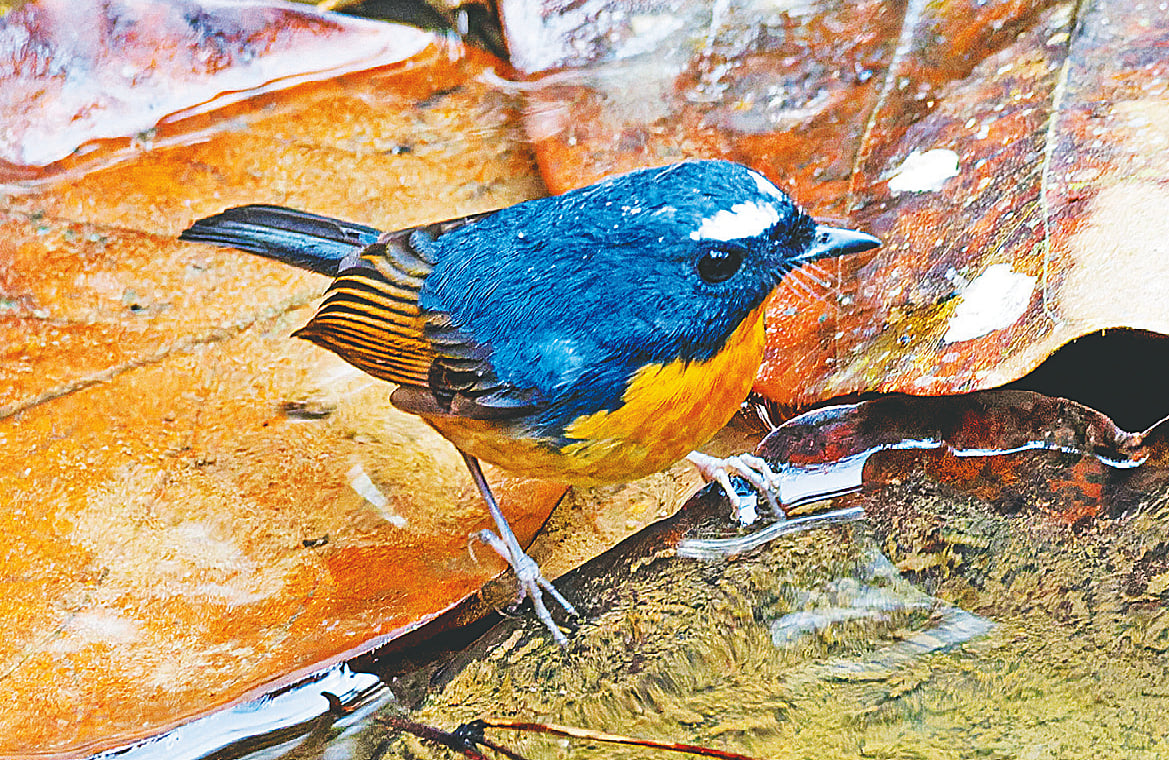
Photo Collected
Deep within the dense, hilly terrain of Satchari National Park in Habiganj, a remote watering hole has emerged as a critical sanctuary for avian life, particularly during the dry winter months. This small pond, established by the Forest Department to provide a reliable hydration source for forest inhabitants, served as the backdrop for a significant observation on March 6, 2018, where a rare encounter with the elusive Snowy-browed Flycatcher was documented.
Guided by local expert Prosenjit Debbarma and bird photographer Dr. Shahenshah Bappi, a group of researchers trekked through rugged jungle paths to reach the site. Their patience was rewarded when, amid a flurry of avian activity, a male Snowy-browed Flycatcher—scientifically known as *Ficedula hyperythra*—emerged from the thicket. The bird, distinguished by its vibrant blue-orange plumage and striking, snow-white eyebrow, initially hesitated before approaching the water to bathe. This rare sighting of the male was followed by a long wait, eventually culminating in the observation of a female of the species in December of that same year.
The Snowy-browed Flycatcher is a member of the *Muscicapidae* family and is native to various regions across South, East, and Southeast Asia. A small, delicate bird, it typically measures 11 centimeters in length and weighs approximately 9 grams. The species exhibits marked sexual dimorphism; while the male features deep blue-grey upperparts with contrasting orange-red underparts, the female displays more muted, olive-brown tones with cream-colored accents. Both sexes possess distinctive brown eyes, black bills, and bluish-grey legs.
In Bangladesh, these migratory birds are primarily spotted during the winter within the mixed evergreen forests of the Sylhet and Chittagong divisions, with rare sightings occasionally reported in the deciduous forests of Dhaka and Mymensingh. They are typically found in damp, low-lying shrubbery and bamboo thickets, where they forage for insects, earthworms, and small fruits. Their presence is often heralded by a distinct, high-pitched vocalization described as a series of sharp, rhythmic whistles.
The breeding cycle of the Snowy-browed Flycatcher takes place between April and June, during which the birds construct cup-shaped nests hidden among tree roots, rocky crevices, or the forest floor. Typically laying three to four speckled eggs, the species demonstrates a cooperative parenting style, with both the male and female sharing incubation and chick-rearing duties. While their average lifespan is estimated to be two to three years in the wild, records indicate that some individuals have lived as long as nine years.
0%
0%
0%
0%