


Low prices, shock of rain, 42 thousand salt farmers of Cox’s Bazar are in trouble
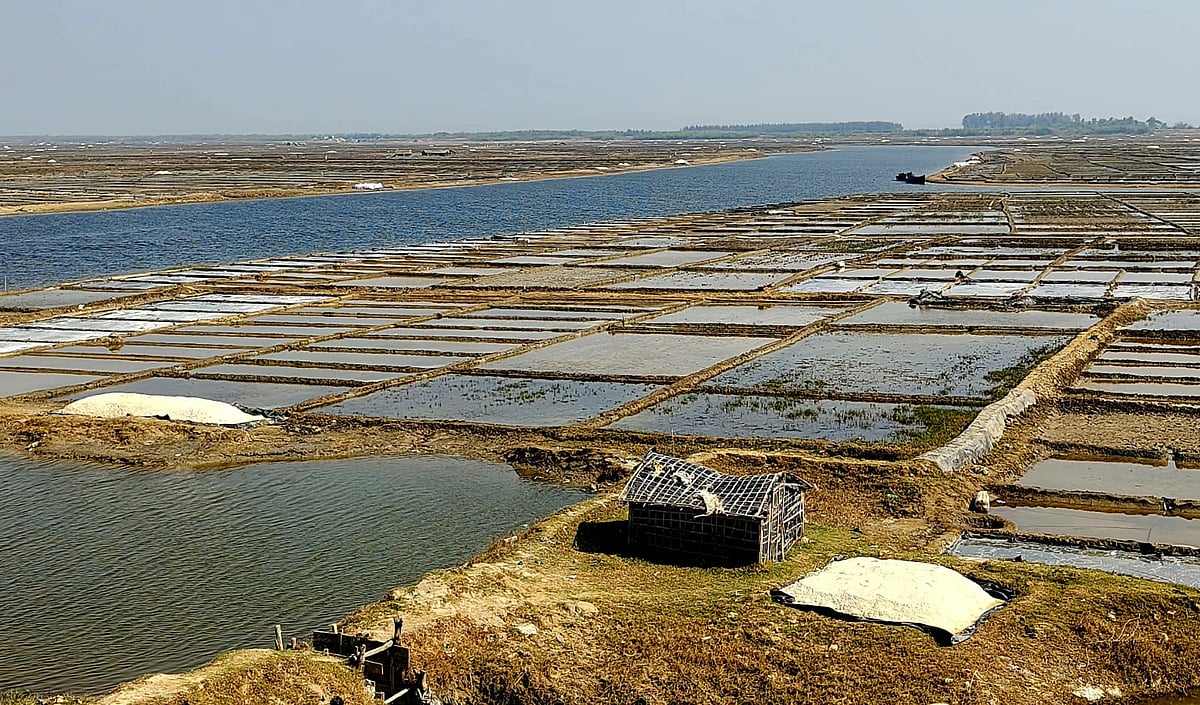
Photo Collected
The price is lower than the cost of production. On top of that, the sudden rain has damaged the salt flats. In such a situation, the salt farmers of Cox’s Bazar are in trouble. Many farmers have stopped producing salt before the end of the season.
In the current season (November 15 to May 15), salt cultivation has been done on about 68 thousand 500 acres of land in the district. About 42 thousand farmers are associated with farming. Most of them have already stopped salt production due to fear of rain.
বিজ্ঞাপন
On Thursday afternoon, going to the Uttarpara area of Shahpari Island in Sabrang Union of Teknaf, Cox’s Bazar, it was seen that there are hundreds of acres of salt flats on both sides of the ‘Bhara Canal’ connected to the Bay of Bengal and the Naf River. Piles of white salt in some places. A handful of workers are collecting salt in the vast field. Black polythene is randomly scattered in the field.
A few workers were loading salt on some boats and small trucks beside the filled canal. One of them said that the salt will be destroyed in the rain, so it is being moved to the warehouse.
বিজ্ঞাপন
Talked to a farmer named Abdul Jalil. He said that on April 7 and 8, the production of salt in 700 to 800 acres of fields on both sides of the canal was stopped due to several hours of rain. Due to non-availability of fair price, the produced salt cannot be sold. He said, “It costs 290 taka to produce one maund of salt, and we have to sell it for 240 to 250 taka.” How much more salt should I sell at a loss?’
Abdul Jalil said that on November 27 of last year, he started cultivating salt on a 1 acre field on the north side of Bhara Canal. Till April 7, 450 maunds of salt have been produced in the field in 4 months and 10 days. He said, “I have sold salt at a loss for the last four months. I will pay the dowry, stay away, I don’t know how to run the family.’
Another farmer, Faridul Alam, said that the salt season is coming to an end, only 20 to 25 days are left. In between, there may be monsoon rains. Once it rains, salt production stops for 7 to 8 days. So the farmers are not getting the courage to go back to salt production after renovating the field for a few days by spending extra money. He said that salt was sold at Tk 190 to Tk 210 in December-January. By the middle of March, the price of salt increased slightly to Tk 230 to Tk 250.
Another farmer Jalal Ahmad said, “The salt production season will end on May 15. As the rains are now, if the price of salt does not increase, the farmers will not take the risk of resuming production. The price should be at least 400 rupees per maund.
In Teknaf upazila’s Hnila, Rangikhali, Jhimangkhali, Kharankkhali, Moulvibazar areas, it can be seen that most of the salt fields have stopped production. Nabi Hossain, farmer of Rangikhali, said, “There may be thunderstorms and stormy weather ahead. Then the production will be stopped for 7 to 8 days. After that, there is no use in renovating the field for 10 to 15 days.
Anchar Ullah, a farmer of Hariyarghona in Maheshkhali, told Prothom Alo on the phone that his 250 maunds of salt were washed away by the one-hour rain on April 8. Since then salt production has stopped. He is not renovating the field due to the fear that there will be more storms in April.
Farmer Nawab Miah of Kutubzom of Maheshkhali Upazila and Giyas Uddin, farmer of Ghatibhanga, said that due to thick fog and cold current in November-December, salt farmers of the upazila were delayed by 20 to 25 days. Now again due to hostile environment we have to leave the field 15 to 20 days earlier. Because of this, salt production has reduced by half. Most of the cultivators took to salt cultivation with loans and money from Dadan. Due to less production of salt, they are worried about repayment of loan.
According to the information provided by Bangladesh Small and Cottage Industries Corporation (BSIC), during the current season (November 15 to May 15), salt has been cultivated in 68 thousand 505 acres of land in Cox’s Bazar Sadar, Kutubdia, Maheshkhali, Pekua, Chakria, Eidgaon, Teknaf and Banshkhali upazilas of Chittagong. 13 lakh 73 thousand 272 metric tons of salt has been produced till April 6, which is 4 lakh 49 thousand metric tons less than last season (same period). 18 lakh 22 thousand 162 metric tons of salt was produced during the same period last season. The target of salt production in the current season has been fixed at 28 lakh 10 thousand metric tons. The demand of salt in the country is 27 lakh 35 thousand metric tons.
When asked to know the reason for the low salt production of the target, BIC Cox’s Bazar Salt Development Project Field Inspector Md. Idris Ali told Prothom Alo that 100% of the salt fields were damaged by the heavy rains on April 7 and 8. Since then salt production has stopped. Hundreds of farmers’ salt has melted (wasted) in the rainwater. He also said that due to cold currents and heavy fog in the current season, there has been a delay of 20 to 25 days in the production of salt by the farmers. Fair value of manufactured salt is not available. Even though the sun is shining now, the farmers are not daring to enter the field due to the fear of rain. At the last moment of the season, the affected farmers are losing direction. Stating that the number of marginal farmers in the district is about 42 thousand, he said that on April 6, 13 thousand 600 metric tons of salt was produced in one day.
Deputy General Manager of Bisik Cox’s Bazar Salt Industry Development Office has expressed apprehension about achieving the national target in salt production. Zafar Iqbal Bhuiyan. He said, currently there are 10 lakh 70 thousand metric tons of salt stored in new and old mills at field and mill (factory) level.
Lutfur Rahman Kajal, Member of Parliament for Salt Cultivation and Cox’s Bazar-3 (Sadar, Ramu and Eidgaon) constituencies, said that the salt cultivators are suffering due to hostile environment and disasters. On the other hand, a fair price is not available for the salt produced. A syndicate is trying to import salt under the pretext of crisis. If salt is imported, the misery of the marginal farmers will increase. At least 1 million people of the district are involved in salt production, transportation, marketing and trade.
Source: Prothom Alo Bangla
0%
0%
0%
0%