
Bangla Academy’s Boishakhi fair is crowded during the holidays
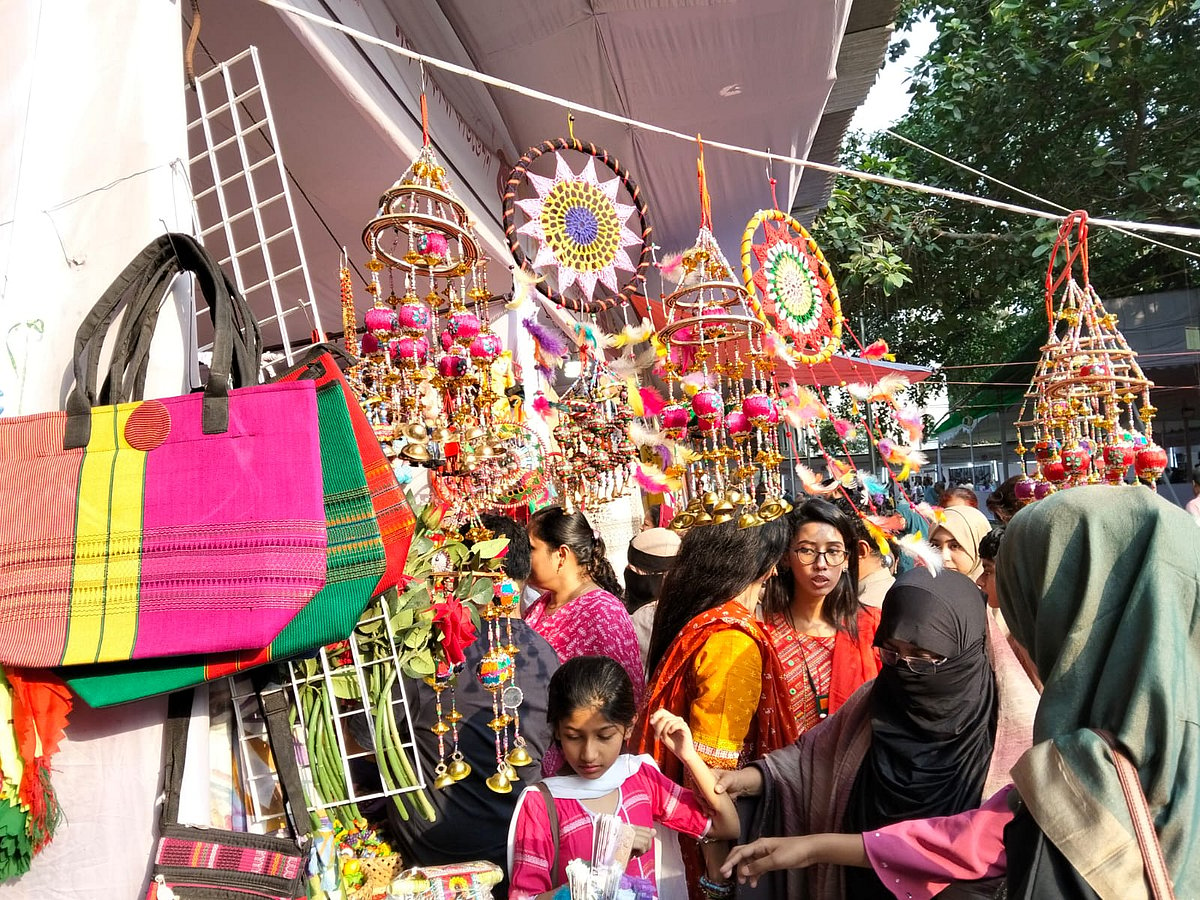
Photo Collected
The Boishakhi fair at the capital’s Bangla Academy premises gathered during the weekend. Many people flocked to this fair arranged in the atmosphere of rural tradition to take a break from the busy city life. Clay dolls, terracotta showpieces, carvings, bamboo and rattan items, hand fans, village toys—all in all, a touch of folk culture permeates every nook and cranny of the fair.
The seven-day Baisakhi fair is organized by Bangladesh Small and Cottage Industries Corporation (BSIC) and Bangla Academy. This fair starts on the first Tuesday of Baisakh.
An overflowing crowd was seen at the fair on the premises of Bangla Academy on Friday afternoon. People from different areas of the capital gather here with their families and friends. The whole premises came alive with the laughter of the children, the exuberance of the youth and the interest of the elders. Not only for shopping, many come to reconnect with rural traditions.
Fahmi Kabir, a resident of Mohammadpur, who came to the fair, said that the atmosphere of the fair is very beautiful, but the prices of some products seemed a bit high to me. Still buying for tradition.
Fahmi bought jute vases, jewelry boxes and wall mirrors to decorate the house. In addition, he bought handmade clothes for himself.
In the fair, the collection of traditional clothes from different regions of the country caught the attention of the visitors. Especially Tangail sarees and Nakshikantha dresses have created a distinct attraction. Due to the fine craftsmanship and traditional designs, interest in these garments has been seen among buyers of all age groups.
The presence of Geographical Indications (GI) products of Bangladesh also enriched the fair. Silk in Rajshahi, Shataranji in Rangpur—the exhibition and sale stalls of these products witnessed a throng of visitors. Many were interested to know about the features of these products.
Nusrat Jahan, who hails from North Badda, expressed her excitement and said that so many kinds of local products are available together here, which are not available anywhere else. Seeing something new at every stall is great.
Saiful Islam brought his family from Mirpur. He said, ‘I have brought the children to see. They have never seen the village Baisakhi fair. The atmosphere of the village is available here. I also remember the village fair of my childhood.
Vendors participating in the fair are also quite optimistic. Abdul Karim came from Sirajganj and gave a stall of cottage industry products. He said, ‘It feels very good to be able to give a stall at a place like Bangla Academy. People are more interested here, sales are also getting better.
Sharmin Akhtar is selling her hand made embroidery and handicrafts at the fair. He said, ‘The specialty of my products is that everything is handmade. There is time and effort behind each design, so buyers are also looking with interest.
A visit to the fair is not just about buying and selling of goods, it is also a cultural get-together. Many are spending time with family, taking pictures. Others are reminiscing about rural life. In this fair, the town and the village are connected.
Not just different products, the fair has created a different world for children. Next to Burdwan House, there are nagardolas, swings, mini-trains for children—all of which are of great interest to them. But not only children, adults too are happily riding the swings, which adds to the merriment of the fair.
“I had so much fun, I want to ride again,” says Ian, a child on the swing.
Little Tanha riding the mini train said, “It was very nice to ride the train, I felt like I was going to travel somewhere.”
The organizers said that there are a total of 160 stalls in the fair. Among them, there are 7 stalls for leather goods, 6 stalls for Jamdani, 4 stalls for Nakshikantha, 44 stalls for textiles, 5 stalls for Shataranji and 2 stalls for Manipuri sarees. Besides, 13 stalls have been allocated for artisan zone, children’s rides and entertainment zone, puppet show, bioscope and cultural programs. 13 stalls for marginal artisans and 2 stalls for minority castes have been provided free of cost.
Books published by Bangla Academy are also being sold at a special discount in the fair. 25 percent discount on books published between 2011 and 2026. And from 2001 to 2010 books are given 50 percent and 2001 books are given 70 percent discount.
Source: Prothom Alo Bangla
0%
0%
0%
0%