



A law is being made so that the Human Rights Commission does not become a ‘fingerprintless’ institution
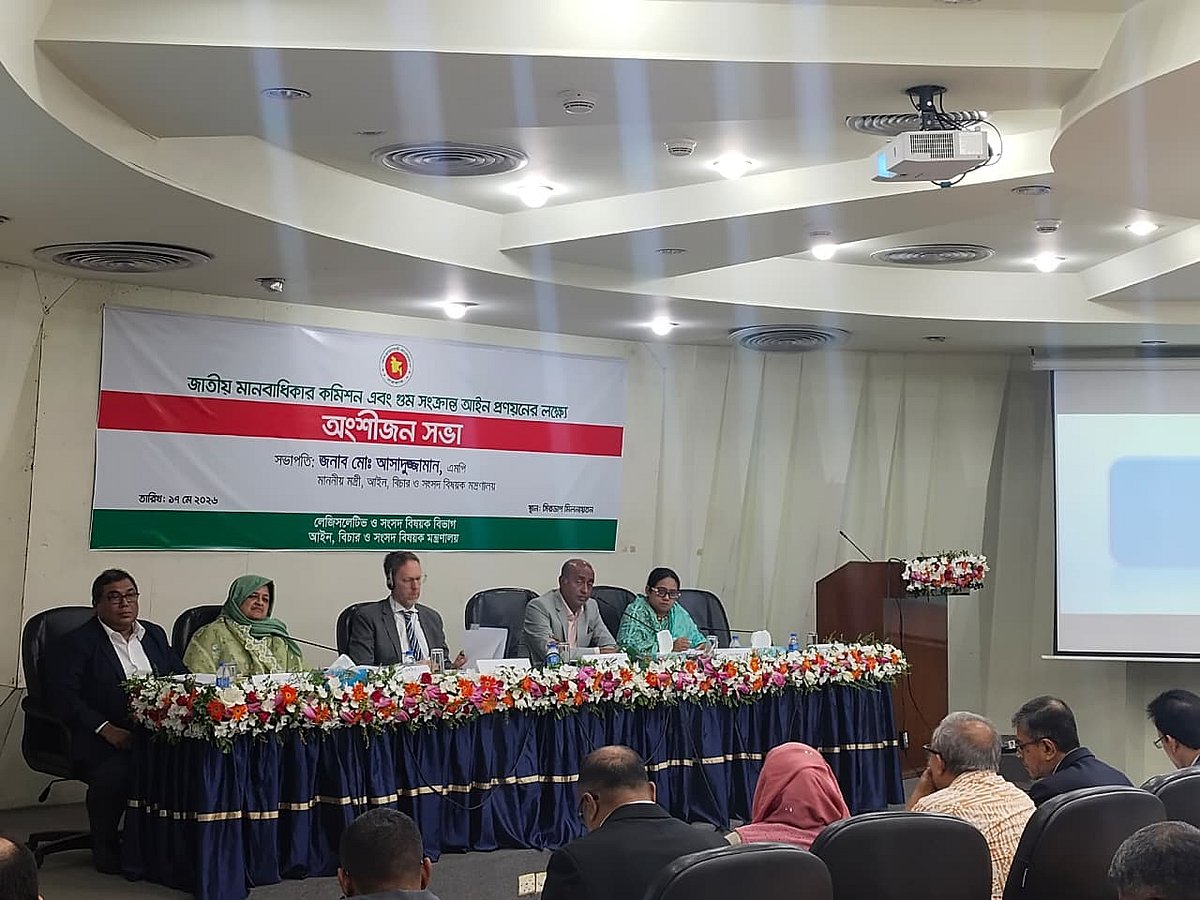
Photo Collected
Law Minister Md. said that the Human Rights Commission should not become a “fingerprintless” institution. Asaduzzaman. He said, the new Human Rights Commission Act has tried to remove some of the limitations of the previous Act.
The law minister said, through the new law, an attempt has been made to recognize the report of the commission as admissible evidence in the court, so that the human rights commission does not become an institution without a record.
বিজ্ঞাপন
The Law Minister said this in a discussion meeting with the stakeholders aimed at enacting the ‘National Human Rights Commission Act and Law on Disappearances’ at Sirdap Auditorium in the capital on Sunday afternoon. He presided over the meeting.
Rasheda K Chowdhury, former caretaker government advisor, Attorney General Md. Ruhul Quddus Kajal, Member of Parliament Tahsina Rushdie, wife of missing BNP leader Ilyas Ali, Member of Parliament and Coordinator of Human Rights Organization ‘Mayer Dak’ Sanjida Islam Tuli, Resident Representative of UNDP Bangladesh Stefan Leeler, Former National Commission on Missing Persons Noor Khan Liton and Nabila Idris, Executive Director of Foundation for Humanity Shaheen Anam, Senior Advocate of Supreme Court Mohammad Shishir Monir, Bangladesh Adivasi Forum general secretary Sanjeev Drang and representatives of various domestic and foreign non-governmental organizations working on human rights and disappearances participated. Hafiz Ahmed Chowdhury, Secretary of the Legislative and Parliamentary Affairs Department of the Ministry of Law gave a welcome speech at the meeting.
বিজ্ঞাপন
The National Human Rights Commission Act and the Draft Law on Disappearances were presented at the meeting. Later, the participants suggested various aspects of this draft law. The Law Minister listened to their advice. He also requested them to give written advice on the draft law. He requested to give written advice to the Law Ministry by the first week of next June.
Highlighting the differences between the draft National Human Rights Commission Act, the Law Minister said, “The new Human Rights Commission Act has tried to remove some of the limitations of the previous law.” The earlier Act provided for a wide timeframe for the functioning of the Commission. In the new law we have kept the timeframe at each level. Second, the new Human Rights Act provides for review of Commission decisions. Because, the commission is also an institution made up of people, after they give a decision, it is not taken as final, and the opportunity for re-review is kept.
The Law Minister also said that although the Human Rights Commission had powers of investigation, inspection and inquiry in the previous law, their reports did not have any separate legal or evidential value. The new law seeks to recognize the commission’s report as admissible evidence in court; The report should be accepted by the court and the judicial process should be enriched based on it.
In response to a question, the law minister said that if the commission or its officers are involved in a conflict of interest in any investigation, provisions have been made in the law to deal with it. If a state signs an international human rights agreement or document but does not follow it, there are also instructions on how international human rights organizations will take action in this regard.
Asaduzzaman said about the law related to disappearances, “I think, the draft of the Disappearance Commission Act was done in such a way that the criminals would have benefited more in the prosecution of the crime.” This is my personal opinion. As a result, I myself am not happy with this draft of the Missing Commission Act. Every line of the law must be re-read. It will need to be discussed further.’
Later in the meeting, the participants gave suggestions on several issues including the burden of crime investigation, the duration of the sentence under the Missing Act. In response, the law minister said, “I have already said that I myself am not very happy with the draft.” When I sit for the second consultative meeting on the law related to disappearances, it will be possible to sort things out a bit more.”
In a suggestion regarding the investigation of the disappearance, Noor Khan Liton said that when the chiefs of the forces were asked for an answer about the disappearance, they did not give any answer. But he gave a made up answer. The same possibility still remains. In this case, we can ask them, we can also start an investigation – he advised to have such a provision.
In response to the question of how many days will be the two laws, Asaduzzaman said that the government is seriously working on the National Human Rights Commission Act and the legislation related to disappearances. He expressed the hope of raising these laws in the session after the next budget session in the National Parliament.
Regarding the draft Human Rights Commission Act, Attorney General Ruhul Quddus said, “The word “government” has been used in some places of the law. I think it would be more appropriate to use the word “State” instead of “Government”. Because protecting human rights is not the responsibility of any particular government; It is the responsibility of the state. As the law minister has also said, there is scope for further amendments and revisions to this law.
‘Clear guidelines should be kept’
In the meeting, Bangladesh Resident Representative of United Nations Development Program (UNDP) Stefan Lilar highlighted Bangladesh’s position on human rights. He said, currently the National Human Rights Commission of Bangladesh has retained the ‘B’ status under the International National Human Rights Organization Alliance. It is a reminder of a long-standing deficit. But it is also known that Bangladesh’s legitimate aspiration is to reach ‘A’ status, which is fully compatible with the Paris Principles. This amendment to the Commission Act provides a rare opportunity to overcome the limitations of the past and build a stronger institution.
Rashed K Chowdhury, advisor to the former caretaker government, suggested a public hearing as well as a meeting with the stakeholders on the two laws. He said that the word ‘minor ethnic group’ has been mentioned in the law on the recommendation of the selection committee. He suggested to refine this term. Apart from this, he objected to the word ‘special’, referring to the context in which any eligible person from underprivileged communities or women would be given ‘special consideration’. He advised not to keep it.
Shaheen Anam, executive director of the Foundation for Humanity, citing past experience, said that there is a kind of ‘cherry picking’ in investigations – which will be investigated and which will not be investigated.
Shaheen Anam said, “When we demanded an investigation in the past, it was said that they (National Human Rights Commission) do not have the manpower, they do not have the power.” A clear guideline should be kept regarding the investigation. He suggested that the issue should be strengthened.
0%
0%
0%
0%