Bloody red flower
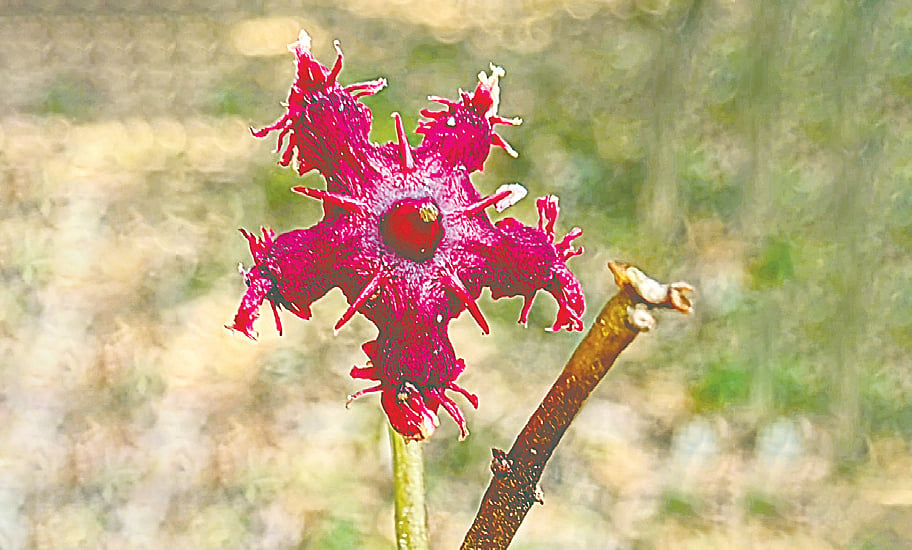
Photo Collected
Seeing something for the first time involves excitement, exhilaration, wonder, joy and curiosity. That’s how I felt when I first saw the blood flower. Such a small flower; But his fruit is so big! And the flowers are blooming hiding themselves in the big leaves of the huge tree, the flowers are falling under the tree.
On the morning of 6th Chaitra spring of this year, eight of us nature lovers went to Mirpur to see the plants of the National Botanical Garden. Passing the beautiful Jaliadanga Lake we entered the forest. Walking along the bank, friend Zia Ul Alam Chowdhury finally stopped near a tree. He said, this is the blood tree. Earlier he informed that the flowers of Raktan, Kainar and Mogulmani have bloomed in Botanical. Come to see. I have seen the flowers of the changing color before, all the flowers and fruits; But Raktan flower was never seen. So go there if you want to go there. I picked up a bloody flower from the ground, raised my eyes and looked up. Thick stem-like crusty trunk, quite tall and a little above the gray-brown trunk, followed by stems and leaves. I started looking for flowers among the leaves. Flowers were seen in the branching inflorescences far above; But there is no way to see the full appearance of the flower seen from above, so I tried to see all of its form by looking at the flowers gathered below.
বিজ্ঞাপন
Why are there two types of flowers? Zia Bhai said, a saju flower; The other is stale. Saju or newly bloomed flowers turn a deep blood red when they are stale. The flowers are beautiful. Much like girls’ designer earrings. The decorative form of the flower is one in the newly bloomed flower, another in the stale flower. The petals of the newly opened flower are five yellow-white, narrow, in the middle a small crimson disk-like five-armed structure in the center of which is a small dome like uterus and pistil. It is guarded by five pale pink anthers like grains of wheat, the anther of the male saffron is yellowish green, the base of the anther where it joins the disc is greenish again. Buds are green, with small egg-like green buds on the heads of short buds next to the buds. All in all a wonderful composition of art, beauty, design and color. An artist painted this form of nature! He bowed his head in surprise. The wonder does not stop when I see, after the petals have fallen, the appearance of the flower has become maroon red; Vriti, saffron and saffron are all red. Then the flower is like dried blood particles, no other color. That’s why the Bengali name of this tree is called Raktan, another name is ‘Sutaranga’. In the literature I found its English name ‘Frily Crest-Petal’, botanical name Lophopetalum wightianum and family Celastraceae.
Raktan is a large tree. The tree grows up to 60 meters tall, trunk up to 195 cm. As the tree grows older, sometimes the roots of the tree can be seen at the base of the tree. The bark of the tree is thick, grey-brown and fissured. Leaves are simple, usually opposite, sometimes alternate. Petioles 1 to 2.5 cm long and rounded, leaves up to 25 cm long, 4 to 10 cm wide, leaflets elliptic-oblong, acuminate to long-lanceolate, base rounded, margins smooth and smooth, leaves papery or somewhat leathery. 6 to 13 pairs of secondary veins are located on either side of the midvein. Flowers showy, peduncles up to 12 cm long. The flower petals are yellowish, the disc is bright red, each petal has an apex. That is why its English name is ‘Frily Crest Petal’.
বিজ্ঞাপন
I was overwhelmed by the beauty of the flowers. Suddenly Captain Kawsar Mustafa picked up a fruit and brought it. He asked if that was the result of blood or not. I have never seen either. I thought, the flower is so small, its fruit will be so big? I confirmed later. The fruit is hard, very similar in appearance to kamaranga; But longer and thinner than Kamranga, triangular. When the fruit is broken, there are white papery winged seeds inside. Blood tree is a woody tree of lowland moist evergreen forests. This tree is often found along swamps and streams. This tree is found in Bangladesh, Pakistan, India and Indochina. According to the information of IUCN and Bangladesh National Herbarium, this species of tree is currently an endangered plant in Bangladesh.
Source: Prothom Alo Bangla
0%
0%
0%
0%