


Former Prison Guard Authors Definitive Study on Colonial-Era Incarceration Systems
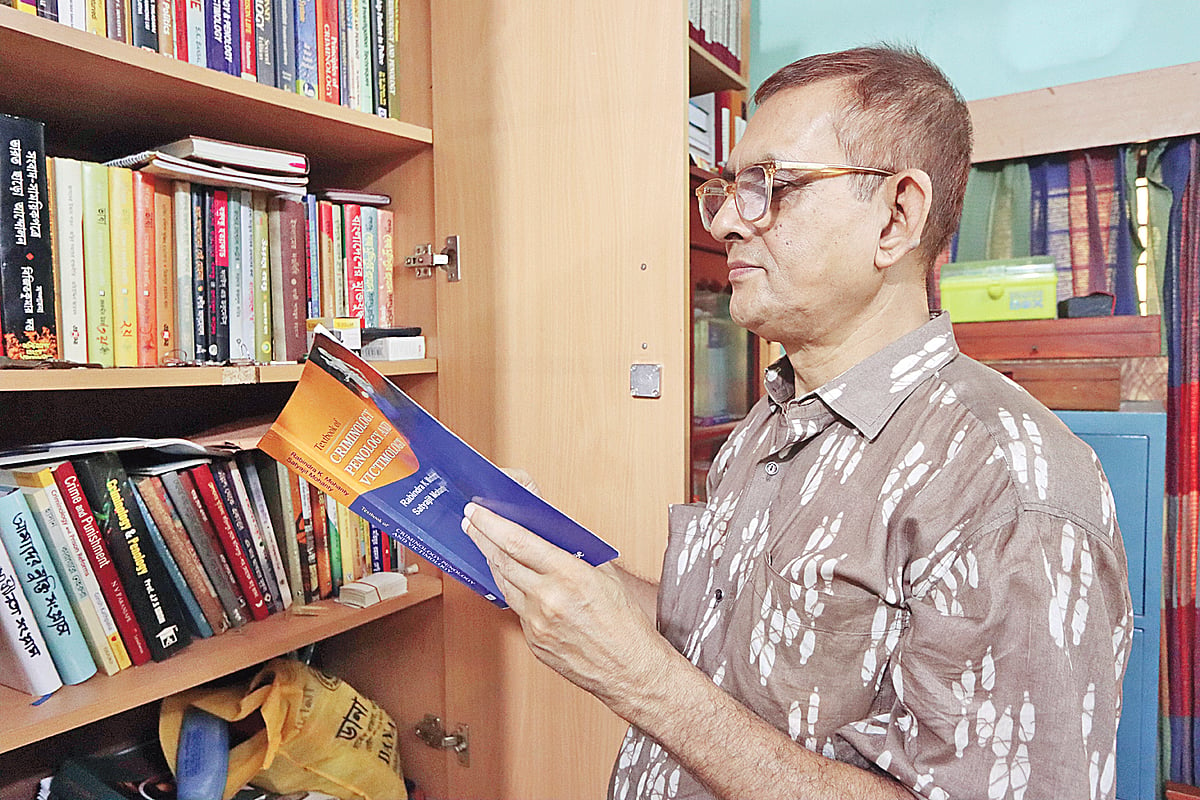
Photo Collected
A former prison guard who witnessed the systematic decay of library resources while on duty has spent decades transforming his lived experience into an authoritative critique of the penal system. Khosbar Ali, who served in the Rajshahi Central Jail, has authored a 600-page research volume titled *Karagare Anusandhan* (Investigation into Prisons), which was formally unveiled at a ceremony at the Bishwo Shahitto Kendro in Dhaka this Thursday.
Ali’s journey began in 1984, when he watched in dismay as heavy rainfall destroyed the library collection at the Rajshahi prison. That event, coupled with his growing discomfort over the dehumanizing conditions imposed by antiquated British colonial laws on inmates, sparked a pursuit of knowledge that would define his life. Driven by a desire to understand the mechanics of incarceration, he eventually resigned from his position two years early to focus entirely on academic research.
বিজ্ঞাপন
The transition from a prison guard to a researcher was fraught with personal risk. Following his retirement in 1999, Ali began contributing a series of articles to a weekly newspaper in Rajshahi in 2001, exposing administrative irregularities and systemic abuse within the prisons. His investigative reporting drew the ire of prison authorities and contractors, forcing him into hiding for six months. These reports were later compiled into his first book, *Bangladesh Karabyabostha* (The Prison System of Bangladesh).
Ali’s expertise eventually gained institutional recognition. In 2015, he served as a guest lecturer for the 33rd BCS batch of assistant superintendents of police at the Bangladesh Police Academy, and later, he taught penology at the Mawlana Bhashani Science and Technology University. Beyond his work on prisons, he has published research on the history of Naogaon district and the Language Movement, as well as a volume of poetry.
বিজ্ঞাপন
Born in 1960 to a farming family in Naogaon, Ali entered the prison service in 1976. Despite initial resistance from recruiters, he began his career with a monthly salary of 145 taka. Throughout his tenure, he sought to educate himself against the backdrop of a rigid system that offered little support for intellectual inquiry. With the encouragement of senior officials in the 1980s, he began accessing resources from local libraries and the Dhaka Archives, eventually expanding his research to include rare texts procured from India and England.
Legal experts have lauded the depth of Ali’s latest research. Mohsinul Haque, a senior district and sessions judge in Cumilla, described the book not merely as historical documentation, but as a testimony to long-standing systemic suffering. According to Haque, the work argues that the colonial prison model functioned as a deliberate strategy for economic exploitation and political control, detailing how the state apparatus stripped individuals of their dignity and subjected their bodies to exhaustive bureaucratic surveillance.
0%
0%
0%
0%