
Digital QR code system launches on buses to enhance passenger safety and driver accountability
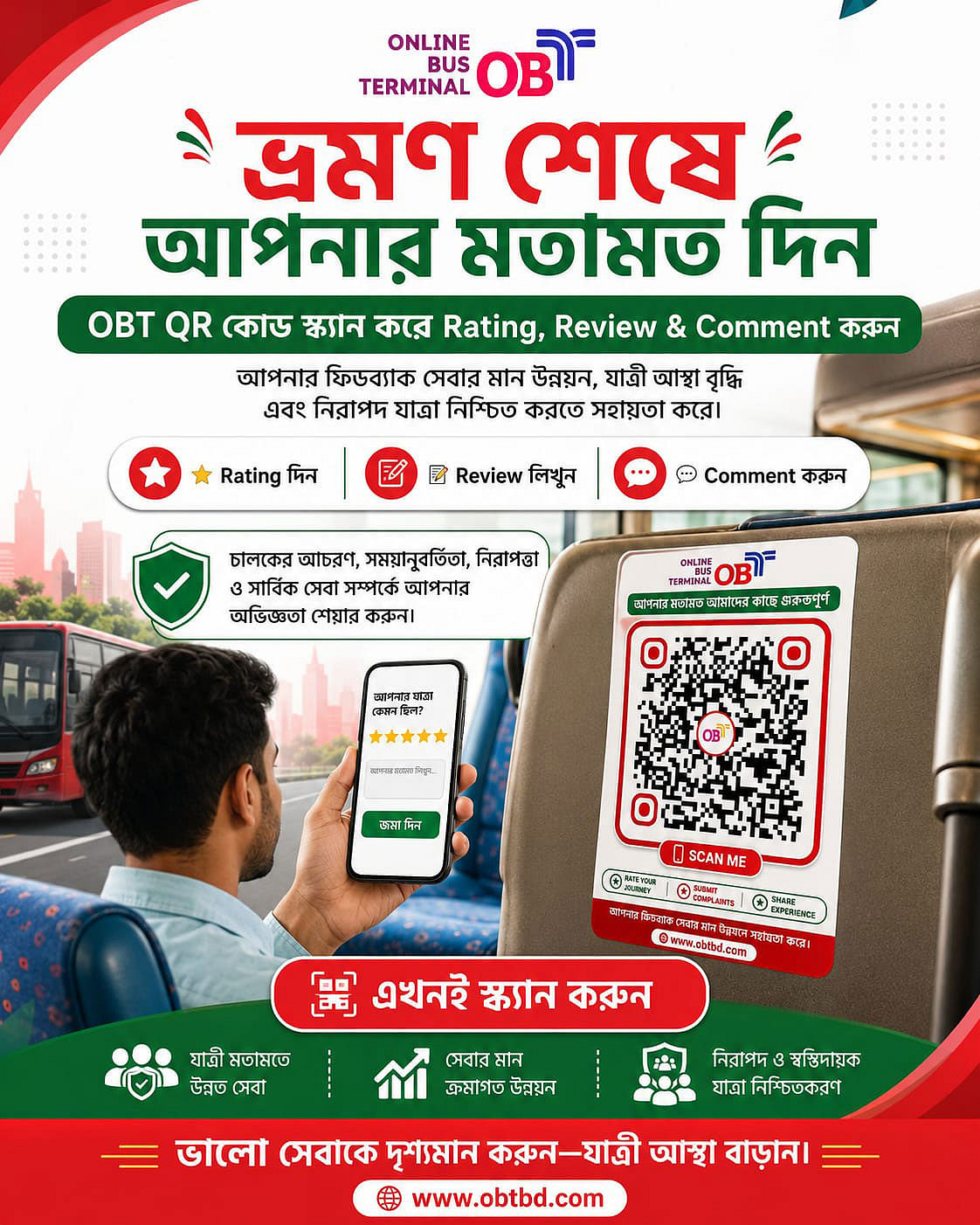
Photo Collected
Passengers traveling on public buses can now access real-time information about their drivers and vehicles by scanning a QR code placed inside the bus, marking a significant push toward digital traffic management and road safety in Bangladesh. The initiative, spearheaded by a platform called Online Bus Terminal (OBT), allows commuters to view driver credentials, verify past safety records, and submit performance ratings or complaints regarding driving behavior and service quality.
The system was launched on September 27, 2024, coinciding with World Tourism Day, starting with operations in Cox’s Bazar. Currently, 102 transport companies, covering approximately 2,500 buses and an equal number of drivers, are integrated into the OBT network. While the pilot began in Cox’s Bazar, which hosts over 100 transport companies, the system has expanded to cover at least 40 routes nationwide.
The project is led by Jasim Uddin, Additional Superintendent of Police (Crime and Ops) for Rangamati district. According to Uddin, the process begins at the bus counter, where details regarding the vehicle, driver, supervisor, route, fare, and schedule are logged into the system before departure. Within 20 to 30 minutes of a bus leaving the terminal, OBT’s virtual call center contacts the supervisor to verify these details and provide safety instructions, including directives on maintaining speed limits.
Beyond passenger utility, the system serves as a digital enforcement tool for law enforcement. Police officers can use a dedicated mobile application, known as Road Monitor, to scan the same QR codes. This gives them immediate access to a driver’s photograph, license information, contact details, and records of past accidents or legal violations.
Proponents of the project argue that by involving passengers in the monitoring process, drivers are more likely to adhere to safety protocols, knowing their performance is subject to public review. Passengers can access this interface via the QR code or by visiting the website www.obtbd.com to provide feedback. This data helps establish a public rating for transport companies, allowing future passengers to make informed travel choices.
While the initiative was launched under the guidance of the Cox’s Bazar district police, it has not yet been formally adopted as a national government system. However, proposals were presented to the Ministry of Home Affairs and Police Headquarters in July of this year, and the initiative is currently being considered for a nationwide rollout.
Transportation experts have welcomed the move, noting its potential to reduce road accidents through data-driven accountability. Professor Md. Hadiuzzaman, a transport expert and former director of the Accident Research Institute at the Bangladesh University of Engineering and Technology (BUET), described the technology-based surveillance as a positive step. He suggested that, moving forward, the platform should be further enhanced to include an emergency response model, which would integrate medical services and rapid rescue efforts in the event of accidents.
0%
0%
0%
0%
More News from Technology