

Shrinking Land and Generational Shifts Threaten Traditional Hill Farming in Chittagong
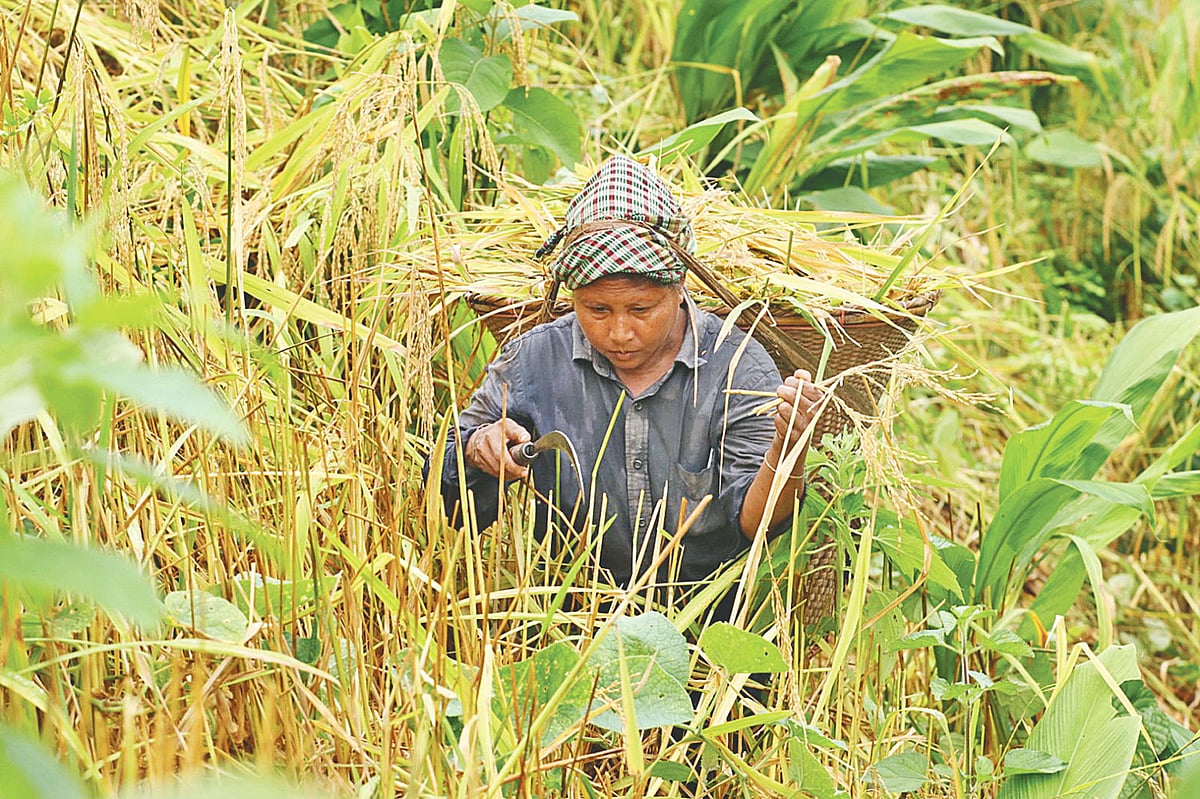
Photo Collected
The traditional practice of *jum*—a rotational, multi-crop farming method deeply embedded in the cultural and ecological fabric of the Chittagong Hill Tracts (CHT)—is rapidly disappearing. Facing mounting pressures from shrinking land availability, environmental degradation, and a generational shift, the indigenous farmers who have sustained this ecosystem for centuries are increasingly abandoning their ancestral practice.
In the hills of Dighinala, 72-year-old Boneranjan Tripura stands as one of the few remaining practitioners in his area. Surrounded by slopes once vibrant with diverse crops—ranging from indigenous rice varieties to turmeric, sesame, and chilies—he expresses deep uncertainty about the future. His children have moved away from farming, and finding labor in the rugged terrain has become nearly impossible. Beyond the labor crisis, the primary constraint is land. Where generations once practiced a fallow cycle of 10 to 12 years—allowing the forest to regenerate and soil fertility to naturally restore—farmers are now forced to return to the same plots after only three to five years. This shortened interval leads to lower yields, compelling farmers to resort to chemical fertilizers and pesticides, inputs that were once entirely unnecessary.
For the indigenous communities of the CHT—including the Chakma, Marma, Tripura, and Mro—*jum* is far more than a method of cultivation; it is a way of life, an expression of food culture, and a repository of intergenerational knowledge. Historically, *jum* has been criticized as a driver of deforestation and soil erosion. However, international research from agencies such as the Food and Agriculture Organization (FAO) and the Center for International Forestry Research (CIFOR-ICRAF) suggests that such characterizations are overly simplistic. These experts argue that *jum* is a cyclic management system that, when given adequate fallow time, allows for secondary forest growth and biodiversity retention.
The decline of *jum* is reflected in official agricultural data across the region. In Khagrachhari, the land area dedicated to *jum* cultivation plummeted from 2,195 hectares in 2014-15 to 1,150 hectares by 2025-26. Similar trends are visible in Bandarban and Rangamati, where orchard cultivation—particularly fruit trees—is steadily replacing the traditional, varied *jum* plots.
This transition is not merely a change in agricultural practice but a fundamental shift in the regional economy. As younger generations seek higher education or employment in the garment sector and abroad, the labor force for *jum* has evaporated. Manju Bikash Tripura, a farmer from Kumardhanpara, notes that while he once relied on diverse indigenous crops for his family’s food security, he now sees no future in *jum* for his educated sons. His village, like many others, is seeing a migration toward commercial fruit farming and wage labor.
Compounding these human factors is the accelerating impact of climate change. A 2025 report by the Bangladesh and Norwegian Meteorological Departments highlights a significant increase in erratic weather patterns in the CHT, including more frequent heatwaves and heavy, unseasonal rainfall. For farmers who rely entirely on natural cycles and rain-fed irrigation, these disruptions make traditional farming increasingly precarious.
Experts like Professor Khaled Misbahuzzaman of the University of Chittagong argue that labeling *jum* as purely destructive ignores the complexities of land management in the hills. He contends that the loss of *jum* is influenced by a range of systemic factors, including infrastructure development, population pressure, and the expansion of commercial monoculture, rather than the practice of *jum* itself.
As the practice fades, the concern among observers is not just the loss of a farming technique, but the erosion of indigenous knowledge regarding soil, seeds, and the seasonal rhythms of the hills. Raja Devasish Roy, Chief of the Chakma Circle, emphasizes that while market forces are inevitable, the transition should be managed in a way that protects the ecological integrity of the land and the food security of the indigenous people. Without a sustainable approach that secures land rights and promotes the preservation of indigenous seeds, the extinction of *jum* may represent an irreversible loss to the cultural and biological heritage of the Chittagong Hill Tracts.
0%
0%
0%
0%