
Livestock Replaces Crops as Primary Income Source for Bangladesh Smallholders

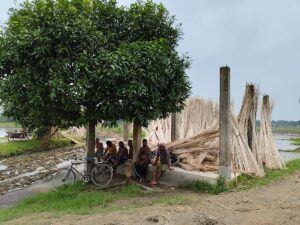
Photo Collected
Small-scale farmers in Bangladesh are increasingly turning away from traditional crop cultivation, with livestock and poultry farming emerging as their primary source of income. According to a national survey released by the Bangladesh Bureau of Statistics (BBS), income generated from rearing animals and birds now dwarfs earnings from temporary crops like rice and vegetables by nearly six-fold.
The “Income and Productivity of Small-Scale Food Producers Survey 2025,” conducted as part of the assessment for the United Nations’ Sustainable Development Goals, highlights a precarious transition in the agricultural sector. Surveying nearly 12,900 households across eight divisions, the BBS report defines small-scale farmers as those in the bottom 40 percent based on land ownership, livestock numbers, and annual income.
Data from the report reveals that a small-scale farmer earns an average of 33,639 taka annually. Of this, livestock and poultry account for 28,421 taka, whereas income from temporary crops—the backbone of traditional subsistence farming—averages only 4,591 taka. Other contributors include fisheries at 12,670 taka and forestry at 10,892 taka, while permanent crops and fruits yield the lowest returns at 2,331 taka.
Industry experts warn that this shift threatens national food security. Mohammad Shahjahan Kabir, former Director General of the Bangladesh Rice Research Institute, noted that because farming remains largely unprofitable, many smallholders are exiting the sector. He observed that as small farmers depart, large-scale investors are moving in, treating agriculture as a commercial enterprise rather than a livelihood, which risks further marginalizing the traditional farming population.
Structural issues, including complex market chains and the influence of intermediaries, remain the primary obstacles to profitability. Recent research from the Centre for Policy Dialogue (CPD) underscored this disparity, showing that while farmers receive roughly 30 taka per kilogram for Paijam rice, the retail price often nears 60 taka. This suggests that the value added throughout the supply chain is captured by middlemen, millers, and wholesalers rather than the producers.
Regional disparities in income were also notable in the survey, with the Rajshahi division reporting the highest average annual income for small farmers at 44,707 taka, compared to a national low of 24,636 taka in Sylhet. While the report did not explicitly detail the causes for these gaps, analysts suggest that the expansion of the poultry and fisheries sectors in regions like Khulna has bolstered local household earnings.
The survey further indicates that access to capital is a significant barrier. Farmers utilizing improved cattle breeds, such as Friesian or Jersey, report significantly higher annual returns compared to those relying on local, low-yield varieties. Despite this, small-scale producers often lack the credit access required to invest in such livestock.
The findings also shed light on the gender gap within the agricultural landscape. Despite women playing a critical role in livestock management, poultry care, and milking, their formal leadership remains minimal; only 10.7 percent of the surveyed small-scale farming households are headed by women, pointing to a persistent lack of formal recognition for their labor.
0%
0%
0%
0%