Reign of Terror Grips Raozan as Political Factions Clash Over Territory and Extortion
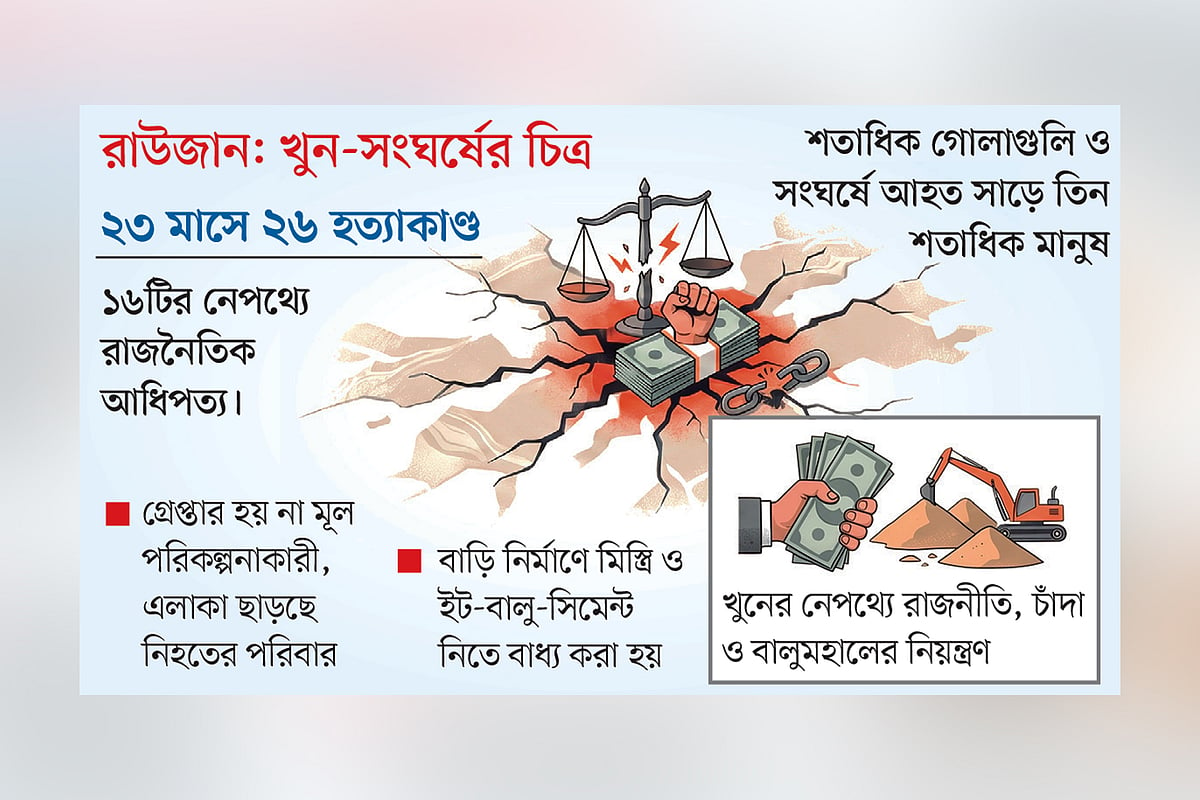
Photo Collected
A climate of fear and lawlessness has gripped Rauzan, a sub-district in Chattogram, as a series of politically motivated murders, extortion schemes, and territorial disputes continue to terrorize local residents. Since the fall of the Awami League government on August 5, 2024, at least 26 people have been killed and over 350 injured in more than 100 separate shooting incidents and clashes.
Investigations indicate that at least 16 of these killings are directly linked to political infighting. The violence has evolved from simple political rivalry into a systematic method for controlling local markets, sand extraction sites, and the construction materials trade. Residents describe an “invisible regime” where criminal groups act as the de facto authorities, forcing locals to live in a state of constant subjugation.
The pattern of violence remains consistent: armed assailants arrive on motorcycles or CNG-powered autorickshaws, execute their targets in public spaces, and retreat into the nearby hilly terrain. Victims, many of whom were associated with the Jatiyatabadi Jubo Dal, have been gunned down in busy markets such as Ishan Bhatter Hat, Pahartali Choumuhani, and Olymier Hat. Following these attacks, families often flee their homes, witnesses remain silent due to death threats, and control over the area effectively shifts to new factions.
Local sources point to a deep-rooted conflict between rival factions within the Bangladesh Nationalist Party (BNP), specifically between groups supporting Gias Uddin Quader Chowdhury and those aligned with Golam Akbar Khandaker. These internal divisions have spilled over into local government elections and the lucrative management of infrastructure businesses.
While police investigations are underway, critics argue that authorities often fail to trace the origins of the weapons, the financiers behind the killings, or the political patrons who provide sanctuary to the perpetrators. Police Superintendent of Chattogram, Masud Alam, acknowledged that criminal gangs frequently exploit the hilly geography to evade capture and confirmed that authorities are using drones to track suspects. However, residents remain skeptical, noting that arrests of low-level gunmen have done little to dismantle the broader culture of impunity.
Criminal groups have extended their reach into the private lives of citizens, reportedly demanding extortion money from homeowners during construction projects and dictating which contractors or suppliers may be used. Those who resist face intimidation or violence. One resident from Noapara noted that an expatriate was forced to abandon a home construction project after being threatened for 2.5 million taka.
Political leaders involved have largely denied direct culpability. Gias Uddin Quader Chowdhury has rejected allegations of fueling violence, attributing the instability to a lack of effective law enforcement. Conversely, Golam Akbar Khandaker has accused Gias Uddin’s associates of orchestrating the unrest to maintain dominance over land and resource extraction.
Criminology experts suggest that the situation in Rauzan is a classic case of the criminalization of politics, where political parties empower individuals who can demonstrate brute force to control territory. They maintain that until the political patrons, financiers, and masterminds are held legally accountable, the cycle of violence is unlikely to be broken. For now, the people of Rauzan remain in the shadow of an invisible administration, where the rule of law is superseded by the whims of local armed syndicates.
0%
0%
0%
0%