

Now, who dies more during lightning strikes?
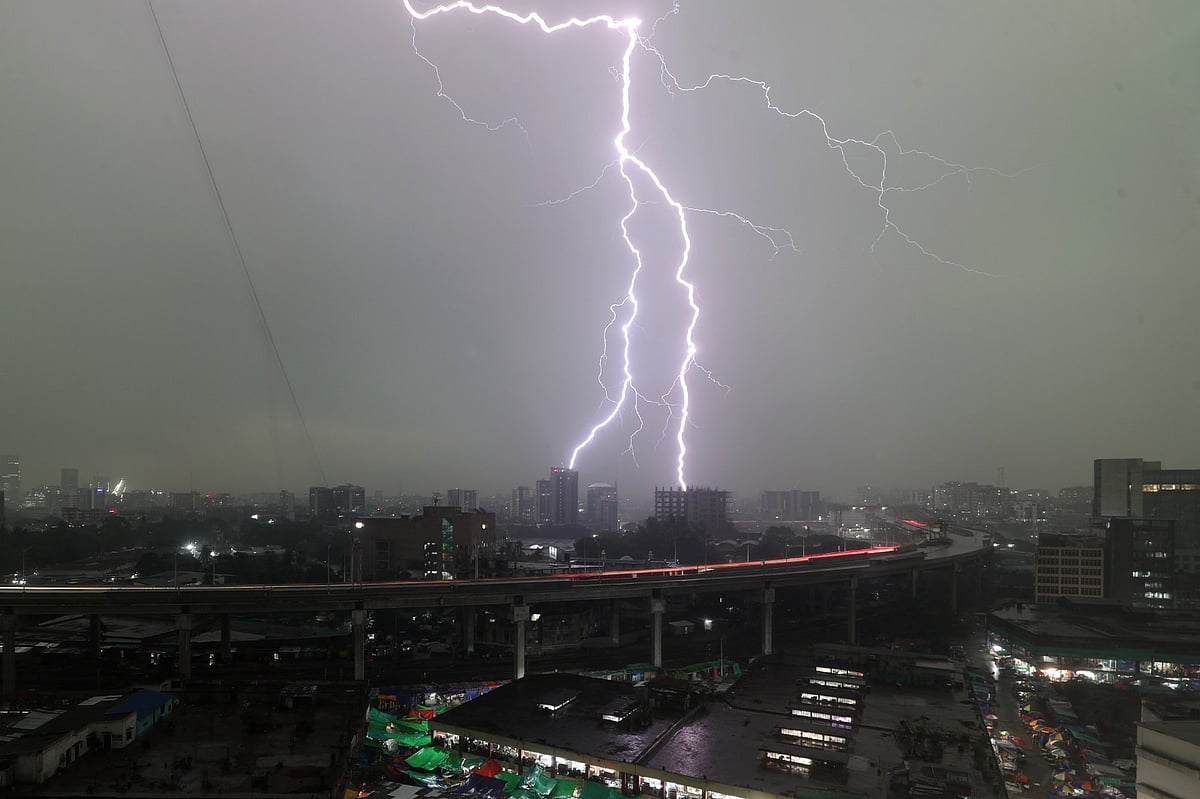
Photo Collected
Labani Akhtar (35) went outside the house to cut grass for the domestic cows. On the way back, it started to rain. He was killed by lightning shortly after. Labani’s house is in Niamatpur village of Pirganj upazila of Thakurgaon. Farmer Elias Hossain (37) of Koshadangipara of the same upazila fell into the storm while looking at the crops in the field. And did not return home. His life stopped there due to lightning.
This is how 14 people died due to lightning in seven districts of the country yesterday. This is the highest death toll in a single day this year. But this is not an isolated incident. According to long-standing data, lightning is now a recurring seasonal disaster in Bangladesh. And its biggest victims are farmers in the fields, fishermen and people working in the open.
বিজ্ঞাপন
Although hundreds of people die every year due to lightning, there is no effective initiative to reduce it. There have been projects like planting palm trees and making shelters to reduce lightning. Some organizations have also worked to provide early warning signals. But in reality they are not working.
Disaster management expert Gauhar Naeem Wara told Prothom Alo, ‘Those who are dying due to lightning are very poor people. So we have less headache with them. When more people die in a single day, the media stirs, various government departments become alert. But there is no advance and far-reaching action to prevent this death.
বিজ্ঞাপন
Analysis of the monthly trend of lightning in Bangladesh shows that the number is low in January-February but it starts increasing from March onwards. It intensifies in April, and reaches its peak in May. Then it started to decrease in June-July. It increases slightly again in September.
According to Earth Networks, an international meteorological technology organization, the total pulse count or thundershowers in Bangladesh is highest in May. March to July is the most active season for it.
The death toll data is also consistent with this trend. Most of the major deaths over the past 15 years have occurred in April, May or June.
Bangladesh Foundation for Disaster Forum (BFDF) regularly records the number of people killed and injured by lightning in Bangladesh. The institute’s data found few cases of major fatalities due to lightning in a single day. It shows that the highest number of deaths in a single day occurred on May 23, 2011, 58 people. On May 12 and 13, 2016, 87 people were killed. 33 people were killed in two days on August 13 and 14, 2014.
In addition, 37 people on June 6, 2021, 33 people on May 6, 2013, 29 people on June 4, 2024, 29 people on May 10, 2018, 24 people on June 17, 2022, 23 people on May 23, 2023, 22 people on April 28, 2025, 20 people on April 6, 2012, 19 people on May 2, 2015, 16 people on May 9, 2017, 15 people on July 7, 2019, 6 May 2024 15 people, 26 April 2026 14 people were killed by lightning.
This list shows that major lightning tragedies occur around the same time of year.
Geographical data shows that lightning occurs in all parts of the country, but the highest concentration is in the northeastern region, especially in the Sylhet region. Apart from this, the number of lightning strikes in the northern part of the country is more than any other region.
Muhammad Abul Kalam Mallick, senior meteorologist of the Meteorological Department, said that there is a relationship between weather and climate. He researched the lightning patterns of Bangladesh.
Abul Kalam Mallik told Prothom Alo that lightning strikes are more common in areas near water or reservoirs. These include the Haor area in the North-Eastern region and the Northern region especially the Rangpur region.
Muhammed Abul Kalam Mallick said that clouds formed by evaporation in the Bay of Bengal, combined with clouds formed by evaporation from reservoirs in the Sylhet region, formed thunderclouds, which created a favorable environment for lightning.
Analyzing Vaisala Xweather data, Abul Kalam Mallik said that in Sylhet, 80-96 lightning strikes occur per square kilometer every year. There are 12-32 per year in Jessore.
That is, the difference between one region of the country and another region is several times. The risk is very high in Sylhet, Sunamganj, Habiganj, Netrakona and nearby Haor-adjacent areas.
Experts say Meghalaya’s mountainous topography, humid air currents, warmth and vast wetlands—all of which create a favorable environment for lightning strikes in the northeast.
Last year’s occupational death data paints a most alarming picture. Of the 263 people killed by lightning in 2025, 110 were farmers. Apart from this, 38 students, 25 housewives, 22 day laborers, 18 jailers.
That is, almost one out of every two deaths is a person engaged in agriculture-related work. A separate analysis also found that the death rate of farmers is the highest among different occupations.
The reason for this is also unknown. Farmers stay in open fields during thunderstorms. They have less chance to go to safe shelter during these tasks like harvesting paddy, watching crops, irrigating, mowing cows, bringing cattle.
According to the Directorate of Disaster Management, the number of deaths due to lightning has fluctuated between 2015 and 2025. However, after 2020, the number of deaths is seen to decrease consistently.
In 2020, where 427 people died, it decreased to 363 in 2021. After that it further decreased to 173 in 2025.
Although the downward trend is seen, experts do not see it as a reason for relief. Because there is no definite evidence that the number of lightning strikes has decreased. And with 14 deaths per day as early as 2026, the risk remains high.
Meteorologists are talking about an increase in lightning strikes. As its numbers have increased, the number of trees in crop fields or elsewhere in the country has decreased at an unusual rate. Especially in Haor region.
Gauhar Naeem Wara thinks that this has happened due to the change in the type of agriculture over time. He said, now farmers are no longer in agriculture. Agricultural land is now only a source of money for the landowner. It doesn’t matter if there is a big tree or not. Hence trees in vast areas of Haor have been destroyed. There is no intention to install them. Some works such as construction of structures or planting of palm trees have not worked at all.
People who are killed or injured by lightning are most likely to die, whose livelihoods and income depend on being outside and moving, according to occupations.
Many farmers do not leave the field even after seeing the storm. Some people think that they will return after finishing their work. Someone goes to fetch the cow. Someone goes to open the irrigation system. Those few minutes became fatal.
Thunderstorms tend to increase in the country from February or March, with a higher frequency in April and May. But when the lightning is high, various campaigns or activities start immediately. During the period when lightning is less frequent, ie from November to February, there is no publicity about it.
Gauhar Naeem Wara urges to increase activity and publicity even during safe times of lightning. He said that even though there are reports of deaths every year, no effort is made to know why and how the deaths occur. Analyzing where people die, why they die, there is no long-term planning initiative.
Gauhar Naeem Wara suggested to activate local government institutions especially Union Parishad in public awareness campaign to prevent death due to lightning. He said that not only responsibility should be given, but how they will do the work, the necessary support should be given.
Experts are talking about large-scale planting of trees in lightning-prone areas of the country. Rakhhari Sarkar, adjunct professor of Botany Department of Dhaka University, suggested that the cutting of big trees should be stopped on a regular basis. He told Prothom Alo, tall trees will attract lightning quickly, it is normal. A tree is a living entity. There is supposed to be a thunder strike first. But in Haor and lightning-prone areas these trees are now much reduced. Trees should be planted in these areas to prevent loss of life.
Labani Akhtar went to cut grass, Ilyas Hossain went to see the crops. Their death is not an isolated incident, it is part of the repeated mourning of many families in the country. According to the data, when April-May comes, the lightning in the sky increases, the risk increases in the field, and the farmers lose their lives the most.
Therefore, lightning should not be seen as a natural phenomenon. It is now a major crisis in agriculture, climate, regional inequality and public safety. If action is not taken now, the same news may return next year.
The Bangladesh government declared lightning a disaster in 2015. Director General of Disaster Management Directorate Rezwanur Rahman was contacted on Monday to find out if the government has any idea about reducing the death due to lightning, he said that he will talk about the matter later.
Source: Prothom Alo Bangla
0%
0%
0%
0%