

Finance Minister Calls for Job-Oriented Higher Education and Cautious Expansion of Universities
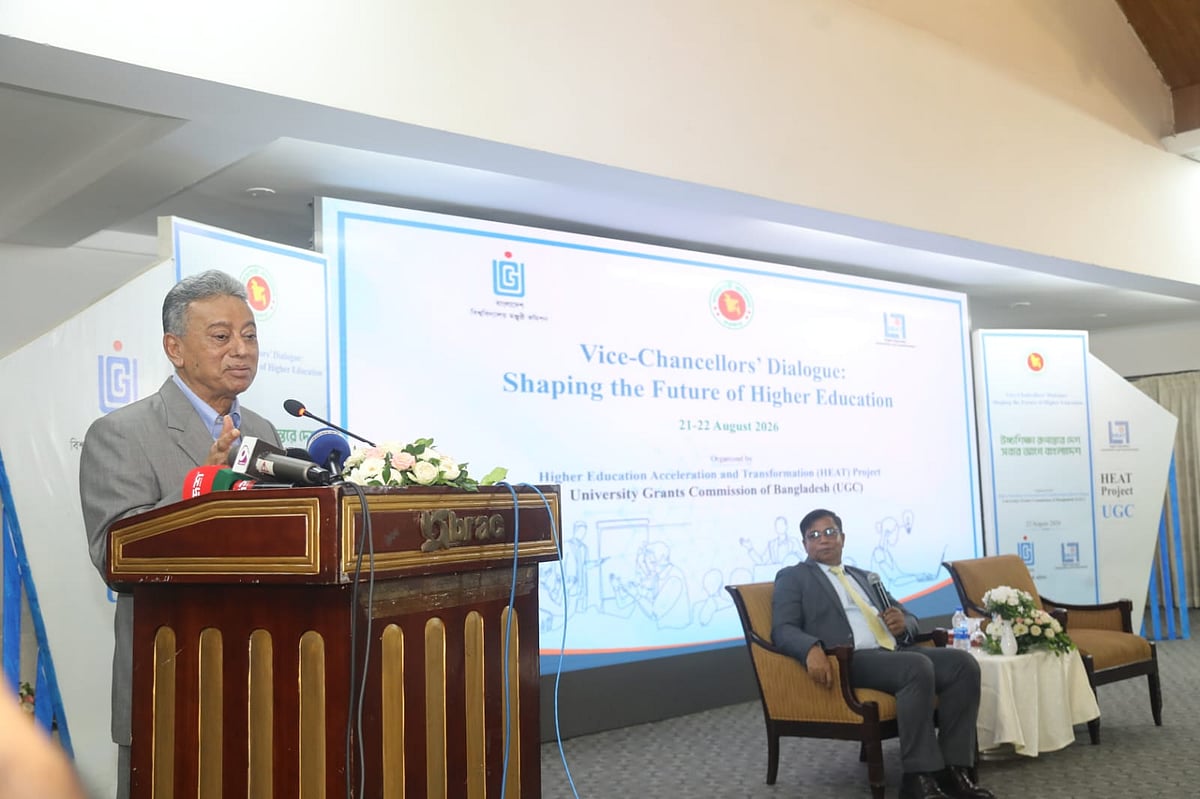
Photo Collected
Finance and Planning Minister Amir Khasru Mahmud Chowdhury has urged the University Grants Commission (UGC) to prioritize economic relevance, employment potential, and entrepreneurship when approving new universities or academic departments. Speaking at the opening of a two-day dialogue for vice-chancellors in Savar on Friday, the minister cautioned against the haphazard approval of new institutions, advocating instead for strategic planning aligned with labor market demands.
The event, held at BRAC CDM under the Higher Education Acceleration and Transformation (HEAT) project, brought together key policy makers, including the Prime Minister’s Education Advisor Mahadi Amin, Secretary of the Secondary and Higher Education Division Abdul Khaleq, and former UGC Chairman Professor S.M.A. Faiz. National Professor Mahbub Ullah, along with various public and private university leaders, also participated in the discussions.
Minister Chowdhury emphasized that higher education curricula must reflect the country’s economic reality, stating that the primary goal of universities should be to produce graduates who are prepared for the workforce or ready to become entrepreneurs, rather than merely focusing on the acquisition of certificates. He noted that despite current economic constraints, the government has prioritized the education sector and is working toward a target of raising education spending to five percent of the Gross Domestic Product (GDP). He stressed that increased funding must be matched by transparency and effective investment in research and skill development.
Prime Minister’s Advisor Mahadi Amin highlighted the need to regularly update university curricula to meet domestic and international labor market needs. He suggested that universities introduce short-term, employment-oriented courses to bolster students’ proficiency in technology, communication, languages, problem-solving, and leadership.
UGC Chairman Professor Mamun Ahmed acknowledged that while the number of students and higher education institutions has grown significantly, ensuring quality and graduate employability remains a critical challenge. He noted that the ongoing dialogue aims to address these systemic hurdles through collaborative sessions focused on governance, digital transformation, research, innovation, and closer integration between academia and industry.
The first day of the conference concluded with four sessions, where experts and university administrators explored strategies to improve higher education standards and institutional accountability.
0%
0%
0%
0%
More News from Local