
Bangladesh Increases Education Budget to 1.36 Trillion Taka as Government Targets Skill-Based Economic Shift
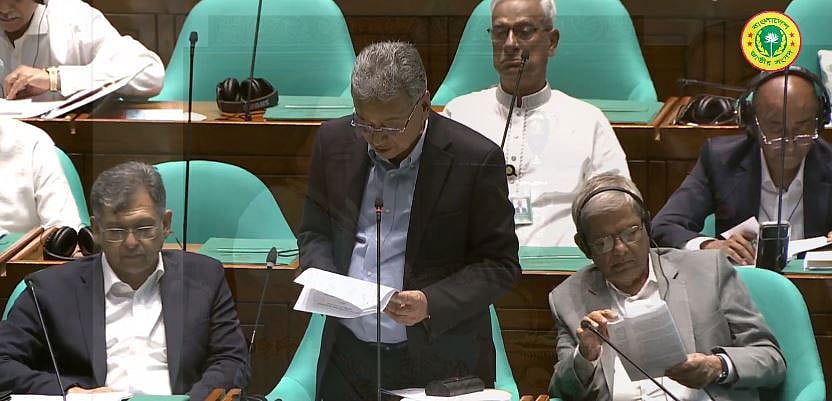
Photo Collected
Finance Minister Amir Khosru Mahmud Chowdhury has proposed a significant boost to the education sector in the 2026-27 national budget, pledging 1.36 trillion taka to elevate spending to 2 percent of the country’s gross domestic product. The proposal, unveiled during the parliamentary session on Thursday, marks a substantial increase from the 872.06 billion taka allocated in the 2025-26 fiscal year, which accounted for 1.39 percent of GDP. The government has further committed to a long-term goal of raising education expenditure to 5 percent of GDP within the next five years.
Outlining a 9.38 trillion taka total budget, the Finance Minister framed human capital development as the “nucleus” of national progress. He emphasized that the government aims to move beyond traditional rote learning, positioning the education sector as the foundation for productivity, social equity, and a job-oriented economy. Under the guidance of Prime Minister Tarique Rahman, the proposed reforms focus on transforming the curriculum to foster leadership, moral integrity, and social responsibility.
বিজ্ঞাপন
Central to these reforms is an emphasis on “learning with happiness,” incorporating technical and vocational training, cultural and sports development, and the introduction of a compulsory third language—such as Japanese, Korean, Mandarin, Arabic, French, or German—to prepare students for the global labor market. To support this, the government has already initiated a 1 million taka loan scheme for students pursuing higher education abroad. Additionally, the administration plans to implement vocational training for all students starting from grade six, covering diverse sectors such as agriculture, ICT, electronics, robotics, and creative industries.
The government’s comprehensive educational roadmap includes the expansion of free tertiary education for women and the nationwide rollout of a mid-day meal program. Technological integration remains a priority, with proposed initiatives such as the “one teacher, one tab” policy, the installation of multimedia classrooms, and the expansion of free Wi-Fi access. Students will also be introduced to artificial intelligence, coding, and digital literacy to ensure they remain competitive in an increasingly automated workforce.
বিজ্ঞাপন
Environmental and civic consciousness also feature prominently in the budget. The Finance Minister announced the “one child, one tree” program, alongside initiatives to involve students in disaster management, social development projects, and the preservation of local ecosystems. Furthermore, the government intends to strengthen industry-academia partnerships to facilitate internships and apprenticeships, helping students transition from traditional learners to entrepreneurs.
Addressing the “brain drain” phenomenon, the government aims to foster “brain circulation” by connecting expatriate Bangladeshi scholars and researchers with the domestic education system through joint research programs and visiting scholar initiatives. Efforts to modernize madrassa education also remain a priority, with plans to integrate science, mathematics, and IT into their curricula. By fostering these diverse competencies, the government seeks to cultivate a generation capable of leading national transformation and creating new economic opportunities.
0%
0%
0%
0%