Academic Integrity Crisis: Over 300 Fraudulent Research Papers Linked to Bangladeshi Institutions Retracted
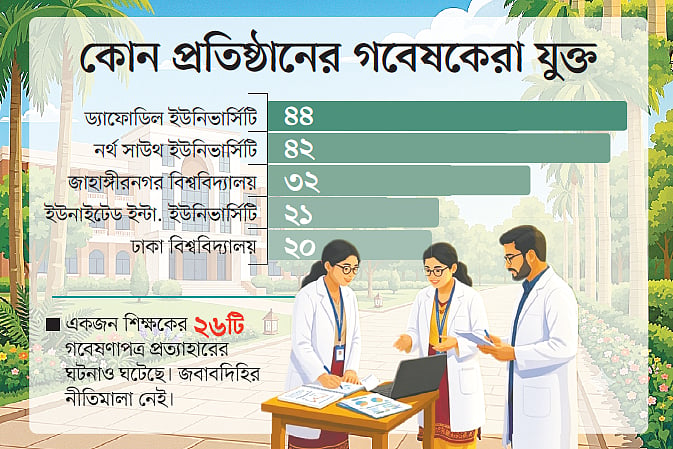
Photo Collected
A sprawling investigation into academic integrity in Bangladesh has revealed that at least 325 research papers authored or co-authored by scholars affiliated with the country’s universities have been retracted by international journals since 2019. These retractions, spanning institutions from North South University (NSU) to the University of Dhaka, underscore a mounting crisis of credibility, characterized by allegations of peer-review manipulation, data fabrication, plagiarism, and the influence of commercial “paper mills.”
Academic research is the primary currency for institutional prestige, faculty promotion, and global ranking. However, experts warn that the systematic retraction of findings acts as a “red card” in the international scientific community, severely damaging the reputation of Bangladeshi scholars and making it increasingly difficult for them to publish in high-impact, reputable journals. According to data tracked by Retraction Watch and verified through independent analysis, these incidents are not isolated outliers but point to a systemic failure in research oversight.
The scrutiny often follows protocols established by the Committee on Publication Ethics (COPE). When irregularities—such as inconsistent data, improper citations, or fake peer reviews—are identified, publishers conduct independent investigations, frequently resulting in formal retraction notices. Major publishing houses, including Elsevier, Springer Nature, Wiley, and Hindawi, have been the most active in flagging these tainted works.
The investigation highlights that several private and public institutions have been disproportionately affected. Daffodil International University leads the count with 44 identified retractions, followed by North South University with 42, Jahangirnagar University with 32, United International University with 21, and the University of Dhaka with 20.
In some instances, researchers have been linked to international schemes, particularly involving universities in Saudi Arabia, which had previously incentivized global scholars with financial benefits to boost their institutional rankings. North South University professor Mohammad Moniruzzaman Khan, for example, saw 26 of his papers retracted between 2021 and 2023. While Khan maintains that his work underwent standard review processes and disputes the publishers’ findings, internal concerns had previously been raised by his faculty regarding the suspiciously high volume of his publications—nearly 80 papers in just 18 months.
Similar trends have emerged elsewhere. At Daffodil International University, which offers financial incentives for high-output research, faculty members have faced retractions for papers covering topics ranging from cancer nanomedicine to COVID-19. Other researchers, such as those at the University of Dhaka and Jahangirnagar University, have faced investigations after their work was found to contain fabricated data rather than empirical evidence.
The consequences for the researchers vary widely. While the University of Dhaka and other institutions have expressed intentions to investigate, actual disciplinary action remains inconsistent. The Begum Rokeya University syndicate, for instance, issued a formal warning to a professor after nine of his papers were retracted, though the university cited a lack of established policy for handling such academic misconduct as a primary challenge in taking further punitive steps.
University Grants Commission (UGC) Chairman Professor Mamun Ahmed stated that the primary responsibility for investigating plagiarism and fraud rests with the respective universities. However, he emphasized that if institutions fail to act or choose to ignore these allegations, the UGC is prepared to intervene and initiate its own investigations to impose direct sanctions.
As the list of retracted works continues to grow, the scientific community in Bangladesh faces a reckoning. With no standardized, national framework to handle academic dishonesty, the burden remains on both institutions and the regulatory authorities to move beyond warnings and address the culture of “publish or perish” that critics argue has incentivized the shortcuts currently undermining the country’s academic standing.
0%
0%
0%
0%