
Bangladesh Records Over 76000 Suicides in Five Years Amid Calls to Decriminalize Attempted Self-Harm
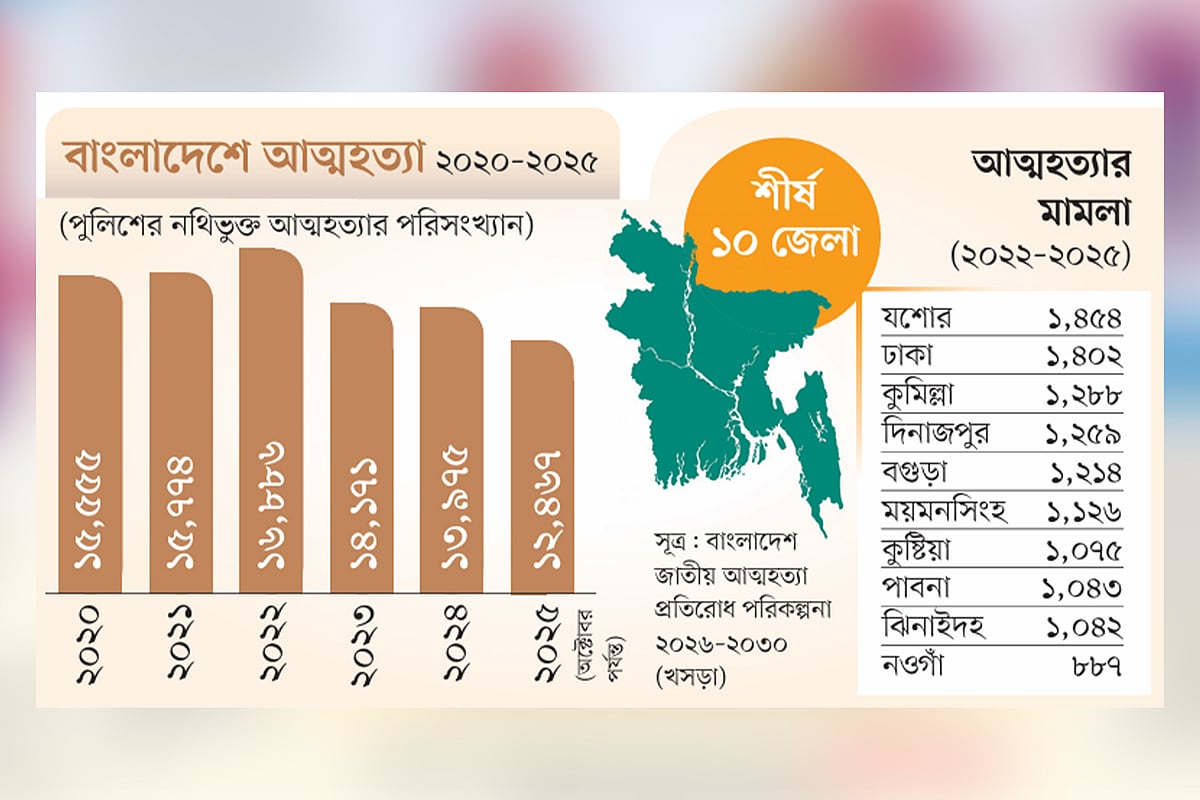
Photo Collected
Suicide has emerged as a significant public health crisis in Bangladesh, with police records indicating that 76,361 individuals died by suicide between 2020 and 2024. This data reflects an annual average of more than 15,000 deaths, a figure more than triple the estimates provided by the World Health Organization (WHO) for 2021.
These findings were presented on Sunday at an event in Dhaka focused on suicide prevention, organized by the International Centre for Diarrhoeal Disease Research, Bangladesh (icddr,b), the National Institute of Mental Health (NIMH), and the WHO. The symposium brought together mental health experts, psychiatrists, researchers, police officials, and government representatives to discuss the urgency of addressing this rising trend.
Presenters noted that the risk of suicide is particularly high among the youth, driven by factors such as family conflict, relationship stress, mental health struggles, unemployment, and academic pressure. Mohammad Sohel Shamik, deputy project coordinator at icddr,b, highlighted that the discrepancy between police records and WHO estimates—which suggested 4,714 annual deaths in 2021—points to a potential underreporting of cases in international datasets.
Draft data from the Bangladesh National Suicide Prevention Plan (2026-2030) reveals that the highest number of recorded suicides occurred in 2022, with 16,886 deaths. While 2024 saw the lowest figure in the five-year period at 13,975, the numbers remain consistently high. By district, Jessore recorded the highest number of unnatural death cases involving suicide between 2022 and 2025, followed by Dhaka, Comilla, Dinajpur, Bogra, Mymensingh, Kushtia, Pabna, Jhenaidah, and Naogaon.
A central point of discussion was the legal status of attempted suicide. Under Section 309 of the penal code, attempting suicide is a punishable offense, carrying a potential sentence of up to one year in prison. Experts argued that individuals attempting suicide are in deep crisis and require medical intervention and empathy rather than criminalization. Several speakers noted that the law, inherited from the British colonial era, has been repealed in Britain and most other nations.
Associate Scientist Anika Tasnim Hossain, also from icddr,b, noted that the stigma surrounding suicide often leads families to report such deaths as accidents, such as drowning, to avoid legal scrutiny. She proposed that better data collection through hospitals, police stations, and community leaders—such as teachers, imams, and pharmacists—could provide a more accurate picture of the crisis.
The symposium also addressed the easy availability of pesticides and herbicides, which are frequently used as a method for suicide. Professor Fowara Tasnim, additional director general of the Directorate General of Health Services, suggested that while legal reform regarding suicide attempts is complex, regulating the accessibility of lethal chemicals is a practical and necessary step. Participants pointed to the success of countries like Sri Lanka and South Korea, which significantly reduced suicide rates by strictly regulating or banning specific agricultural chemicals.
While some officials, including Additional Deputy Inspector General of Police Md. Ashraful Islam, argued that the threat of legal action may deter some from attempting suicide, the prevailing consensus among mental health professionals was that criminalization exacerbates the problem. The event concluded with a call to prioritize mental health support, revise outdated legal frameworks, and implement stricter community-based control over hazardous substances.
0%
0%
0%
0%