Rising crime rates and police morale crisis persist in Bangladesh six months after new government formation
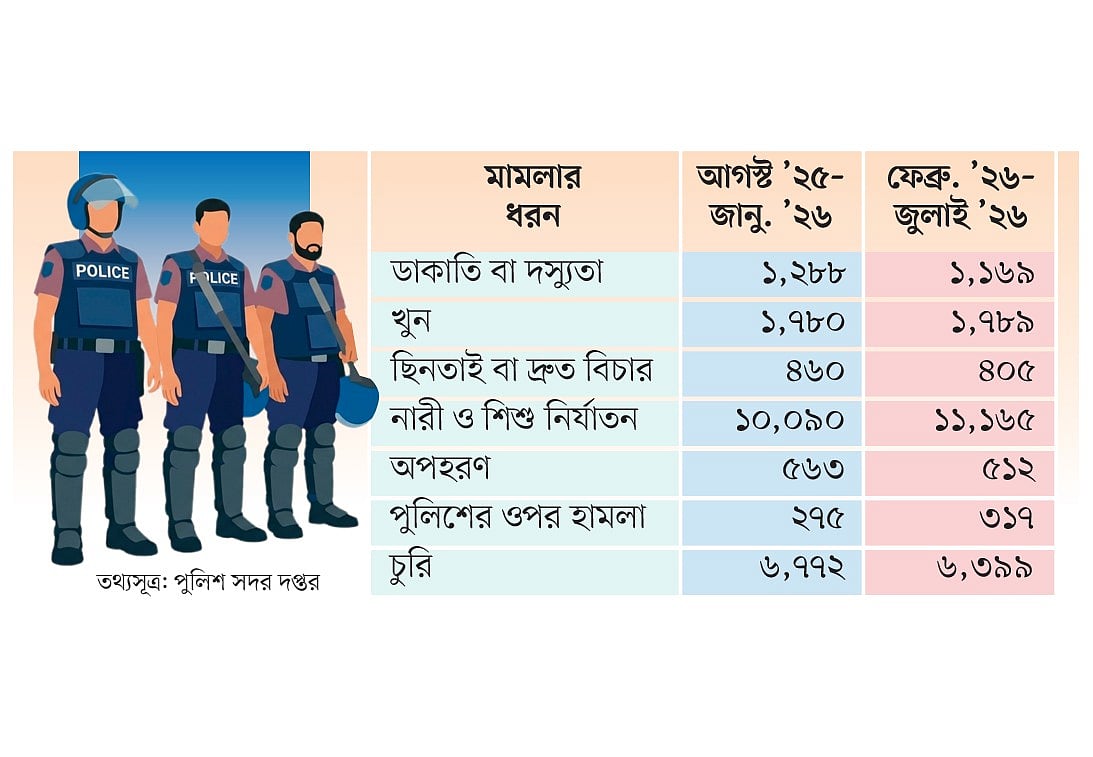
Photo Collected
Six months after the interim government assumed office, Bangladesh continues to grapple with a volatile law and order situation, marked by an uptick in violent crimes and a decline in police operational capacity. Despite government assurances, public concern remains high over instances of public shootings, extortion, kidnapping, and the frequent lynching of suspects.
Official data from the Police Headquarters reveals that 21,756 cases were filed across seven major crime categories—murder, violence against women and children, assaults on police, robbery, mugging, kidnapping, and theft—between February and July. This represents a 2.5% increase compared to the 21,228 cases recorded in the preceding six-month period.
While cases of robbery, kidnapping, and theft saw a collective decline, incidents of murder, violence against women and children, and attacks on law enforcement have surged. Specifically, murder cases rose to 1,789, while violence against women and children reached 11,165. Attacks on police officers also increased, totaling 317 reported cases.
Security experts and police officials warn that these figures do not fully capture the ground reality. Many victims avoid reporting crimes due to fear of harassment or a lack of trust in the police. Internal reports suggest that some police stations remain reluctant to register cases to maintain a facade of stability, a practice that critics argue emboldens criminal elements.
The morale of the police force, severely shaken following the July mass uprising, remains fragile. Field officers report that they are hampered by a pervasive sense of uncertainty, fear of legal repercussions, and a lack of clear directives from senior leadership. The force is also managing an administrative crisis: nearly 1,500 police personnel are currently facing legal action, with dozens arrested or suspended over allegations related to their conduct during the recent political unrest.
Police Headquarters officials maintain that the force is gradually recovering from the trauma of the uprising. Khandaker Rafiqul Islam, Additional Inspector General of Police for Crime and Operations, stated that the department is taking steps to ensure accountability, warning that officers who refuse to record complaints will face disciplinary action. He emphasized that the force requires public cooperation to effectively combat crime.
However, the rapid turnover of leadership and frequent transfers have disrupted operational continuity. Former Inspector General of Police (IGP) Md. Abdul Kaiyum underscored that police effectiveness depends on restoring the chain of command while ensuring that appointments are based on merit rather than political influence.
“Police must move away from the culture of subservience to power and misconduct to regain public trust,” Kaiyum stated. He added that while it is essential to hold officers accountable for human rights violations, the indiscriminate harassment of personnel without substantiated evidence undermines the force’s ability to maintain order.
As the government seeks to restore stability, the challenge remains to balance the demand for accountability with the necessity of boosting the morale of a force currently operating under significant psychological and administrative pressure.
0%
0%
0%
0%