Bangladesh has officially contested the accuracy of recent data published by Myanmar regarding the Rohingya refugee crisis, urging Naypyidaw to rely on statistics registered under the United Nations system.
The formal objection was raised on Tuesday during a meeting between Mohammad Towfiq-ur-Rahman, Director General of the Myanmar Wing at the Bangladesh Ministry of Foreign Affairs, and Myanmar’s Ambassador to Bangladesh, U Kyaw Soe Moe, at the ministry’s headquarters in Dhaka.
The dispute stems from a statement issued by Myanmar’s Ministry of Foreign Affairs last Saturday, which claimed that authorities had verified a list of 828,824 refugees provided by Bangladesh as of late July. Myanmar asserted that out of 426,545 individuals screened, only 308,797 were residents of Rakhine, while 113,507 could not be successfully verified. Furthermore, the Myanmar government alleged that 4,241 individuals were involved in terrorist activities and explicitly denied that more than one million people had been displaced from Rakhine.
During the meeting, Mohammad Towfiq-ur-Rahman dismissed the claims, stating that the data provided by the Myanmar government was based on misinformation. He emphasized that the official records maintained by the United Nations accurately reflect the refugee population. He further rejected the characterization of the Rohingya as "Bengali," noting that the community possesses a distinct ethnic identity that had been recognized by Myanmar authorities until recently.
The Bangladeshi delegation requested that the Myanmar ambassador accelerate the verification process for displaced Rohingyas based on agreed-upon bilateral frameworks. The discussion included the urgent need to incorporate children born in refugee camps and those who arrived after the mass exodus of 2017. Bangladesh confirmed that registration for these additional individuals is currently underway and pledged to share updated data with Myanmar authorities in due course.

Ambassador U Kyaw Soe Moe assured the Bangladeshi officials that he would convey these concerns to his government and reaffirmed Myanmar's commitment to expediting the verification process to facilitate the commencement of repatriation.
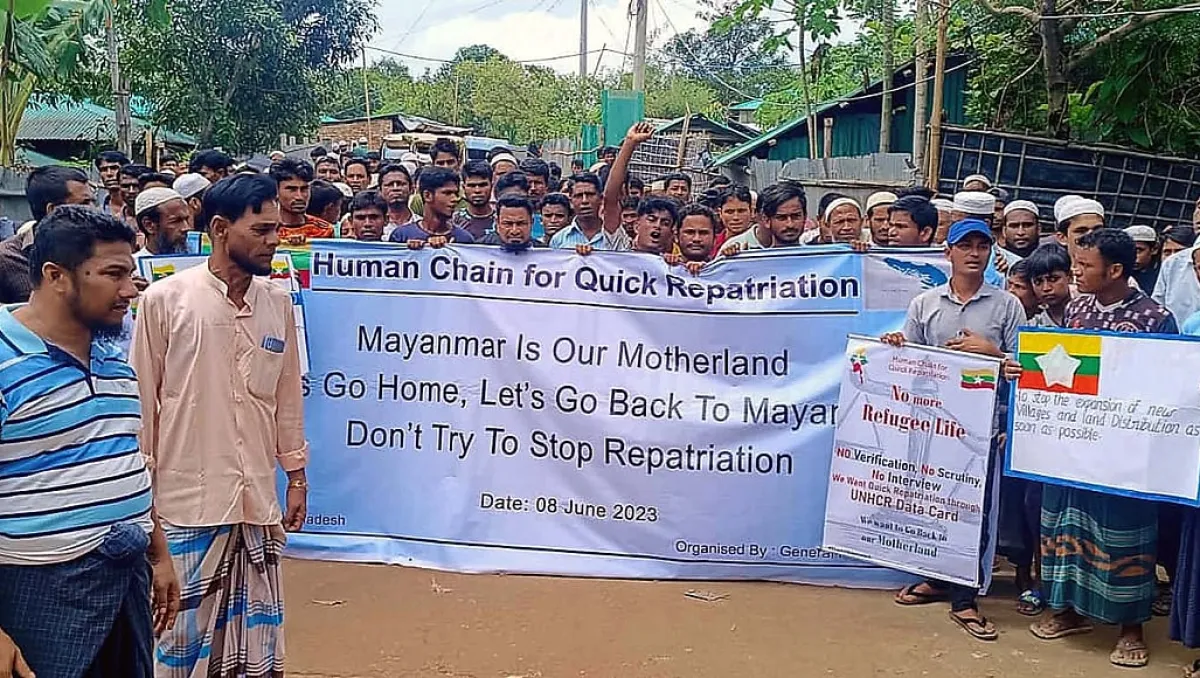
Mohammad Towfiq-ur-Rahman reiterated that the only sustainable solution to the crisis lies in the safe, dignified, and voluntary repatriation of the Rohingya to their homes in Rakhine.
Since the brutal military crackdown in 2017, approximately 700,000 Rohingya have fled to Bangladesh, joining hundreds of thousands who had sought refuge in Cox’s Bazar during previous waves of ethnic violence. Bangladesh currently hosts over one million Rohingya, who continue to live in camps while awaiting a viable path to return to their homeland.