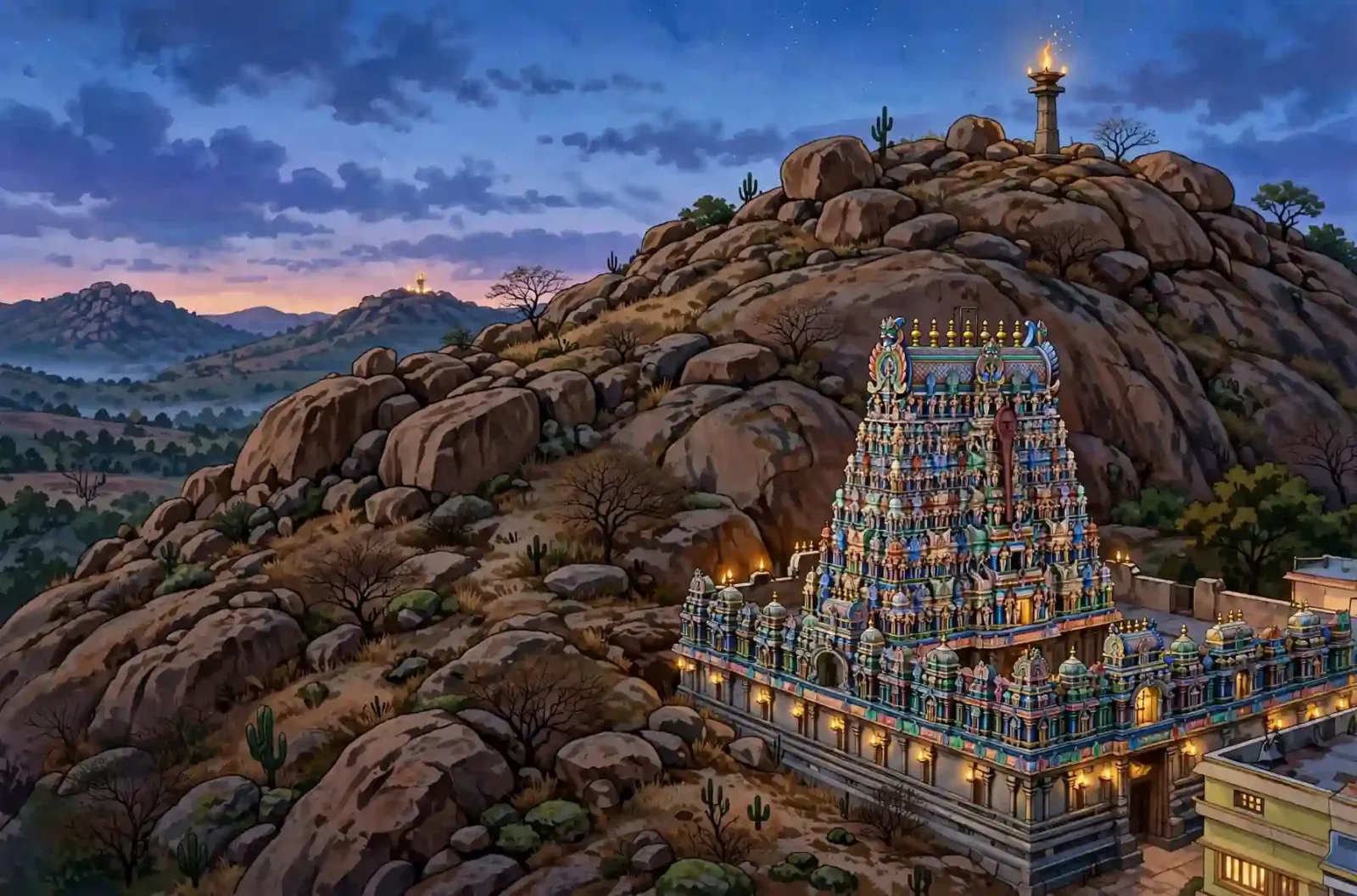
The Supreme Court on Friday ordered that the Karthigai Deepam lamp be lit at the disputed Deepathoon pillar on Thiruparankundram hill on Saturday, November 28, and issued contempt notices to Tamil Nadu's top officials for failing to carry out its November 20 order.
A bench of Justices Aravind Kumar and Vipul Pancholi held that the sequence of events prima facie disclosed wilful and flagrant disobedience of the earlier order, which had permitted the lamp to be lit at the Deepathoon on November 24 as a one-time measure.
The court directed that the lamp be lit at the Deepathoon using the flame lit at the Uchipillaiyar Mandapam on November 24, provided it is still burning, or by any other arrangement. The time of the lighting is to be fixed in consultation with the temple's sthanikars, the hereditary priests.
In a departure from its November 20 order, which had allowed only a small team authorised by the temple administration to light the lamp, the court said every devotee may light the lamp at the Deepathoon, at a distance of at least 50 metres from the Sikandar Dargah on all sides.
The court suspended the Board of Trustees of the Arulmigu Subramania Swamy Temple and appointed former Madras High Court judges Justice S Vaidyanathan and Justice V Parthiban as receivers to take charge of the temple's administration and ensure the directions are carried out.
The receivers have been directed to administer the temple in accordance with its traditions, rituals and sanctity, with the state government providing all necessary logistical support. They are to take charge forthwith, preferably on Friday itself.
Security of the temple perimeter was handed over to the Central Reserve Police Force. The court also directed the force to protect the nearby dargah and ensure that Muslim devotees visiting it are neither obstructed nor prevented from offering prayers.
The court vacated its stay on the Madras High Court's findings regarding the Deepathoon, while clarifying that its safeguards to protect the dargah will continue to apply.
The bench took a stern view of the conduct of the state authorities, observing that there appeared to be administrative chaos in Tamil Nadu, at least in Madurai district. It said the executive authorities seemed to have acted on the dictates of their political bosses, and that this had to be unearthed.
The court directed the Chief Secretary to file a comprehensive affidavit explaining the entire sequence of events, including the production of communications, emails, telephone calls and messages exchanged between officials on the issue.
It also rejected the Madurai District Collector's preliminary status report, describing it as shedding crocodile tears. The Collector had tendered a formal apology and said the administration had made all arrangements, but the ceremony could not be conducted because the temple's Board of Trustees had not authorised the team proposed to carry it out.
The court took serious exception to a resolution passed by the Board of Trustees stating that the lamp cannot be lit at the Deepathoon and can be lit only at the Uchipillaiyar Mandapam as per the prevailing custom. It described the resolution as an attempt to overreach the November 20 order by adopting a strained interpretation of its directions.
The bench said the failure to light the lamp at the Deepathoon, viewed with the resolution and the invocation of temple traditions, prima facie disclosed wilful and flagrant disobedience of the order.

The court issued show-cause notices to 13 officials and trustees, asking them to explain why contempt proceedings should not be initiated against them. They include Chief Secretary Dr M Sai Kumar, Director General of Police Dr Mahesh Agarwala, HR&CE Secretary V Rajaram and Commissioner TG Vinay, Madurai District Collector Nishant Krishna, Superintendent of Police L Devanathan, temple Executive Officer G Selvi, Board Chairman V Shanmughasundaram and trustees C Rajapandian, K Azhagapan, K Rejina Devi and K Chitra.
They have been asked to file their affidavits within 10 days of service of the notice and to remain personally present before the court on December 15, the next date of hearing.
The court also directed the Chief Secretary to file a personal affidavit confirming that notice has been personally issued to all of them, and to remain personally present on the next date.
In strongly worded observations, the bench said the time had come to deal with such situations with an iron hand, otherwise it would lead to constitutional chaos. It reminded the authorities that under Article 144 of the Constitution, all authorities are to act in aid of the Supreme Court, and that an order of the court is not an invitation to negotiate.
The row erupted on Tuesday, November 24, when the ceremonial lamp was lit at its traditional spot, the Deepa Mandapam near the Uchipillaiyar temple, while the Deepathoon pillar higher up the hill remained dark. The Tamil Nadu government later apologised to the Supreme Court for failing to implement the order.
The festival evening saw heavy security across Madurai, with more than 5,600 police personnel deployed, prohibitory orders banning gatherings and unauthorised climbing of the hill, a drone ban over the area, and barricades around the Deepathoon. Hindu outfits protested as the lamp stayed unlit, scuffles broke out with the police, around 50 protesters were detained and two policemen suffered minor injuries.
Reports said around 300 people were booked over the protests, and the Madras High Court later ordered the release of those detained unlawfully.
At the heart of the dispute is a simple question: where on the hill should the traditional lamp be lit? Hindu organisations say the Deepathoon, a stone pillar about 50 metres from the Sikandar Badusha dargah, is an ancient lamp post and the Deepam should be lit there too. The state maintains that it is only a survey stone put up in the British era and has no connection with the temple.
The dispute is decades old. It first reached the Madras High Court in 1994, returned in November 2025 when devotees sought permission to light the lamp at the Deepathoon, and a single judge directed the lighting in December 2025. A division bench upheld that direction on January 6, 2026, and the state government then took the matter to the Supreme Court, which passed its November 20 order.
The controversy has also turned into a political flashpoint in Tamil Nadu, with the BJP and Hindu Munnani accusing the state government of defying the court. The contempt petitions were filed by Rama Ravikumar, who sought action against 11 officials, and advocate V Ramasubbu, who alleged a deliberate violation of the order.
One petition also asks for a personal affidavit from the Tamil Nadu Chief Secretary, setting out how the decision was taken, including the role of Chief Minister Vijay. With the court now ordering the lamp to be lit on Saturday and the officials to appear before it on December 15, the focus shifts to whether the ceremony takes place this time — and what the court does next.