


Sreepur’s safari park is losing Sri, increasing visitor frustration
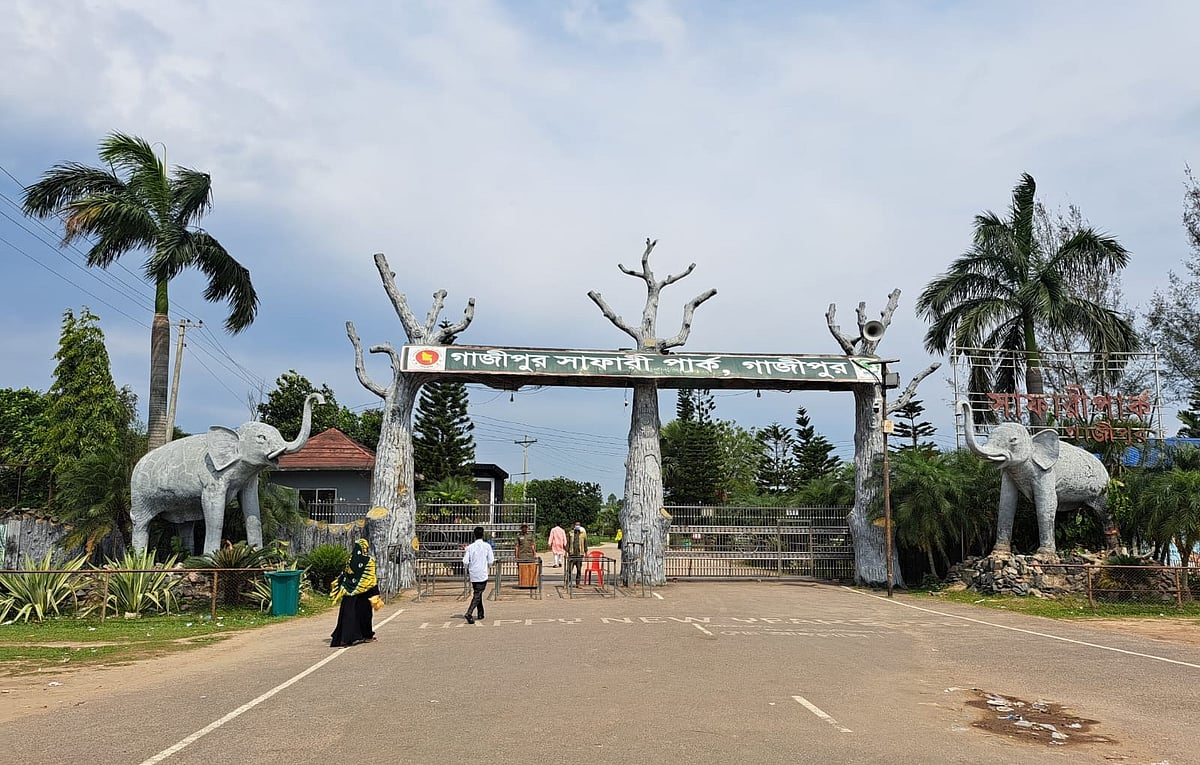
Photo Collected
“I don’t understand why I came here to see what I saw,” he said while leaving the Gazipur Safari Park. He was lonely in the heat. This man was accompanied by three sons and his wife, who were also in the same situation.
On March 28, when I went to Gazipur Safari Park, I talked to this middle-aged man. Although he expressed his displeasure with this entertainment center, he did not want to reveal his name.
The reasons for this man’s annoyance were discovered after visiting the safari park. Eating and drinking will be complete with tiger and lion watching, as there are two restaurants, both closed. The nature observation center, which prepares visitors mentally about wildlife and nature, is also closed. Two observation towers, paddle boat tours, egg world, elephant show gallery, children’s park are all closed for visitors. There is no souvenir shop inside the park. There is no guide for domestic and foreign tourists. There is no special provision for disabled visitors except for a wheelchair.
The Safari Park is located in Bhawal Shalban of Sripur Upazila of Gazipur District, 40 km north of Dhaka. This safari park spread over an area of 3,690 acres is managed under the Ministry of Environment, Forests and Climate Change.
Earlier it was called Bangabandhu Safari Park. It was closed from 21 July to 14 November 2024. After Sheikh Hasina was ousted in a mass coup and left the country on August 5 of that year, the main gate of the park, the mural of Bangabandhu was vandalized. Later it was renamed Safari Park, Gazipur.
The location of the safari park is three kilometers west of Bagher Bazar on the Dhaka-Mymensingh highway. At the entrance of the tiger market, a gate with the image of a tiger has been constructed. It is difficult to understand that the model is of a tiger in front of the dilapidated gate.
In the core safari of this park, various wild animals like tigers, lions, bears, deer roam freely in the forest. Visitors take a tour in a protected vehicle. And in Safari Kingdom, wild animals are exhibited in large enclosures, much like a zoo.
At one time, 50,000 visitors gathered in the park on festival days in winter. But at present the number of visitors has reduced to an average of one to one and a half thousand a day. The number of animals has also decreased.
The park authorities could not provide much information such as how many animals are waiting to die due to age, how many animals have been bought from abroad, how many animals have died so far. The Safari Park does not have its own website. There is no mention of any information on the website of the forest department.
There is no police camp inside the park for the safety of visitors. Park staff are not provided with any protective equipment other than clothing. Talking to the workers, it was found that they do not have any risk allowance. No training with wild animals.
Visitors enter with polythene bags filled with various food including chips. Children are trying to give that food to the cages of different animals including crocodiles. Food packets are being thrown away after eating. As a result, some of the visitors expressed their anger about the dirty environment of the park.
The weekend at the Safari Park is Tuesday. Other days open from 9am to 5pm. If a visitor goes to the park in a private car, it will cost Tk 100 for car parking. 50 rupees will be required to enter the park. 150 rupees will be required to visit Core Safari by car. Then whatever you want to see, you will need a separate ticket. Macaw and Parrot 40 taka, Aquarium 20 taka, Crown Pheasant 20 taka, Dhanesh Aviary 20 taka, Nature History Museum 20 taka, Butterfly Center 20 taka, Hanging Bridge 10 taka, Nine D movie (short 3d video on different themes) will cost 100 taka. It will take 10 taka to go to public toilet once.
That is, if an adult person wants to visit the entire safari park, then he has to pay at least five hundred taka. Additional money will be added to the food.
Children and students get some discount. No entry fee is charged for children below six years of age. Park entry fee for minors below 12 years will be Tk 20, Core Safari visits by car will be Tk 50. If you want to see something else, you will have to pay the same ticket price as the adults. If you are a student, the entrance fee to the park is 10 taka, while visiting the core safari costs 50 taka. And for foreign tourists, the entrance fee to the park is 1 thousand taka.
Most of the people visiting the park are visiting with family members. Some of them have come as many as 10 people. As a result, a single family traveling with a large group needs more than 5 thousand rupees for the ticket. As a result, thinking about the pocket, many people were cutting down to see some places of the park.
There were a total of 9 people including three children from the family of businessman SM Habib Sarkar who came to the park from Sreepur. He said, ‘After buying a ticket and entering the park, I need to buy a ticket again for whatever I want to see. The park does not have a pleasant atmosphere, the surroundings are dirty. The road inside Core Safari is also very bad.
According to the calculations given by the park officials, the total number of visitors to the park from November 2024 to June last year was 3 lakh 58 thousand 127 people. Among them, adult visitors were 260 thousand 559 people. There were 62 thousand 525 students. There were only 464 foreign tourists.
From July last year to March 26, the total number of visitors is 3 lakh 6 thousand 842 people. Among them 230 thousand 836 adults, 26 thousand 583 minors, 49 thousand 38 students, and 370 foreigners.
Last March 21, the number of visitors on the day of Eid-ul-Fitr was 11 thousand 366 people. However, on March 28, the number of visitors decreased to 1,885. From March 21 to March 28, the amount of revenue collected from park entry fees was Tk 42 lakh 25 thousand.
The Implementation Monitoring and Evaluation Division of the Ministry of Planning released a detailed monitoring report on the Safari Park Project (Third Revised) in June 2016. It is said that there are about 3 thousand 813 wild animals of different species of domestic and foreign in the park. However, except for various fishes, there are 7 tigers, 5 lions, 21 bears, deer, and more than 1,000 animals.
Sharmeen Sultana, who came from Savar with her husband and children, said that she had come once before, but did not see tigers and lions in Seva Kor Safari. But this time he got it.
This woman is upset that the bus to Kor Safari is not air-conditioned. Because, they have to be lazy in summer.
According to the news, two jeeps in the park were damaged. One bus bought with Climate Trust Fund is broken, seven are operational. AC works in only two of them. There were three restrooms and resorts for visitors. Currently only one is active.
Uganda’s national bird, the gray crowned crane, has hatched, two nilgai have given birth to two cubs, a zebra cub or a hippopotamus have given birth—more news than animal deaths in the park.
An inspection report by the Ministry of Planning published in 2016 called the death rate of both domestic and foreign wild animals in safari parks alarming. It said that proper ratio of males and females was not maintained in imported lions and tigers. Due to lack of ideal proportions, animals fight or infighting. Failure to create an environment compatible with the original habitat of wild animals or failure to adapt, irregular vaccination, inadequate and contaminated water supply, poor sewage system are blamed for the death in the report.
A total of 25 zebras were brought to the park from South Africa in two phases from 2013-15. These zebras could not adapt to the new environment. On February 2, 2022, a writ petition was filed in the High Court regarding the death of 11 zebras and one tiger. After that various steps were taken from the ministry including investigation committee, departmental case against the park workers, transfer. Then all activity stops.
A white lion died on 24 September 2021. Park authorities said the cause of death was heat stroke in summer.
A report published in Prothom Alo on October 25 last year says that the only surviving giraffe in the park died of tuberculosis (TB) while undergoing treatment. This female giraffe was brought from South Africa. Due to this, 12 giraffes died in the safari park in the last era.
After the establishment of the park, several kangaroos were brought from abroad for visitors, but due to successive deaths, it has now reduced to zero.
The zookeepers at the park have highlighted various issues including lack of proper facilities for testing animal food, lack of training opportunities on exotic animals.
Fodder fields were to be created within the park to produce food (grasses, fruits etc.) for wild animals. The park authorities said that fruit trees suitable for animal food have been planted. However, no fruit was seen on any tree on the ground. A list of what trees are there is not available. There was once a food pantry in the park, now that too is closed.
In 2018, several animals were recovered by law enforcement while being smuggled out of Madagascar. Four of them were handed over to the Gazipur Safari Park. Last year in March, three ringtail lemurs were stolen by cutting through the park’s security fence late at night. One of them was rescued but later died. The other two have not been found.
In an editorial of Prothom Alo on April 10 last year, it was mentioned that the boundary wall was broken in at least five parts. In some places the walls are made very low, which can easily be toppled over. At some places the broken walls are covered with bamboo. As a result, outsiders can easily enter the park. Earlier, a male nilgai escaped over a low wall.
In 2024, police arrested a man for stealing two green-winged macaws from Safari Kingdom inside the park by cutting iron nets. A bird was later rescued.
The park has a wildlife hospital and laboratory. The only doctor or veterinary officer Hatem Sajjat. Zulkar Nine told Prothom Alo that the hospital once had a surgery room with modern equipment. The operating room no longer exists due to the rainwater seeping through the roof. The lab is also on the verge of closure due to lack of skilled manpower.
On the surface, it was seen that various equipments of the lab were covered with polythene in damp environment. The quarantine room where the trafficked animals are brought and kept is also filthy.
A modern laboratory and operation theater have been set up in the wild animal hospital, the planning ministry’s inspection report said. PCR machines, thermal cyclers, microscopes, operation tables were purchased for advanced treatment, but their full use and modern facilities could not be ensured. The overall condition of the hospital is not up to standard. There are no modern sheds or arrangements for post-mortem of dead animals. No separate wildlife rescue centers have been established for injured and rescued wild animals.
Assistant Forest Conservator and Officer-in-Charge of Gazipur Safari Park. Tarek Rahman told Prothom Alo that, in addition to not having a strong border wall, security tower, enough CCTV cameras, important positions including curator, lack of skilled manpower, lack of budget are the major challenges of managing the park.
The Safari Park project was approved by the Executive Committee of the National Economic Council (ECNEC) on 11 May 2010. Its cost was estimated at 64 crore rupees. It was opened for visitors in 2013.
The main objective of the park was to preserve the diversity of wild animals and plants of Shalban. Conservation and development of the country’s rare and extinct wild animals in and out of their habitats. Development of tourism industry, poverty alleviation and employment generation through creation of eco-tourism opportunities.
Until 2023, the park ran through various projects. From 2024 comes under revenue budget. However, allocation is still not being given from the government treasury.
At present, the essential management support project of Safari Park is ongoing at a cost of Tk 449 million. Under this project, which runs from 2024 to 2027, some renovation works of the park have started. Park operations are running with 31 revenue sector and 56 outsourcing staff. There are no important posts like curator, micro biologist in this safari park. A nutritionist was appointed a month and a half ago.
A master plan for the park was taken up in 2019. The first phase, over a five-year period from 2020 to 2025, mainly focuses on renovating the existing infrastructure and improving the basic management of the park.
During this period of the master plan, the ‘Multipurpose Mega Hall’ was supposed to have a ticket counter, visitor centre, museum, souvenir shop, food court and restrooms under one roof. Existing fences or cages were supposed to be renovated in urgent need.
The fragile enclosure of the crocodile park was visible on the surface. Children can be seen moving very close to the enclosure, feeding the crocodiles with various foods. As a result, the park staff were saying that an accident could happen at any time.
During this period of planning, river safaris were to be established and operationalized for tourists. Modernization of elephant and bird show galleries, making the core safari trail longer, attractive and visually impressive, operationalizing nature observation centers, making crocodile, vulture and gannet breeding programs more scientific and effective, developing hospitals and labs, ensuring natural environment within wild animal enclosures, excavating wetlands, solar powered night security, patrolling with modern weapons, modern electrification of park boundaries. It was supposed to ensure fencing and bio-fencing, create a modern website, conduct education and awareness-raising activities. Modern restrooms for tourists, first aid corner, maternity corner and special facilities for disabled tourists were to be ensured during this period.
The second phase of the master plan is to transform the park into a self-sustaining international tourism and research center over a 15-year period from 2025 to 2040. River Safari, Jungle Safari, Swamp Safari, Oriental Safari are planned during this period. Construction of forest trails for tourists, introduction of night safaris in eco-tourism zones.
Md. Forest Conservator of Wildlife and Nature Conservation Zone of Forest Department. Chanaulya Patwari is in charge of the overall maintenance of the Safari Park. He told Prothom Alo that it is necessary to invest at least 4 thousand crore rupees to implement the master plan to make the park international standard. At present, the park is not connected, it can be said that it has to be managed in different ways. Efforts are being made to protect the park from damage through the Safari Park Essential Management Support Scheme.
Tapan Kumar Dey, the first project director for the establishment of the Safari Park, told Prothom Alo that many things were done in the beginning of the park. A lot of things don’t exist now. It is necessary to increase the attention of the government to protect the important park.
Source: Prothom Alo Bangla
0%
0%
0%
0%