



Rising Salinity in Coastal Groundwater Threatens Public Health and Agriculture in Barishal
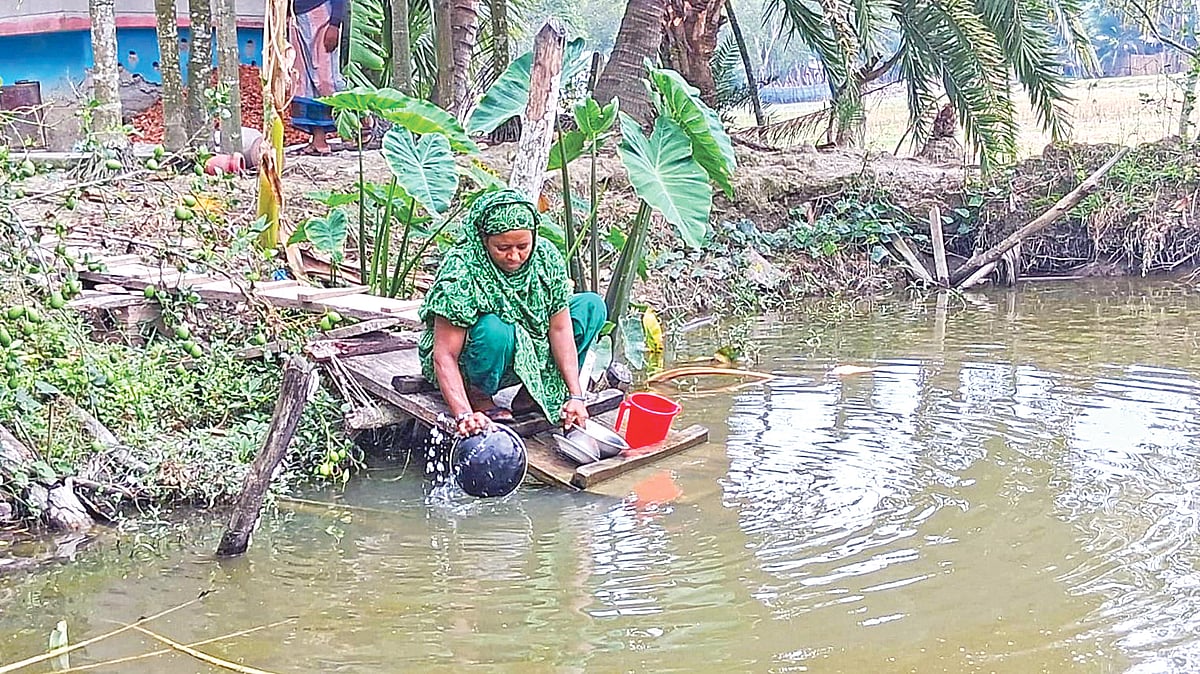
Photo Collected
Coastal communities across Bangladesh’s Barishal division are facing a mounting public health and agricultural crisis as saline intrusion penetrates deep into the region’s groundwater. Once the bedrock of survival, deep tube well water in these areas is now testing at salinity levels that threaten long-term human health and render vast tracts of land unproductive.
Research from the Soil Resource Development Institute (SRDI) highlights a steady, alarming rise in salinity levels across major rivers such as the Tentulia, Baleshwar, Payra, and Meghna. In some locations, salinity concentrations have increased exponentially over the past few years, with the impact spreading up to 100 kilometers inland. Recent tests of deep tube wells—sunk between 1,000 and 1,200 feet—have confirmed that the salt content has breached safety thresholds, effectively poisoning the region’s primary source of drinking water.
Public health experts warn that the chronic consumption and use of saline-tainted water are driving a surge in hypertension, kidney disease, and reproductive health issues. For women in coastal villages, the crisis is particularly acute. Prolonged exposure during daily activities, including fishing and domestic tasks, has been linked to high rates of gynecological complications, urinary tract infections, and, in severe cases, the necessity for hysterectomies. Many residents remain unaware of the clinical connection between their water sources and their worsening health, further complicating efforts to mitigate the crisis.
The economic fallout is equally severe. According to data from the Department of Agricultural Extension, approximately 52 percent of the 802,000 hectares of cultivable land in the Barishal division is now affected by salinity. In districts like Patuakhali, the impact is even more pronounced, with nearly 40 percent of land compromised. Farmers, struggling to produce anything beyond a single monsoon-season rice crop, are finding it increasingly difficult to sustain a livelihood as soil quality continues to deteriorate.
Agricultural scientists are now pivoting toward innovative solutions, such as the “relay cropping” technique, which introduces salt-tolerant wheat and pulse varieties. Research supported by the Australian Centre for International Agricultural Research suggests that utilizing deeper groundwater—below 1,100 feet—via submersible pumps could enable farmers to cultivate crops during the dry season, potentially yielding up to 1.3 million tons of wheat annually.
However, experts emphasize that technical solutions in agriculture must be paired with urgent, systemic interventions in water management. Proposals include the large-scale harvesting of rainwater, the restoration of natural freshwater reservoirs, and the expansion of surface water treatment plants. Pilot projects, such as those implemented by the NGO NSS in Pathorghata with support from Oxfam, have demonstrated that community-managed water purification systems can provide a sustainable lifeline for thousands of families.
As the reach of saline intrusion continues to expand into areas previously considered safe, researchers warn that without immediate, coordinated action to protect freshwater sources, the coastal region risks a deeper, irreversible collapse of both public health and economic stability.
0%
0%
0%
0%