

Rickshaw driver prioritizes minimal food expenses
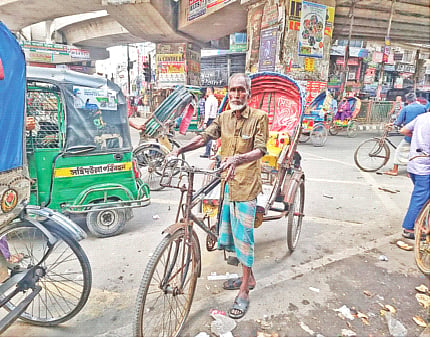
Photo Collected
An elderly rickshaw puller paused his grueling work on a sweltering afternoon in Dhaka, wiping sweat from his brow before heading to a roadside food stall for a single paratha. Md. Ansar Ali, 74, clad in a damp, olive-green shirt, sat at a small table, his day’s labor interrupted by the need for sustenance. His journey from Jatrabari to Shantibag, carrying a passenger, had taken over an hour, battling the city’s notorious traffic jams.
Ali, a resident of the capital since 1998 and originally from Patuakhali district, pedals a traditional, non-motorized rickshaw. He lives in a rickshaw garage in Shonir Akhra and supports a family of six. While two daughters are married, his eldest son, Shahidul Islam, 18, studies at a Qawmi madrasa in Barisal, and his younger son, Maruf Hossain, 14, whose education has been halted due to financial constraints, lives with his mother in their ancestral village.
বিজ্ঞাপন
His meager income, he explained, is barely enough to cover expenses, especially with the rising cost of living. A paratha and a small portion of fried vegetables for 10 Taka constituted his breakfast, a testament to his efforts to eat as cheaply as possible. “Sometimes I go hungry,” Ali admitted, his voice tinged with weariness. “When I eat rice, I look for cheap vegetables. I don’t remember when I last ate fish or meat, maybe at a feast a few months ago.”
The demand for traditional, pedal-powered rickshaws has diminished, Ali noted, impacting his earnings. He recalled a time when he could save a substantial amount after paying the daily garage fee. Now, after depositing 100 Taka, he is left with little more than 150-200 Taka. The heavier, battery-operated rickshaws are beyond his financial reach and physical capacity, especially given the risk of breakdowns in remote areas.
বিজ্ঞাপন
His primary concern remains his son’s education. Sending 2,500 Taka monthly for Shahidul’s studies, in addition to household expenses, is a constant struggle. On the day he was interviewed, Ali had only earned 200 Taka. “People are reluctant to hire my rickshaw when they see its condition and my age,” he confided, highlighting the challenges faced by those reliant on manual labor.
Further along in Shantibag, Md. Khoka, 69, a mobile vendor selling fruits, ginger, and garlic, echoed the sentiments of economic hardship. He procures his goods at 4 a.m. from Karwan Bazar, selling 20 kilograms of ginger, 10 kilograms of garlic, and 10 kilograms of jamrul fruits on the day of the interview.
“Since prices increased, sales have dropped,” Khoka stated, explaining that consumers now buy less due to the inflated costs. Originally from Islampur in Jamalpur district, he rents a room in the Karwan Bazar area. He supports himself and sends money to his wife, who lives in their village, while his three sons and two daughters are married and live separately.
In Paltan, 58-year-old Delowar Hossain works at a restaurant for a daily wage of 400 Taka. He was forced to close his own food stall in Jatrabari Fish Market about 18 months ago due to mounting losses. Delowar, who lives with his family in a rented accommodation in Jatrabari, has five sons. Three are married and live independently, while his two younger sons contribute to the family income by working in the fish market. The family is managing, but recently had to take out a loan to finance the marriage of his daughter, Imaan.
0%
0%
0%
0%