

New Recruitment Syndicate Concerns Mount as Malaysia Selects 25 Agencies Including Firms Linked to Fraud Investigations
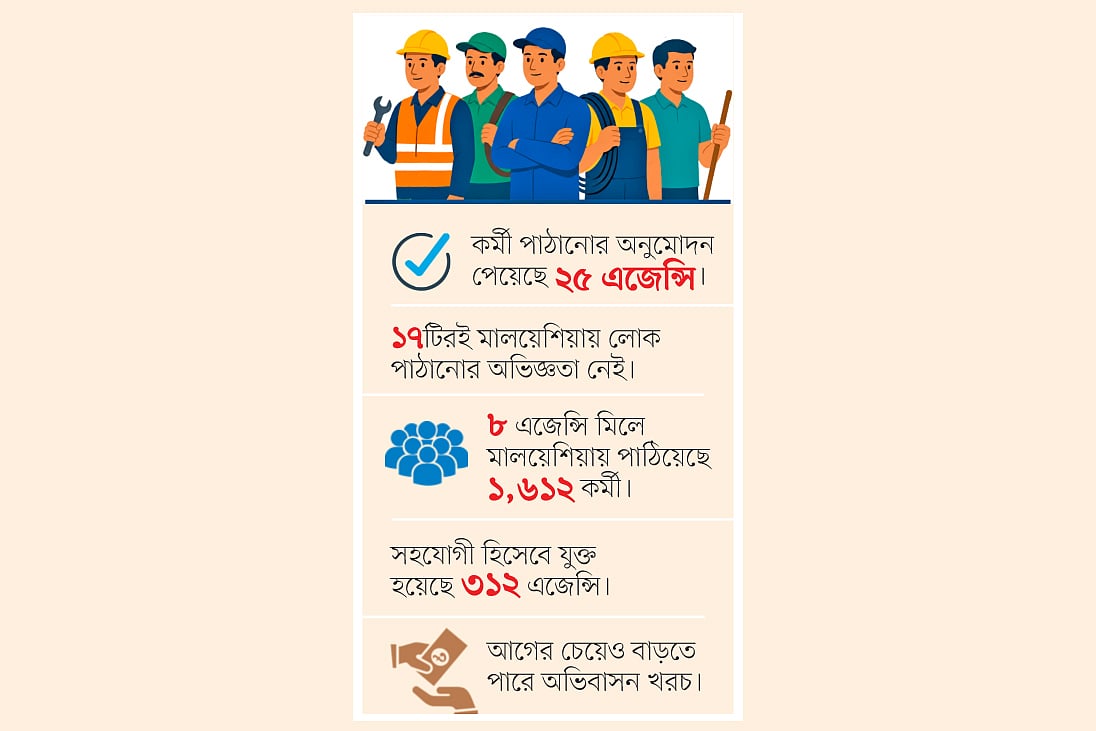
Photo Collected
Despite a recent government overhaul, the recruitment process for Bangladeshi migrant workers to Malaysia remains dominated by a syndicate-led structure, raising concerns over transparency and the potential for high migration costs. While 25 agencies have been selected to facilitate labor exports, analysts and industry insiders warn that the system mirrors previous exploitative models that have historically burdened workers with exorbitant fees.
An investigation into the 25 selected agencies reveals that 17 possess no prior experience in sending workers to Malaysia. Data from the Bureau of Manpower, Employment and Training (BMET) indicates that the remaining eight agencies have historically sent only a combined total of 1,612 workers. Among the selected firms is Bhaluka Overseas, which, despite having no experience in the Malaysian market, has received official clearance to participate. Bhaluka’s owner, Md Abu Sohag Khan, stated that his agency was selected automatically by the Malaysian system without requiring any illicit payments.
The selection process is governed by the Foreign Workers Central Management System (FWCMS) and its software, Migram, owned by Aminul Islam bin Abdul Noor—a Malaysian citizen of Bangladeshi descent widely known as Amin Noor. Industry sources allege that Amin Noor, working in tandem with Ruhul Amin, also known as Swapan, a former secretary-general of the Bangladesh Association of International Recruiting Agencies (BAIRA), effectively controls the recruitment trade. While Swapan is currently in hiding and facing legal action, critics argue that the new structure serves as a sophisticated evolution of the old syndicate.
Labor experts and BAIRA members estimate that migrants may face costs ranging from 600,000 to 700,000 BDT, significantly higher than previous averages. This financial burden is attributed to “syndicate fees” and the high cost of purchasing visa demand letters. Furthermore, three of the selected agencies—Godness Service Ltd, General Trading Company, and Rifa International—are currently under investigation by the Anti-Corruption Commission (ACC) regarding allegations of human trafficking and the forgery of documents.
The Ministry of Expatriates’ Welfare and Overseas Employment maintains that the list of 25 agencies was finalized independently by the Malaysian government, based on a shortlist of 423 agencies submitted by the Bangladeshi interim government. State Minister Md Nurul Haque stated that the inclusion of 338 additional “associate” agencies is a positive shift intended to decentralize the process. He emphasized that the government is committed to capping migration costs and will revoke the licenses of any agencies found involved in trafficking or corruption.
However, critics remain skeptical of this “associate” model. Shariful Hasan, head of the migration program at BRAC, described the selection of these 25 agencies as proof that the syndicate remains more powerful than the state. He warned that without structural changes to the labor agreement, the system is destined to repeat past failures, ultimately leading to the exploitation of thousands of workers and potential market closure.
The current labor recruitment agreement with Malaysia is set to expire on December 31. While the interim government has announced plans to export 10,000 workers free of cost through the state-run Bureau of Manpower, Employment and Training (BOESL), officials acknowledge that previous attempts to bypass middlemen were consistently hampered by administrative obstruction and a lack of demand letters for cost-free recruitment.
0%
0%
0%
0%