

July 18: How the Nationwide Complete Shutdown Transformed the Student Movement into a Mass Uprising
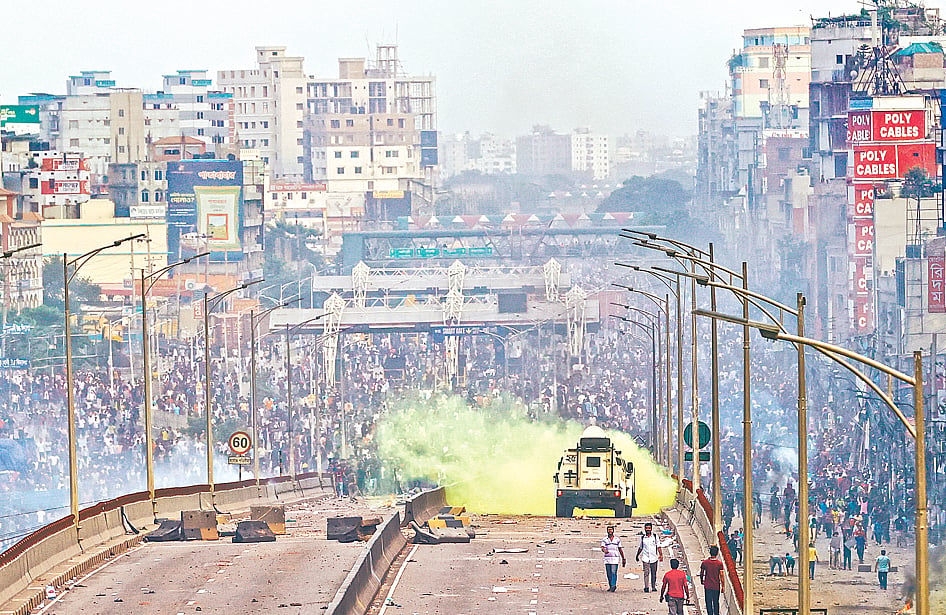
Photo Collected
The nationwide movement for quota reform in Bangladesh reached a critical, violent turning point on July 18, 2024, as students and ordinary citizens clashed with security forces and government-affiliated groups across the country. Following the evacuation of Dhaka University residential halls and the perceived weakening of the movement, private university students emerged as a pivotal force, staging massive protests that effectively brought the nation to a standstill.
The escalation was particularly intense in the Badda area of the capital, where Brac University students confronted police throughout the morning. As tensions peaked, police sought refuge inside the Canadian University of Bangladesh, where they were trapped for hours by protesters until being extracted by two helicopters shortly before 3:00 p.m. This standoff mirrored chaos erupting simultaneously across major neighborhoods in Dhaka, including Uttara, Rampura, Mirpur, and Dhanmondi, which were transformed into battlegrounds.
বিজ্ঞাপন
The unrest extended far beyond the capital, with violent clashes reported in cities including Chittagong, Comilla, Narayanganj, Khulna, and Rangpur. By the end of the day, 27 people—19 in Dhaka and eight elsewhere—had been killed, with approximately 1,500 others injured. This surge of violence marked July 18 as one of the deadliest days in the course of the July uprising.
Operating under the banner of a “Complete Shutdown” called by the Anti-Discrimination Student Movement, protesters effectively paralyzed the country’s transport network. Road and rail links were severed, and the Dhaka Metro Rail suspended operations by late afternoon. The volatility reached state institutions as well; the Bangladesh Television (BTV) headquarters was set ablaze, leading to a complete broadcast shutdown by evening. Numerous government buildings, police installations, and political offices of the ruling party faced similar attacks across the nation.
বিজ্ঞাপন
In response, the government deployed the Border Guard Bangladesh (BGB) to restore order. Authorities further tightened control by suspending mobile internet on July 17, followed by a total shutdown of broadband services on the evening of July 18, effectively severing the country’s digital connection to the outside world.
Asif Mahmud Sajjad Bhuiyan, a prominent coordinator of the movement, announced the extension of the “Complete Shutdown” into the following day. Reflecting on the movement’s trajectory in his book, *July: Motherland or Death*, Bhuiyan noted that the scale of the bloodshed had forced the protest to transcend its original mandate, evolving from a call for quota reform into a broader movement against the state’s repressive actions.
The government’s heavy-handed response was subsequently documented in a United Nations report on human rights violations during the July-August period. The UN findings highlighted that a “Core Committee,” chaired by the then-Interior Minister and attended by top security and intelligence officials, had coordinated a strategy of mass arrests and total communication blackouts. According to the report, these measures were deliberately employed to suppress peaceful protests and conceal grave human rights abuses, signaling a coordinated state effort to dismantle the growing uprising.
0%
0%
0%
0%