

Interim governments pilot citizen service centers face collapse due to lack of equipment and operational support
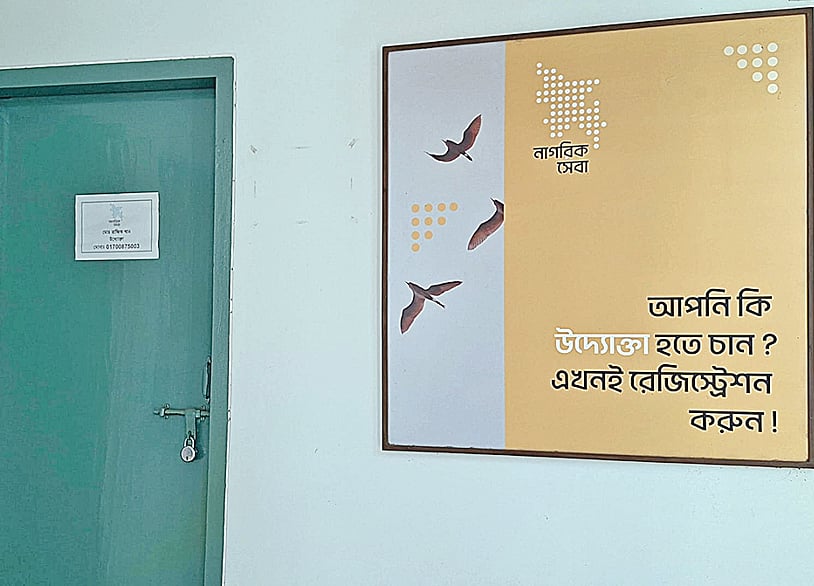
Photo Collected
A government-led pilot project designed to provide integrated public services to citizens has effectively collapsed, with the majority of centers now shuttered due to a lack of resources, equipment, and administrative support.
The initiative, launched on May 26, 2025, under the banner “All Citizen Services Under One Address,” was inaugurated by former Chief Adviser Professor Muhammad Yunus at the State Guest House Jamuna. Spearheaded by Faiz Ahmad Taiyab, a special assistant to the former interim government, the project aimed to streamline access to 450 public services—including passports, birth registration, and land services—while curbing bureaucratic corruption and middleman exploitation.
Six pilot centers were established across Dhaka in Mohammadpur, Gulshan, Uttara, Nilkhet, Gulistan, and Banasree. However, a field investigation reveals that four of these facilities are now permanently locked, while the remaining two operate sporadically with minimal public engagement.
At the Mohammadpur center, located in the local sub-post office, investigators found the facility abandoned with scattered furniture and no personnel. The designated entrepreneur, Md. Mustakim, stated that he left his private computer business to run the center based on promises from the Information and Communication Technology (ICT) division. He claimed that the government failed to provide the necessary hardware, internet connectivity, and official support, leaving him unable to provide services or generate income.
Similar conditions were reported at the Nilkhet and Gulistan sites, where centers housed in state-owned telecommunications offices remained locked during business hours. Entrepreneurs cited a lack of formal contracts, missing digital infrastructure, and the absence of essential tools—such as biometric scanners—as the primary reasons for the project’s failure.
In Uttara, entrepreneur Ashikur Rahman noted that he initially attempted to use his personal laptop, but the equipment was insufficient to handle government portals. Furthermore, a biometric machine provided by the passport office was reclaimed by authorities several months ago.
Critics and officials alike have labeled the project as poorly planned. An anonymous official from the ICT division admitted that the initiative lacked a dedicated budget and strategic implementation, describing it as a superficial effort that failed to account for the technical requirements of public service delivery.
Md. Mojibor Rahman, Joint Secretary of the Digital Governance and Security wing of the ICT division, acknowledged the failure, stating that the centers did not prove sustainable or produce the expected results. He confirmed that the government has not officially terminated the project but has ceased further development, with plans to potentially re-evaluate the model in the future.
Industry experts warn that the collapse highlights the risks of hasty policymaking. B.M. Mainul Hossain, a professor at the Institute of Information Technology at the University of Dhaka, emphasized that future initiatives must prioritize realistic assessments and sustainable infrastructure rather than creating new programs that mirror the flaws of unsuccessful predecessors. Efforts to reach Faiz Ahmad Taiyab for comment remained unsuccessful as of Friday night.
0%
0%
0%
0%