

Garment Worker Cultivates Vineyard with 20 Grape Varieties
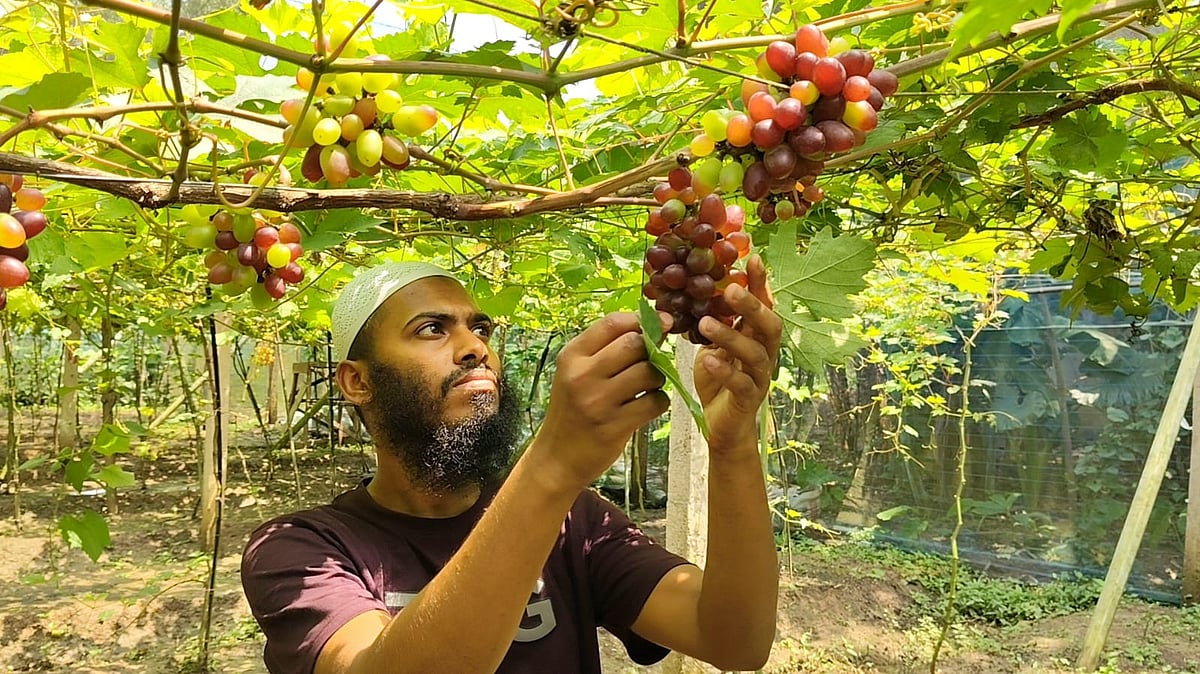
Photo Collected
A young entrepreneur in Mymensingh’s Bhaluka Upazila has transformed a personal passion for grape cultivation into a burgeoning commercial venture, successfully growing over 20 varieties of the foreign fruit on 14 decimals of land, inspiring local residents and demonstrating significant agricultural potential. Md. Maksudul Islam, who recently completed his master’s degree (Kamil), financed his dream by working at a garment factory, meticulously learning cultivation techniques from online videos.
Islam’s journey began in 2022 when he planted a couple of grapevines out of curiosity at his home in Mallikbari village. Initially, local varieties yielded some sweetness, prompting him to research further into making grapes sweeter and identifying suitable sweet varieties. He delved into Facebook groups and YouTube videos, studying cultivation techniques and care practices, eventually sourcing 20 different grape varieties through various channels.
বিজ্ঞাপন
The successful yield from these initial plants, characterized by their sweetness, encouraged Islam to plan a commercial operation. Last year, he planted 180 saplings on a 14-decimal plot behind his home. On Tuesday, May 5, visitors to his vineyard observed clusters of plump grapes, including varieties like Valet, Dickson, Green Long, Akelo, Black Ruby, Baikonur, and Summer Black, hanging from the vines. A signboard marks the mother garden by the main road, where saplings are propagated from the existing plants.
Islam, whose father, Khurshed Alam, is a local mosque imam, has been involved in agriculture since childhood. From 2022 to 2025, he worked in a garment factory, saving approximately 300,000 Taka to invest in his vineyard. He also learned sapling production technology by following an Indonesian gardener online, a skill that now allows him to produce his own plants. He anticipates earning over 150,000 Taka this year by selling grapes at 400-500 Taka per kilogram, in addition to significant income from selling saplings at 400-500 Taka each.
বিজ্ঞাপন
Despite his success, Islam faces challenges, particularly grape rot during excessive rainfall when fruits begin to ripen. He notes that growers in other countries use poly-nets to mitigate this, suggesting similar methods could boost production in Bangladesh and enable exports.
Md. Rashedduzzaman, a local sub-assistant agricultural officer, regularly monitors the vineyard, calling grapes a “promising crop.” He confirmed good yields in Islam’s garden and noted that the agricultural department provides ongoing advice. Rashedduzzaman highlighted that domestic grape cultivation could reduce reliance on imported foreign grapes, saving valuable foreign currency.
The vineyard has become a local attraction, with residents like Mohammad Alam Mia from Mallikbari expressing admiration for the beautiful and diverse grape varieties. Md. Shahinur Alam, a local NGO worker, described the grapes as “delicious and very sweet,” stating he had never seen such quality grapes grown domestically and plans to start his own vineyard after retirement.
Nusrat Zaman, the Bhaluka Upazila Agricultural Officer, mentioned that another young entrepreneur successfully cultivated grapes commercially in Kaiyadi village last year. She emphasized Bhaluka’s suitability for fruit cultivation and the potential for expanding grape farming due to the successful sweet varieties. The agricultural department offers saplings and training to interested farmers, and Zaman hopes that agricultural scientists will focus on grape preservation and sweetness enhancement to further benefit the country.
0%
0%
0%
0%