

Former Corporate Employee Finds Success Farming Exotic Grapes in Rural Bangladesh
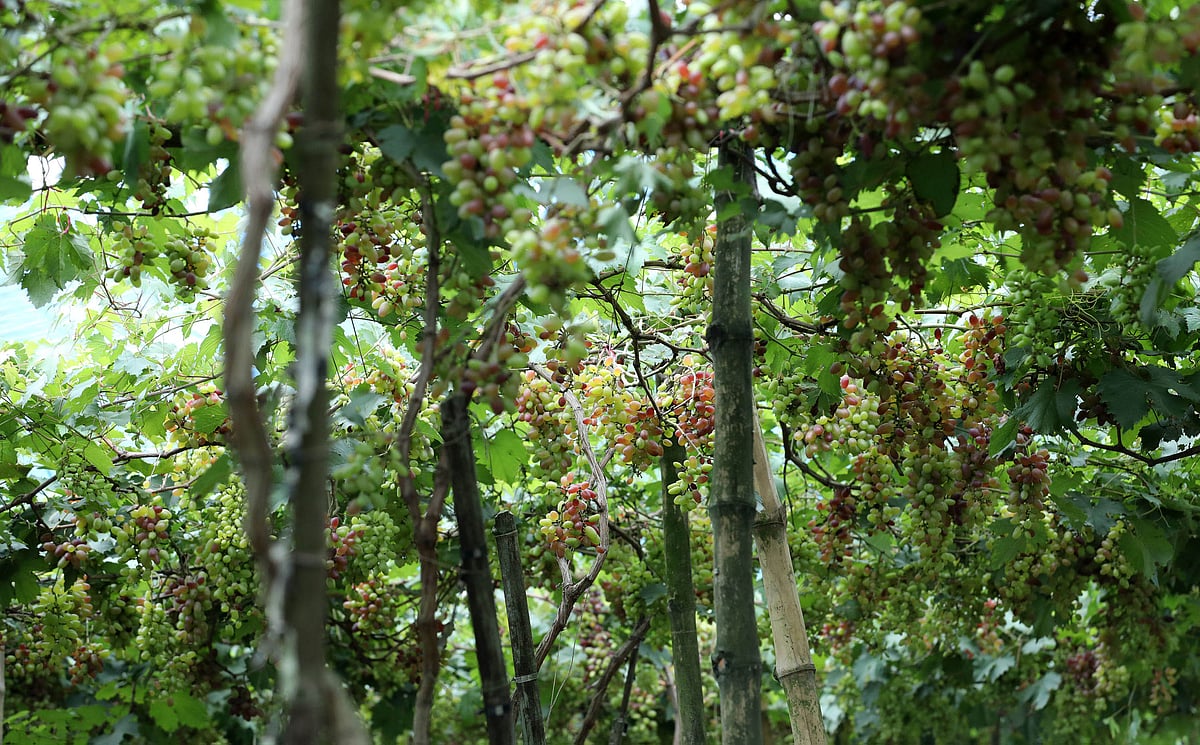
Photo Collected
In the rural village of Nimgachhi in Bogura, Bangladesh, a former corporate employee has turned an unconventional agricultural experiment into a thriving enterprise. Minhajul Islam, a 33-year-old business graduate, has successfully cultivated premium varieties of foreign grapes, transforming his 15-decimal plot into a showcase of agricultural ingenuity that is drawing visitors from across the region.
After a decade of high-pressure work in the pharmaceutical industry, Islam transitioned to agriculture in 2024. Starting with “Bharat Sundari” jujubes, he expanded his operations to include dragon fruit, strawberries, guavas, and pomegranates. His venture into viticulture began a year ago, when he sourced 94 grape saplings from a nursery in Rajshahi. His current harvest includes international varieties such as Baikunur, Green Lawn, Black Magic, Jayshree Place, and Dikshan.
বিজ্ঞাপন
The results have been significant. Islam reports that his grapes sell directly from the farm at 370 taka per kilogram. To date, he has generated approximately 200,000 taka in fruit sales, with an expected net profit of 400,000 taka after accounting for his 80,000-taka initial investment. Beyond the fruit itself, Islam has established a lucrative side business by selling grafted saplings at 300 taka each, generating an additional 300,000 taka in revenue.
Islam’s success is rooted in meticulous, modern farming practices. He relies heavily on organic fertilizers, such as vermicompost and cow dung, to maintain fruit quality while minimizing costs. To protect his crop from birds, pests, and adverse weather—including heavy rainfall that can damage grape vines—he has installed protective netting. For added security, he utilizes a closed-circuit camera system that monitors the site and alerts him to unauthorized movement.
বিজ্ঞাপন
The local agricultural department has taken note of Islam’s achievements. According to Sohail Rana, the Upazila Agriculture Extension Officer, the government is actively supporting this shift toward high-value crops. The department has provided Islam with technical assistance and incentives, including a power tiller and an irrigation pump, to bolster his efforts. Furthermore, a local service center has been established to provide other aspiring farmers with digital resources and professional guidance.
Minhajul Islam remains optimistic about the future of viticulture in the region, though he emphasizes the need for better infrastructure. He suggests that the government should support the construction of poly-houses, which would shield grape crops from excessive humidity and rain, potentially reducing the country’s dependence on imported fruit.
“I want to see grape cultivation in every household so that we no longer need to rely on imports,” Islam said. His transformation from a corporate professional to a successful agricultural entrepreneur has inspired a new generation of local youth and farmers to pursue similar high-value cultivation, signaling a potential shift in the local agricultural landscape.
0%
0%
0%
0%