
Experts Urge Long-Term Institutional Strategy and Regional Geopolitics to Resolve Rohingya Crisis
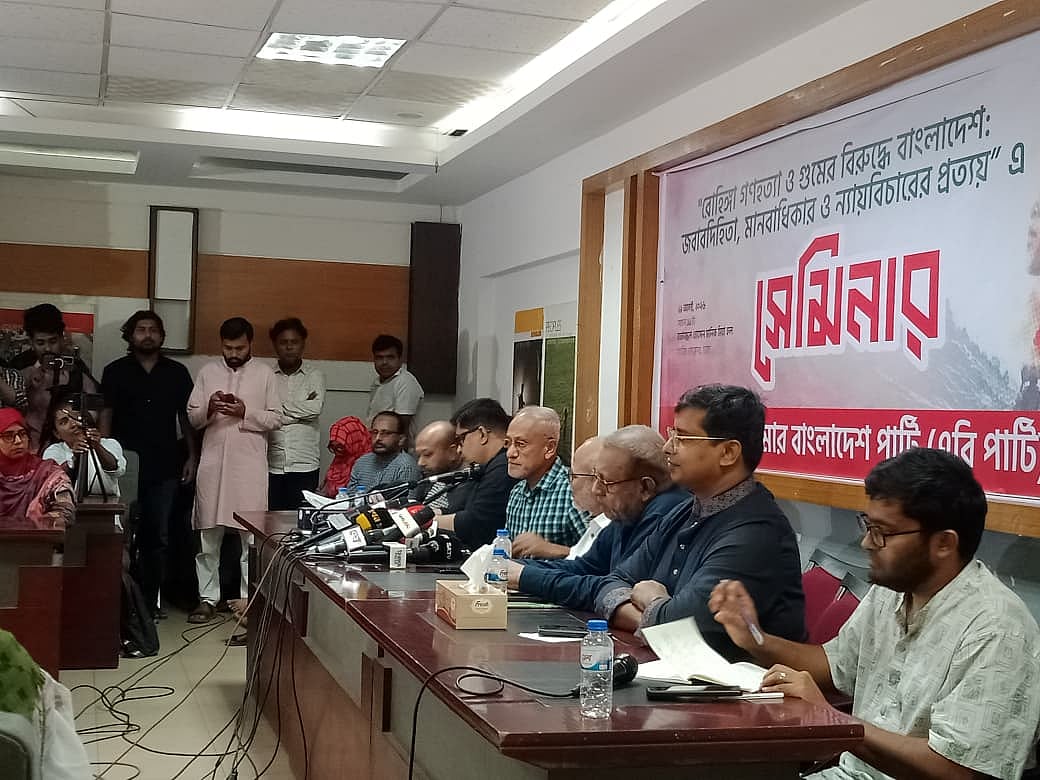
Photo Collected
Speakers at a seminar in Dhaka on Saturday urged the government to move beyond the mere formation of committees and instead adopt long-term, institutional strategies to resolve the Rohingya crisis. Experts emphasized that the repatriation of Rohingya refugees must leverage the geopolitical interests of regional and global powers, including India and China.
The seminar, titled “Bangladesh Against Rohingya Genocide and Enforced Disappearance: Commitment to Accountability, Human Rights, and Justice,” was organized by the Amar Bangladesh Party (AB Party) at the Tofazzal Hossain Manik Mia Hall of the National Press Club.
Major General (retd) Fazle Elahi Akbar, Chairman of the Foundation for Strategic and Development Studies (FSDS), noted that while the current government’s formation of a committee to address the crisis is a positive step, past efforts have suffered from poor implementation. He proposed the establishment of a National Security Agency to ensure a coordinated approach to national security challenges.
Akbar argued that Bangladesh could strategically utilize the Rohingya crisis to strengthen relations with India, noting that the security and progress of India’s Kaladan Multi-Modal Transit Transport Project are directly linked to the situation in Myanmar’s Rakhine State. He suggested that by highlighting this connection, Bangladesh could encourage more active Indian involvement in the repatriation process. Similar opportunities for diplomatic engagement exist with China, given its infrastructure interests in the region.
Addressing the issue of enforced disappearances, Akbar stated that state accountability and a functioning, corruption-free judiciary are essential to prevent the recurrence of such crimes. He expressed personal distress that members of the armed forces had been implicated in past disappearances, asserting that soldiers have a duty to reject unlawful orders.
Mawdud Hossain Alamgir Pavel, convener of the BNP’s media cell, highlighted the shifting power dynamics within Myanmar, where the central government’s control is limited by the influence of groups like the Arakan Army. He stressed that Bangladesh must navigate the competing interests of China, India, the United States, and Russia to establish a viable pathway for repatriation.
Professor Sahab Enam Khan of Jahangirnagar University’s Department of International Relations warned that the crisis cannot be resolved through a purely humanitarian or bilateral lens. He noted that Myanmar’s strategic importance regarding energy pipelines, maritime access, and trade routes has made it a focal point for regional powers. He called for a unified national political consensus focused on repatriation and urged the international community to shift its focus from merely hosting refugees to creating the conditions necessary for their safe return.
Regarding domestic accountability, Hummam Quader Chowdhury, a BNP leader who was himself a victim of enforced disappearance, emphasized the need for independent investigations. He proposed that under the planned anti-disappearance legislation, no agency or force accused of involvement in a crime should be permitted to investigate its own actions. He further advocated for holding “superior command” officials accountable, rather than only those directly executing orders.
AB Party General Secretary Asaduzzaman Fuad concluded that Bangladesh must clarify its national stance on the three available options: repatriation, third-country resettlement, or integration. He reiterated that ensuring an independent, impact-focused investigation mechanism is vital to ending the culture of disappearances in the country. The event was inaugurated with welcome remarks by AB Party Joint Secretary General Zobayer Ahmed Bhuiyan.
0%
0%
0%
0%
More News from Local