


Bangladesh Suspends New Industrial Gas Connections Amid Supply Shortage
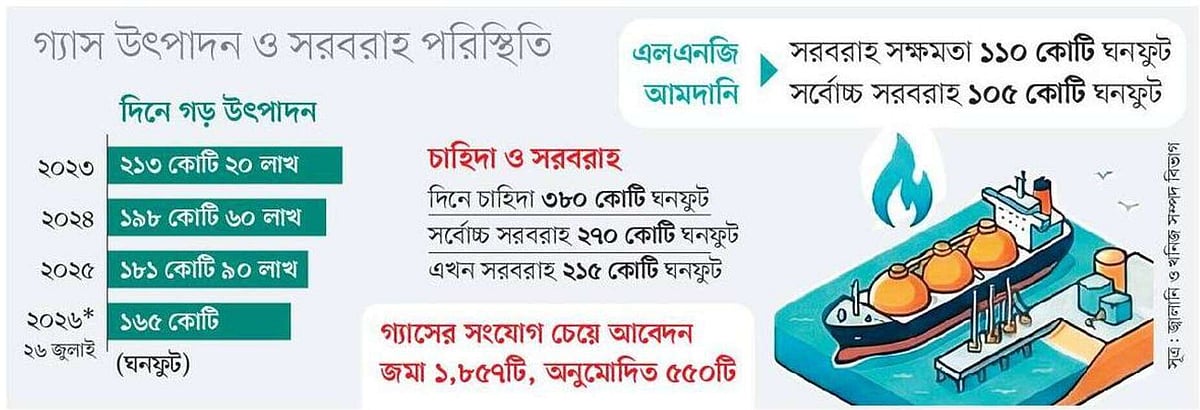
Photo Collected
The Bangladeshi government has suspended all new industrial gas connections indefinitely as the nation grapples with a deepening energy crisis characterized by dwindling domestic production and import limitations. According to directives issued by the Ministry of Power, Energy and Mineral Resources to the state-run Petrobangla, the current supply deficit renders the expansion of industrial connections untenable.
Domestic gas production has seen a sustained decline, dropping by more than 150 million cubic feet per day annually. Over the past decade, daily output has plummeted by over one billion cubic feet. While the government has increasingly relied on Liquefied Natural Gas (LNG) imports to bridge the gap, the infrastructure remains insufficient. The nation currently operates two floating storage and regasification units (FSRUs) at Moheshkhali, which have a combined capacity of 1.1 billion cubic feet. However, technical disruptions—including the recent closure of one terminal—have severely constrained supply, leaving the industrial, power, and manufacturing sectors in a state of chronic shortage.
বিজ্ঞাপন
Energy officials indicate that even with new drilling efforts, domestic production continues to slide, and the lack of pipeline capacity further limits the ability to redistribute imported gas effectively. Current infrastructure, specifically the transmission lines beyond the Anwara station, cannot accommodate an increase in flow, creating a bottleneck that complicates any short-term supply strategy. Data from Petrobangla highlights the strain of this imbalance: the power sector consumes 41 percent of the available gas, followed by 36 percent for industries and 11 percent for residential use, leaving little margin for error.
To mitigate the crisis, the government has launched an initiative to drill 100 new wells and has reopened bidding for offshore gas exploration. Despite these long-term plans, industry experts and ministry officials caution that a turnaround is unlikely within the next year. Plans to import LNG via ISO tanks from Malaysia are under discussion, though analysts note the volume would be negligible—approximately 13 million cubic feet per day—at a significantly higher cost than pipeline imports.
বিজ্ঞাপন
The suspension of connections has drawn concern from economists and energy experts, who warn that businesses that have already invested based on approved government demand notes now face potential insolvency. Energy analyst M. Tamim noted that while the moratorium is a realistic response to the current deficit, the government must prioritize infrastructure development and restore cancelled terminal projects to avoid a prolonged economic stagnation. For now, the administration remains in what officials describe as a “vicious cycle,” where limited energy supplies stifle the economic growth necessary to generate the foreign currency required for future energy imports.
0%
0%
0%
0%