Bangladesh Information Minister Calls for Media Reform to Combat Spread of Misinformation
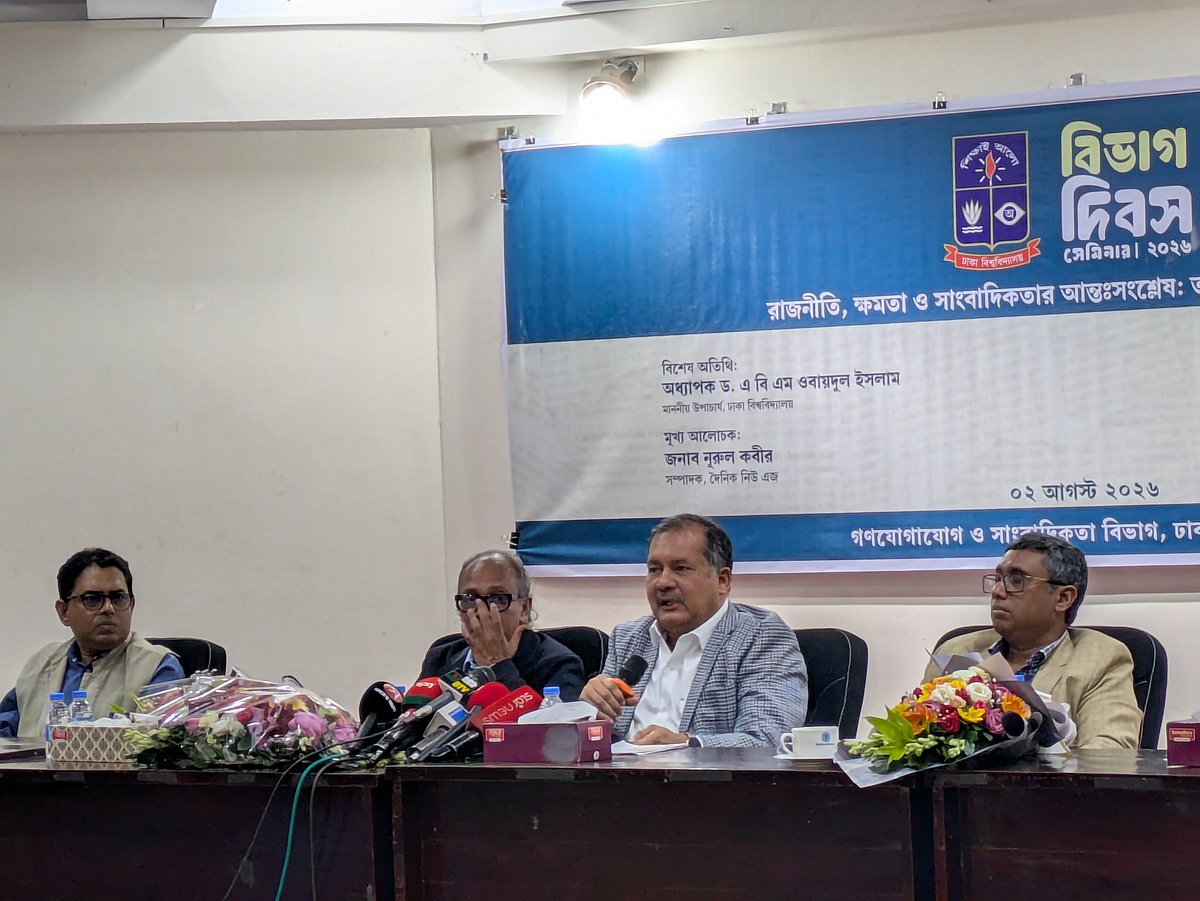
Photo Collected
The spread of misinformation and distorted narratives has eclipsed traditional concerns regarding press freedom, emerging as the most significant challenge facing contemporary journalism in Bangladesh. Information and Broadcasting Minister Zohir Uddin Swapan highlighted this shift during a seminar titled “Politics, Power, and Journalism: Theory, Reality, and Future,” held Sunday at Dhaka University. Addressing the audience at the Professor Muzaffar Ahmed Chowdhury Auditorium, the minister noted that while information scarcity was once the primary obstacle, the modern era is defined by an overwhelming deluge of data that is frequently exploited to manipulate public perception and electoral behavior.
Minister Swapan emphasized that the government is actively seeking to address this crisis through a combination of advanced technology, improved education, and strategic policy interventions. He acknowledged that while professional security remains a vital concern for journalists—particularly for field reporters who face greater risks than editorial staff—the government is committed to reforming the media landscape. This process, he noted, involves working closely with industry stakeholders to establish a media commission that balances power, freedom, and responsibility, aiming to move beyond the ineffective wage board implementations of the past.
Reflecting on historical milestones, including the Liberation War and the recent July mass uprising, the minister remarked that journalism often splits into competing narratives during times of political upheaval. He cautioned that media discourse is frequently shaped by the victors of political conflicts, noting that intellectual and journalistic support often aligns with whoever controls the state narrative at a given time. Regarding the limits of free speech, the minister stated that the government intends to define acceptable standards through collaborative discussion rather than unilateral decree.
Daily New Age editor Nurul Kabir, serving as the keynote speaker, challenged the view that journalism is merely the dissemination of information. He argued that the profession carries a deeper responsibility to analyze power structures and raise public awareness regarding exploitation and inequality. Kabir sharply criticized lingering colonial-era restrictions, specifically pointing to the 1973 publication laws that require publishers to sign affidavits pledging not to engage in activities contrary to government interests—a provision he described as fundamentally antithetical to democratic principles.
Echoing the need for integrity, Dhaka University Vice-Chancellor Professor A.B.M. Obei-dul Islam underscored that journalism must be the domain of trained, skilled professionals. He urged the media to reject “yellow journalism” in favor of objective, truthful reporting capable of fostering societal change. Renowned photographer Shahidul Alam concluded the discussion by noting that the very existence of obstacles and crises reinforces the necessity of the journalistic profession. He encouraged reporters to maintain their commitment to truth, asserting that the importance of a free press is most acutely felt precisely when the environment is most hostile.
0%
0%
0%
0%