


Bangladesh Hikes Electricity Prices by 17 Percent Across All Consumer Tiers
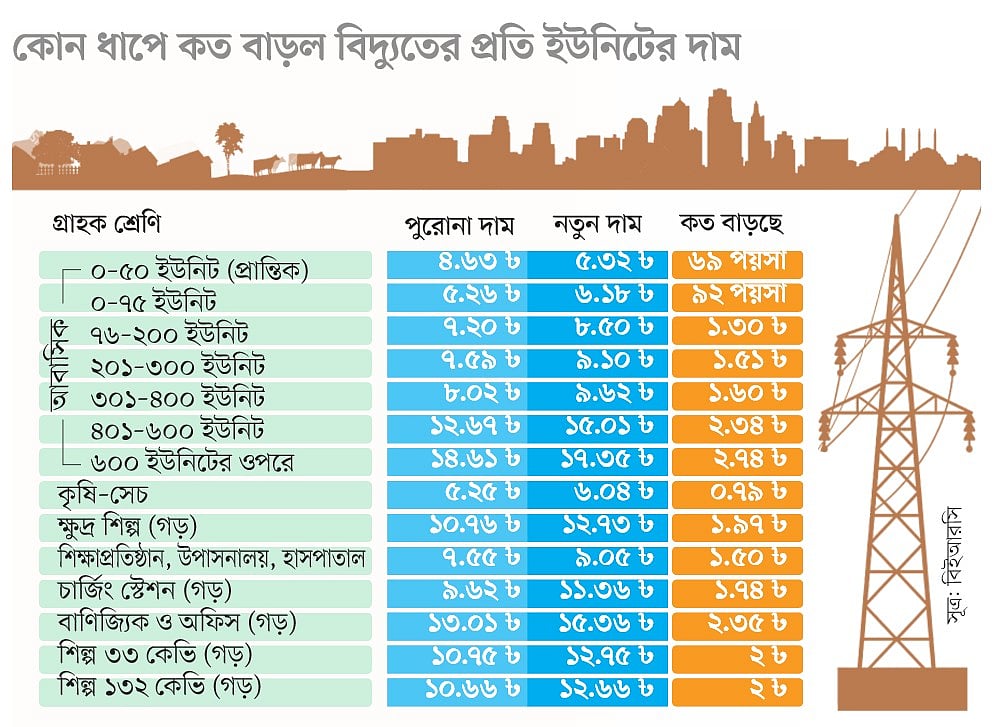
Photo Collected
Bangladesh has announced a significant hike in electricity prices across both wholesale and retail levels, a move expected to increase the financial burden on all consumer segments, including low-income rural households. The decision, revealed by the Bangladesh Energy Regulatory Commission (BERC) following a briefing in Dhaka, will see wholesale prices rise by an average of 19.85 percent, transmission charges by 23.96 percent, and retail rates by 16.68 percent, effective from June.
The adjustment arrives despite previous government assurances that electricity prices would remain stable to provide relief to the public. Under the new tariff structure, the price for lifeline consumers—those using up to 50 units per month—has been increased by 69 paisa per unit. Despite a recommendation from the Power Development Board (PDB) to spare this segment from price hikes, the BERC opted to incorporate the proposal of the Rural Electrification Board (REB), a decision that is projected to generate an additional 781 crore taka annually from the country’s most vulnerable users.
বিজ্ঞাপন
Industry analysts suggest the wholesale price hike will bolster the PDB’s annual revenue by 14,000 crore taka, theoretically reducing the government’s subsidy burden. Even with this increase, the state is expected to provide 41,000 crore taka in subsidies. Meanwhile, the retail adjustment is anticipated to draw an extra 15,500 crore taka from consumers annually, alongside additional government revenue from value-added taxes and surcharges.
The regulatory process drew scrutiny due to its unprecedented speed. Following a directive from the Power Division on May 3, the BERC formed a technical committee and held public hearings on May 20 and 21. While the law allows for a 60-day window following hearings, the commission finalized the new rates in just three working days. BERC Chairman Jalal Ahmed denied outside pressure, citing the upcoming national budget as the impetus for the accelerated timeline, though he conceded that no formal economic assessment of the impact on consumers had been conducted.
বিজ্ঞাপন
The new rates affect a wide range of consumers, including residential, agricultural, industrial, commercial, and institutional users. The average price of electricity at the wholesale level has risen from 7 taka to 8.39 taka per unit, while the average retail price has climbed from 9.11 taka to 10.63 taka per unit. Residential users in the 76–200 unit bracket will see their monthly bills increase by approximately 198 taka, while industrial consumers will face a surcharge of 2 taka per unit.
Consumer rights advocates have sharply criticized the decision, labeling the price hike an injustice. M. Shamsul Alam, energy advisor to the Consumers Association of Bangladesh (CAB), argued that the move unfairly shifts the burden of systemic inefficiencies—such as the 40,000 crore taka paid annually in “capacity charges” to idle power plants—onto the public. Critics contend that rather than imposing these costs on citizens already grappling with record-high fuel prices and inflation, the government should have focused on reviewing existing, often costly, power purchase agreements.
0%
0%
0%
0%