


Bangladesh has dropped three steps in the media freedom index
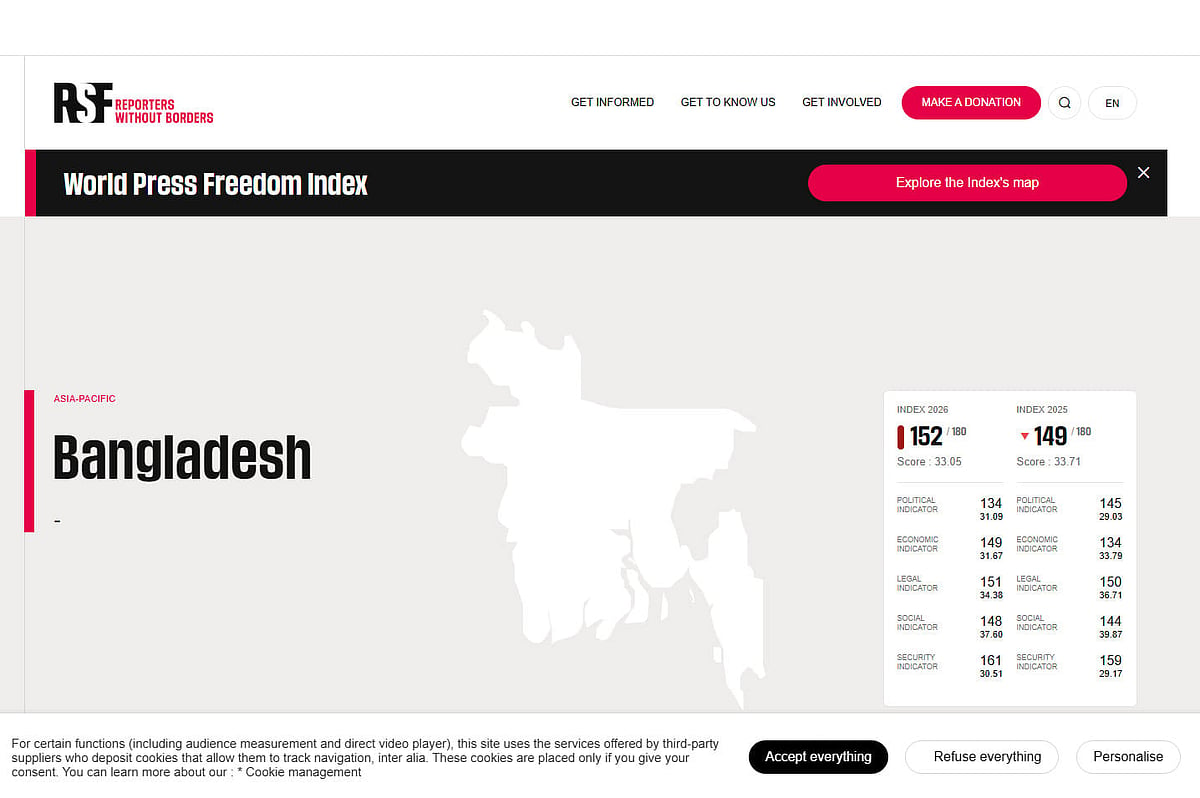
Photo Collected
PARIS, FRANCE — Global media freedom has collapsed to its lowest level in a quarter-century, according to the 2026 World Press Freedom Index published by the Paris-based international watchdog Reporters Sans Frontières (RSF). The landmark report highlights a severe, worldwide trend toward the criminalization of journalism, with more than half of the 180 countries surveyed now designated within the “difficult” or “very serious” categories.
Bangladesh has experienced a parallel decline within this deteriorating global landscape, slipping three notches to rank 152nd out of 180 nations, down from its 149th position in 2025.
বিজ্ঞাপন
The socio-economic and technical reality of the domestic media space remains highly polarized. Over 20% of Bangladesh’s 169 million citizens live below the poverty line, drastically restricting general access to traditional mainstream news channels, though internet-based news consumption is steadily expanding. Structurally, the country’s primary state-run media apparatuses—Bangladesh Television (BTV), Bangladesh Betar, and the national news agency Bangladesh Sangbad Sangstha (BSS)—lack basic editorial autonomy and function as direct state propaganda outlets.
Conversely, the private sector boasts a highly fragmented landscape of approximately 3,000 newspapers and periodicals, 30 radio stations (including community broadcasters), 30 television channels, and hundreds of online portals. Major private broadcasters, including Jamuna TV, Somoy TV, and Ekattor TV, previously maintained staunchly pro-government stances under the administration of Sheikh Hasina but largely refrained from criticizing the subsequent interim authority. Among leading publications, the Bengali daily Prothom Alo and the English-language paper The Daily Star were singled out for managing to maintain a distinct level of editorial independence.
বিজ্ঞাপন
The report offers a deep historical analysis of the country’s systemic media suppression. Since achieving independence in 1971, successive ruling regimes in Bangladesh have consistently co-opted the media landscape for state propaganda. The Awami League administration led by Sheikh Hasina from 2009 to 2024 heavily restricted independent reporting through state censorship, targeted cyber harassment, direct pressure from military intelligence wings, judicial harassment, repressive statutes, and police crackdowns.
Following the collapse of the Hasina regime during a student-led mass uprising on August 5, 2024, a Nobel laureate-led interim administration governed the nation until February 2026, after which the Bangladesh Nationalist Party (BNP) assumed power through parliamentary elections.
A primary tool of statutory intimidation has been the Cyber Security Act (CSA)—modeled directly after the widely condemned Digital Security Act—which grants law enforcement sweeping authority to conduct warrantless searches, execute arbitrary seizures, confiscate digital equipment, and compromise confidential journalistic sources. This highly repressive framework routinely forces local editors and reporters into strict self-censorship.
Furthermore, private media ownership has become concentrated within a few major corporate conglomerates that utilize media assets as leverage for profit and political influence, prioritizing ties with the state over editorial autonomy. Security threats also stem from extremist factions; while Islamist groups were responsible for multiple targeted killings of secular media professionals over the past decade, they have now pivoted to digital spaces to systematically threaten and harass secular writers.
The political transitions following August 2024 have also introduced severe legal vulnerabilities, with more than 130 journalists hit with baseless criminal lawsuits—including extreme charges of “murder” and “crimes against humanity”—and at least five journalists currently held in state detention. Additionally, the industry remains heavily male-dominated, leaving female journalists exposed to systemic workplace discrimination and toxic online smear campaigns.
| RSF World Press Freedom Index 2026: Notable Rankings | Global Position (Out of 180 Countries/Territories) | Year-on-Year Rank Trajectory / Status |
| Norway | 1st | Ranked 1st (Maintains top spot for a decade) |
| Netherlands | 2nd | Ranked 2nd |
| Estonia | 3rd | Ranked 3rd |
| France | 25th | Categorized as “Satisfactory” |
| United States | 64th | Dropped 7 places due to systematic anti-press policies |
| Argentina | 98th | Dropped 11 places |
| Israel | 116th | Dropped 4 places amid extensive military crackdowns on press |
| Georgia | 135th | Dropped 75 places since broad crackdowns began |
| Hong Kong | 140th | Dropped 122 places historically due to tight Beijing control |
| El Salvador | 143rd | Dropped 105 places since 2014 war on criminal gangs |
| Bangladesh | 152nd | Dropped 3 places (Down from 149th in 2025) |
| Pakistan | 153rd | Ranked 153rd (Fraught political climate and content suppression) |
| India | 157th | Ranked 157th (Severe legal indicator decline) |
| Egypt | 169th | Ranked 169th |
| Russia | 172nd | Ranked 172nd (Misuse of anti-terror laws to stifle independent press) |
| Iran | 177th | Ranked 177th (Severe regime crackdowns) |
| Eritrea | 180th | Ranked 180th (Maintains bottom spot for three consecutive years) |
On a broader scale, the 2026 index shows that journalists are actively treated as criminals in more than 60% of all surveyed states (110 out of 180), driven by the deliberate misuse of emergency legislation and common laws to bypass established press protections. Active military conflicts and severe blockades on information access remain primary drivers of the global collapse.
In the Middle East, the report notes extensive casualties among media professionals, recording that Israeli forces have killed more than 220 journalists in Gaza since October 2023, with at least 70 losing their lives while actively performing their professional duties.
RSF Editorial Director Anne Bocandé warned that modern assaults on the right to information are becoming increasingly covert, diverse, and aggressive. Bocandé attributed the global regression to the rise of authoritarian regimes, weak political leadership, predatory economic interests, and completely unregulated online platforms. She concluded with an urgent appeal to democratic governments and global citizens to counter the systematic criminalization of media workers, demanding concrete guarantees for the safety of reporters and the swift prosecution of those who commit crimes against the press.
0%
0%
0%
0%