
Bangladesh Government Announces Major Salary Restructuring for Public Employees Across All Pay Grades
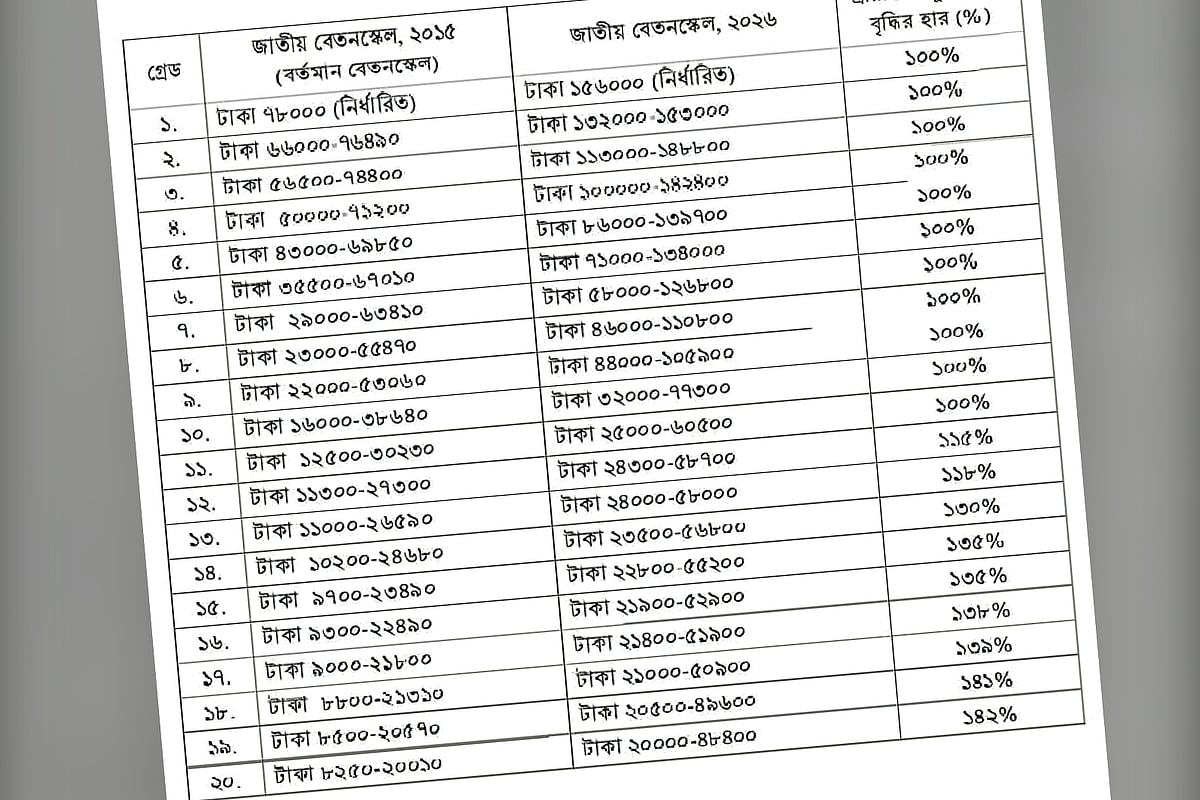
Photo Collected
The government of Bangladesh has unveiled a new pay structure for public sector employees, significantly increasing basic salaries across all grades. The reform introduces a phased implementation strategy, prioritizing lower-grade employees while phasing out existing special benefits.
Under the new framework, the starting basic salary for Ninth Grade positions, which includes Bangladesh Civil Service (BCS) cadres, will rise from 22,000 taka to 44,000 taka. For Tenth Grade positions, such as primary school headmasters, the base salary will increase from 16,000 taka to 32,000 taka, while Thirteenth Grade assistant teachers will see their starting base rise from 11,000 taka to 24,000 taka. The lowest tier, Twentieth Grade, will see an increase from 8,250 taka to 20,000 taka.
The implementation for Ninth Grade and above will occur in three stages. Starting this July, 40 percent of the salary increase will take effect, followed by 30 percent in January 2027, and the final 30 percent in July 2027. Existing special allowances of 15 percent will be abolished once the new structure is implemented.
Employees in Tenth to Twentieth Grades will receive a larger share of their raises earlier, with 50 percent of the increase effective from July to December of this year. An additional 25 percent will be applied between January and June 2027, with the final 25 percent implemented by the end of 2027. For all grades, updated allowances—including house rent, medical, education, and festival bonuses—are scheduled to be fully integrated by January 1, 2028.
House rent allowances will continue to be calculated based on the location of the duty station, with rates currently set at 50 percent in Dhaka, 45 percent in other divisional headquarters, and 40 percent in district towns. By January 2028, a new entrant in the Ninth Grade stationed in Dhaka could expect a total monthly compensation package of approximately 70,000 taka, including base salary and applicable allowances.
For existing employees, the transition is more complex. Total earnings will depend on current basic pay, length of service, and accumulated increments. While new recruits follow a straightforward calculation, current personnel will see varying increases based on their existing pay scales and historical service data. Officials noted that definitive salary figures will be finalized upon the formal issuance of the government notification regarding the new structure.
The government also intends to introduce a new mobile allowance for employees across all grades. The primary school sector, where headmaster positions are typically filled by a mix of direct recruitment and promotion from assistant teacher roles, is expected to see significant upward adjustments in overall compensation as the multi-stage implementation concludes.
0%
0%
0%
0%
More News from Local