
Pressure mounts on agricultural officials to greenlight solar power plant on farmland in Bhaluka
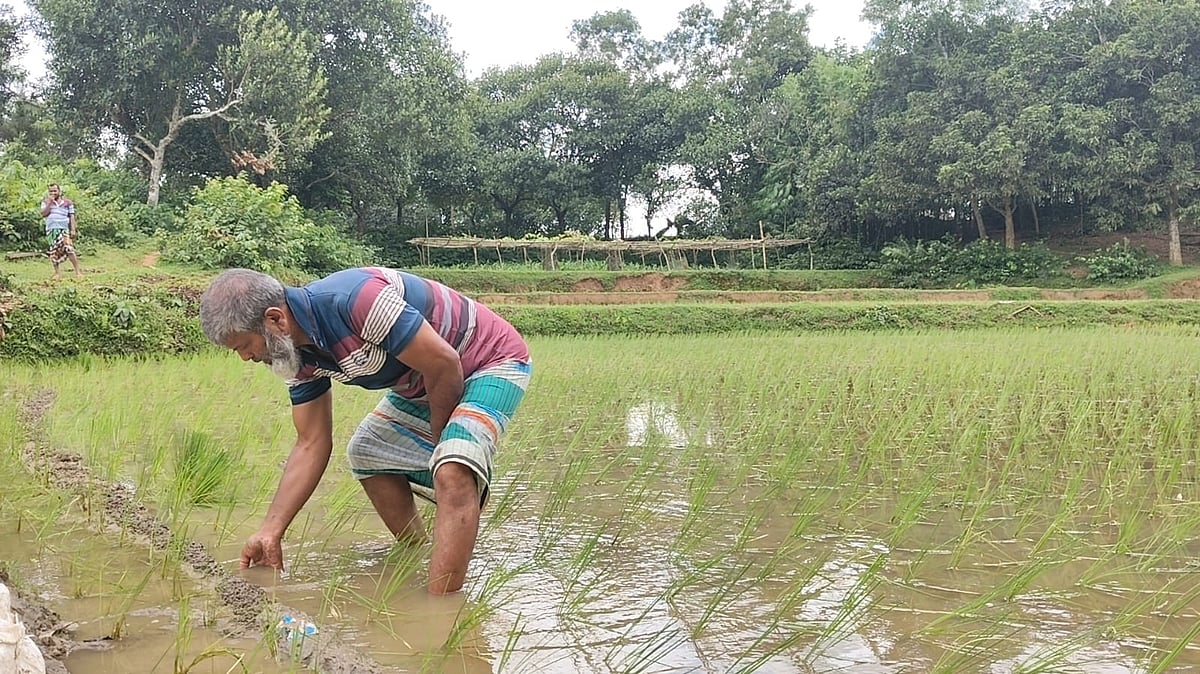
Photo Collected
Authorities in Bhaluka, Mymensingh, have faced allegations of coercing agricultural officials to issue a No Objection Certificate (NOC) for a proposed 45-megawatt solar power project situated on fertile farmland. The project is being spearheaded by Bhawal Engineers and Construction Ltd., a company chaired by Taslima Akter, the wife of Fakhr Uddin Ahmed, the Bangladesh Nationalist Party (BNP) Member of Parliament (MP) for the Mymensingh-11 constituency.
The controversy centers on approximately 173.13 acres of land across Nandipara and Jhalpaja mouzas. Initially, the local agricultural department resisted approving the site, citing its status as productive farmland. However, internal sources and officials have alleged that they were pressured by local administration and high-ranking figures to categorize the land as non-agricultural to facilitate the project’s development.
The Bangladesh Power Development Board (PDB) invited tenders for 10 solar power plants nationwide in April, with the Bhaluka project slated for completion by January 2029 under the Independent Power Producer (IPP) model. While three other firms—Gatco Energy Ltd., TS Transformer Ltd., and Mir Ceramic Ltd.—also submitted applications for similar projects in the region, their bids were disqualified, leaving the MP’s spouse’s company as the sole viable candidate.
A verification committee formed by the Bhaluka Upazila administration on July 16 initially reported that a significant portion of the land is used for Boro rice cultivation, warning that construction would severely impact local food production. Despite this, an NOC was issued on August 19, reclassifying 141.97 acres as non-agricultural land, while acknowledging only 31.16 acres as single-crop land.
Nusrat Jahan, the Bhaluka Upazila Agriculture Officer, confirmed that she was pressured by her superiors and political stakeholders to sign off on the certification, citing the need for “development” and addressing energy shortages. Similarly, Md. Enamul Haque, Deputy Director of the Department of Agricultural Extension in Mymensingh, admitted that despite the presence of productive soil and fish farms, officials were forced to comply with directives from “higher authorities.”
MP Fakhr Uddin Ahmed has denied all allegations of exerting influence. “I have never spoken to any agricultural official regarding this matter, nor have I directed anyone else to pressure them,” he stated, asserting that the land in question is largely unsuitable for farming.
Local residents and farmers remain firmly opposed to the project, expressing concerns that the loss of their land—which sustains multiple harvests and homesteads—will jeopardize their livelihoods. Several farmers have filed formal grievances with the Mymensingh Deputy Commissioner, claiming the process was carried out without transparent public consultation.
According to the ‘Land Use Control and Agriculture Land Protection Act,’ the conversion of multi-crop land for commercial use is strictly prohibited. However, Bhaluka has seen a rapid decline in agricultural land over the past decade, with data showing a loss of over 1,000 hectares in the last six years alone due to industrial expansion. As of 2026, the industrial footprint in the area continues to grow, with the region already hosting nearly 200 industrial factories.
0%
0%
0%
0%