

Eight-year-old girl with rare progeria syndrome dreams of a future she may never see
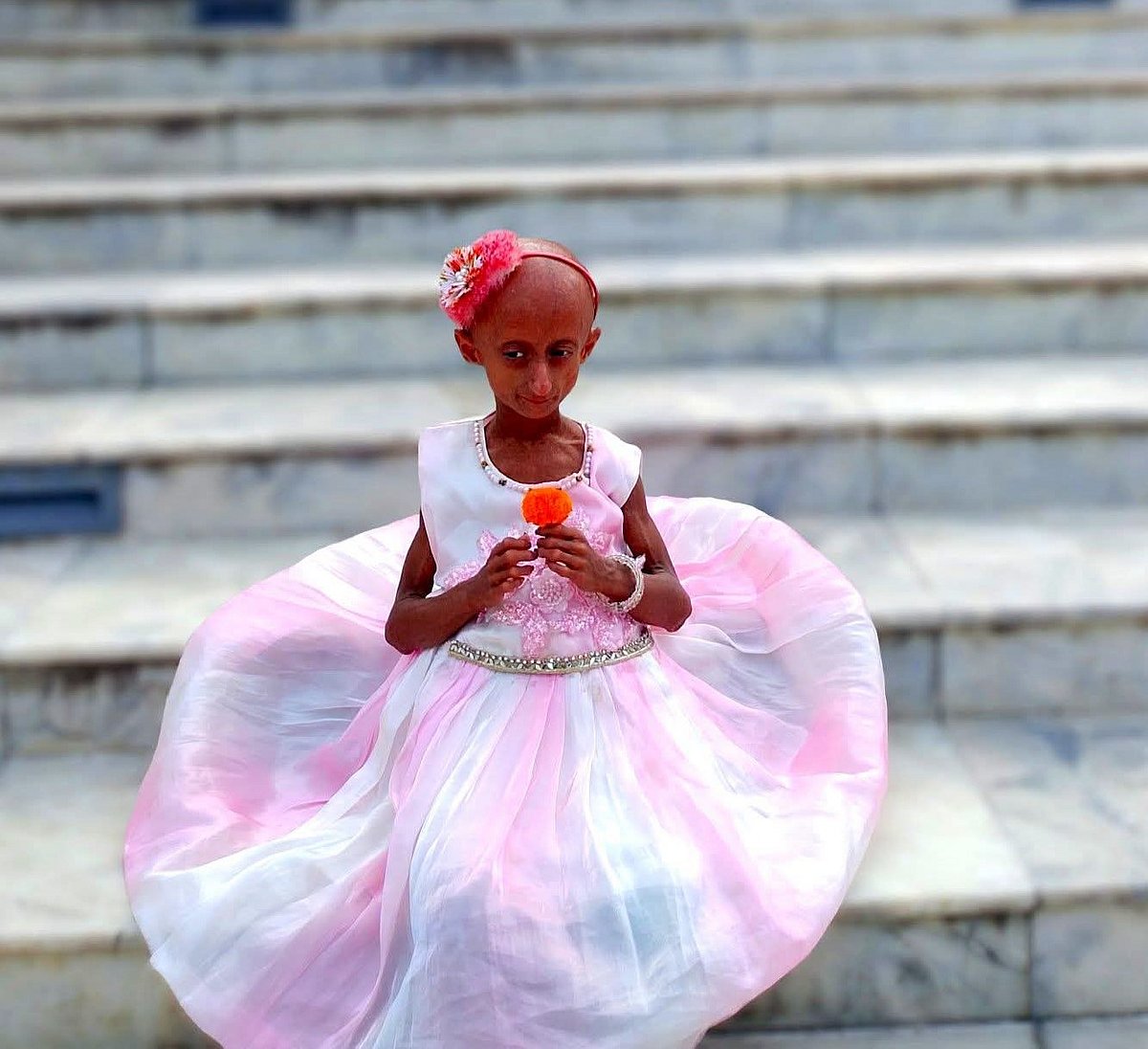
Photo Collected
DEWANGANJ, Jamalpur — Eight-year-old Mobashira Mostarin spends her days dreaming of the day she can buy a beautiful hair clip. While her peers spend pocket money on chocolates or toys, Mobashira diligently saves hers, unaware that the physical condition she has lived with since the age of three makes her wish impossible.
Mobashira suffers from Progeria, a rare genetic disorder characterized by accelerated aging. Despite being only eight, her facial features bear the appearance of a 60-year-old. She lacks eyebrows and eyelashes, her head is disproportionately large, her joints are swollen, and her skin is thin and wrinkled. Yet, she continues to play, smile, and adorn herself, often wrapping a cloth around her head to mimic hair before attaching a decorative hair band.
Her mother, Kohinoor Akter, struggles to reconcile her daughter’s joyful spirit with the grim medical reality. “I do not know how many years she has left,” Akter said during a video call. “She is incredibly bright and even tries to save her pennies to help me pay off debts. I hide my tears from her, but when I am alone, I cannot stop crying.”
The family’s journey to identify the illness was long and fraught with misinformation. For years, they sought help from both physicians and traditional healers, often being told Mobashira was suffering from supernatural influences. It was only after sharing photos of her daughter on Facebook that they learned of Progeria. Since then, they have been in contact with the Progeria Research Foundation (PRF), which has initiated efforts to collect blood samples for international testing, though the family is still awaiting official results.
Medical experts describe Progeria as a mutation in the LMNA gene, which produces a protein essential for the structural integrity of the cell nucleus. Prof. ABM Abdullah, a former dean of the Faculty of Medicine at Bangabandhu Sheikh Mujib Medical University, explained that the condition accelerates the aging process, leaving children vulnerable to heart disease and strokes. While there is no known cure, the average life expectancy for those affected is often less than 15 years, though some, like 29-year-old Tuhin Islam Raju—the first recorded case in Bangladesh—have defied the odds.
The social toll has been equally heavy. Akter frequently faces cruel comments online and in person, with some observers mocking her daughter’s appearance or accusing the family of exploiting the child for attention. “People call her a ghost or laugh at her,” Akter said. “It breaks my heart, but to me, she is still the beautiful daughter she was at birth.”
Akter’s social media account, titled “Mobashira’s Mom,” serves as both a chronicle of her daughter’s life and a desperate plea for awareness. She often dresses Mobashira in festive clothing, hoping to capture the childhood milestones she fears her daughter may never reach.
As Mobashira grows, the financial burden of her medical needs—including constant medication for recurring illnesses—continues to strain the family, whose primary income comes from her father, Mahabubur Rahman, an auto-rickshaw driver. For now, Mobashira remains focused on the simple joys of cartoons and her mother’s company, unaware of the precarious nature of her future. Her mother’s greatest hope is not just for medical support, but for society to treat her daughter with the dignity and kindness every child deserves.
0%
0%
0%
0%
More News from Health