
Economist Anu Muhammad Criticizes Government Energy Policies and Demands Reforms at Dhaka Protest
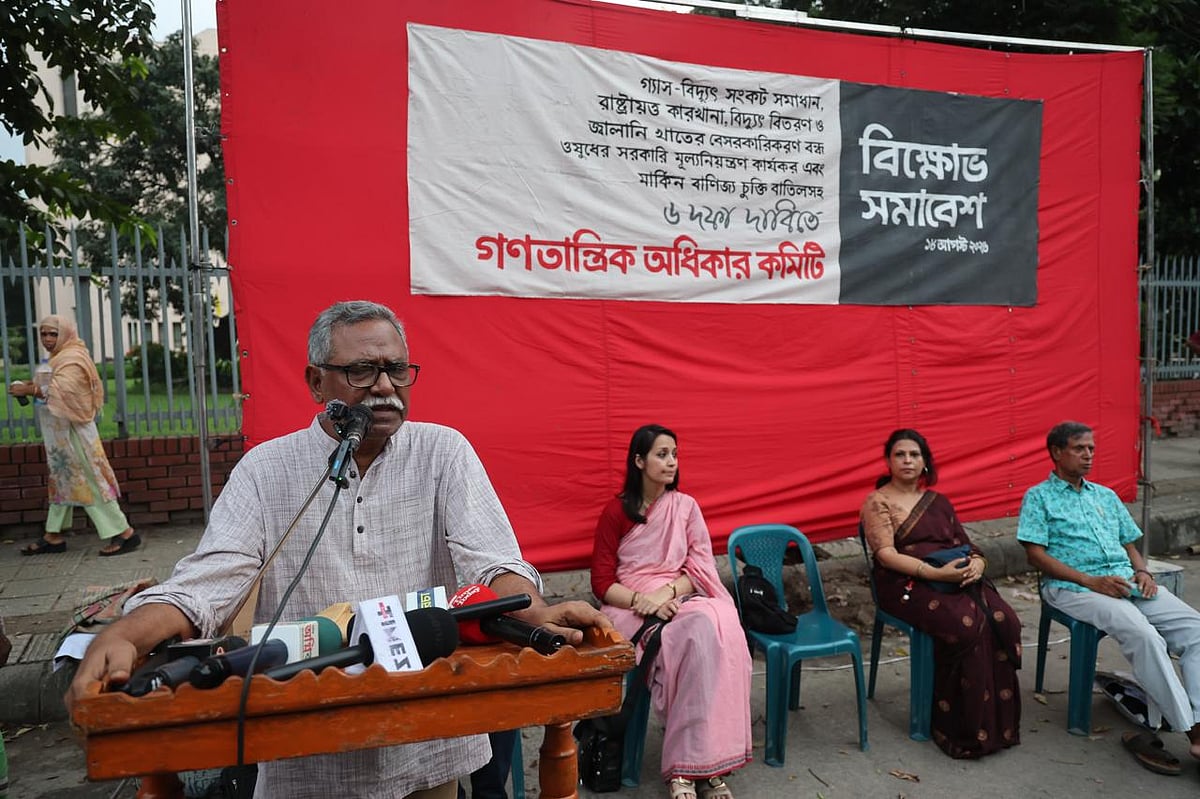
Photo Collected
Economist Professor Anu Muhammad has criticized the current interim government for failing to prioritize public interest, arguing that its policies remain indifferent to the needs of the general population despite its short tenure. Speaking at a protest rally organized by the Committee for Democratic Rights in front of the National Museum at Shahbag in Dhaka on Tuesday, the economist asserted that the government has adopted policies favoring specific business syndicates and private interest groups rather than utilizing national resources for public welfare.
The rally, held to highlight a six-point demand including the resolution of gas and electricity shortages and an end to the privatization of state-owned enterprises, served as a platform for experts to denounce the government’s energy strategy. Professor Anu Muhammad pointed to the continued reliance on expensive imported Liquefied Natural Gas (LNG) despite the availability of domestic gas reserves in Bhola. He argued that the current energy crisis could be swiftly mitigated by extracting local gas, repairing aging power plants, and investing in solar energy.
The economist also cautioned against proposals to open the Phulbari coal mine through open-pit mining, a move recently discussed by Finance Minister Amir Khasru Mahmud Chowdhury. Anu Muhammad characterized such initiatives as detrimental to national interests, suggesting that they are designed to manipulate share prices for the unlicensed Global Coal Management company on the London Stock Exchange. In response to these policies, the Committee for Democratic Rights announced plans for a protest march from Dhaka to Phulbari starting August 24, culminating in a public rally on August 26.
Development economics researcher Maha Mirza echoed these sentiments, noting that the country’s energy security is at severe risk due to the power sector being controlled by private mafias. She criticized the marginalization of BAPEX, the state-owned oil and gas exploration company, stating that the authorities favor foreign firms for personal gain while ignoring BAPEX’s proven international-standard capabilities. Mirza emphasized that drilling new gas wells using domestic expertise remains the only viable path to long-term energy stability.
Dhaka University researcher and teacher Moshahida Sultana highlighted that the lack of long-term energy planning has exacerbated the power crisis. She noted that while generating electricity from domestic gas is cost-effective, the government’s insistence on imported LNG is depleting foreign currency reserves. Sultana further attributed the current disaster to systemic policy failures, including the mismanagement of rental power plants and a lack of oversight in the renewable energy sector.
The rally was moderated by Salman Siddiqui, coordinator of the Democratic Student Alliance. Other notable attendees included committee member Harun-or-Rashid, Dhaka University Sociology Professor Samina Lutfa, filmmaker Akram Khan, Professor Fahmidul Haq, and Basad (Marxist) coordinator Masud Rana.
0%
0%
0%
0%
More News from Local