

Critics argue proposed human rights and anti-enforced disappearance legislation weakens independent oversight and institutional accountability
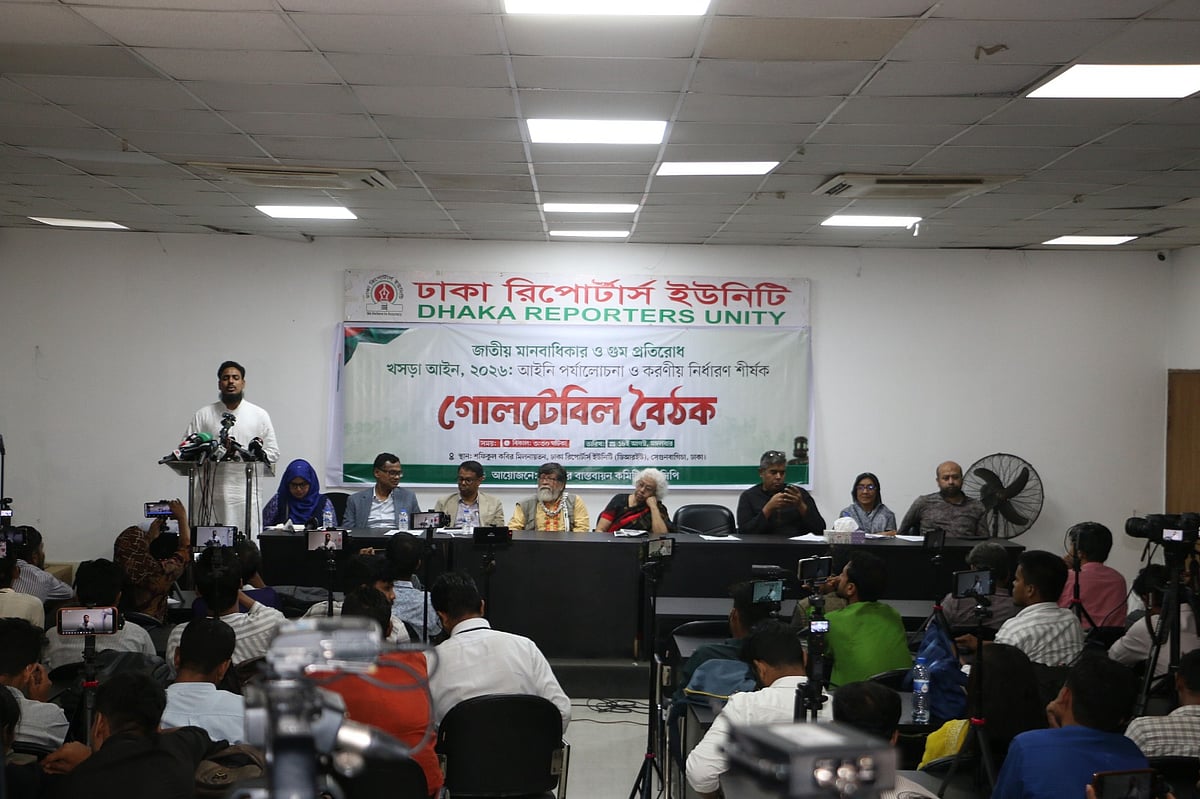
Photo Collected
DHAKA — Civil society members and political activists have criticized the government’s proposed legislation on human rights protection and the prevention of enforced disappearances, arguing that the draft law undermines independent oversight and threatens to entrench a culture of impunity.
The criticism emerged during a roundtable discussion titled “National Human Rights Commission and Enforced Disappearance Prevention Draft Act, 2026: Legal Review and Way Forward,” hosted by the Reform Implementation Committee of the National Citizen Party (NCP) at the Dhaka Reporters Unity auditorium on Tuesday.
Speakers at the event contended that the proposed law limits the National Human Rights Commission’s authority to conduct independent investigations. Furthermore, they expressed concern that entrusting the investigation of disappearance allegations to law enforcement agencies creates a conflict of interest, as these same agencies are often the subjects of such accusations.
Akhtar Hossain, member secretary of the NCP and a Member of Parliament, argued that while the government claims the new law aims to strengthen protections, it effectively restricts the Commission’s independence. He specifically criticized a provision that mandates a five-year prison sentence for those filing “false” complaints, warning that such a measure could be used to intimidate victim families.
Renowned photographer and rights activist Shahidul Alam emphasized that the current government must fulfill the public aspirations for systemic change that emerged following the July mass uprising. He called for the complete decoupling of state security forces from the oversight process and urged the government to ensure that the Commission remains free from political influence.
Asaduzzaman Fuad, general secretary of the Amar Bangladesh Party (AB Party), called for a decentralization of power and comprehensive institutional reform. He stated that mere changes in political leadership are insufficient without structural transformations, including the establishment of an independent police commission.
Sarwar Tushar, deputy head of the NCP’s Reform Implementation Committee, echoed these concerns, noting that assigning police to investigate disappearances is inherently flawed given their potential involvement in such crimes. Fahim Mashrur, convener of the Referendum Implementation Citizen Forum, added that the process of selecting commission members must be based on a broad consensus among political parties to ensure the body’s neutrality.
Nabila Idris, a former member of the National Human Rights Commission, presented the keynote paper, detailing how the draft legal framework restricts independent investigations into security forces. She advocated for the creation of specialized legal and security protocols for sensitive operations that do not compromise investigative integrity.
The roundtable, moderated by NCP central organizer Arman Hussain, also featured contributions from political scientist Professor Dilara Chowdhury, Supreme Court lawyer and former Judicial Reform Commission member Tanim Hossain Shawon, and former Constitutional Reform Commission member Sharif Bhuiyan. The speakers collectively urged the government to revise the draft to ensure full accountability and the autonomy of state institutions before the law is enacted.
0%
0%
0%
0%
More News from Local