Barisal artisan preserves fading tradition of crafting clay vessels for Mansa Puja
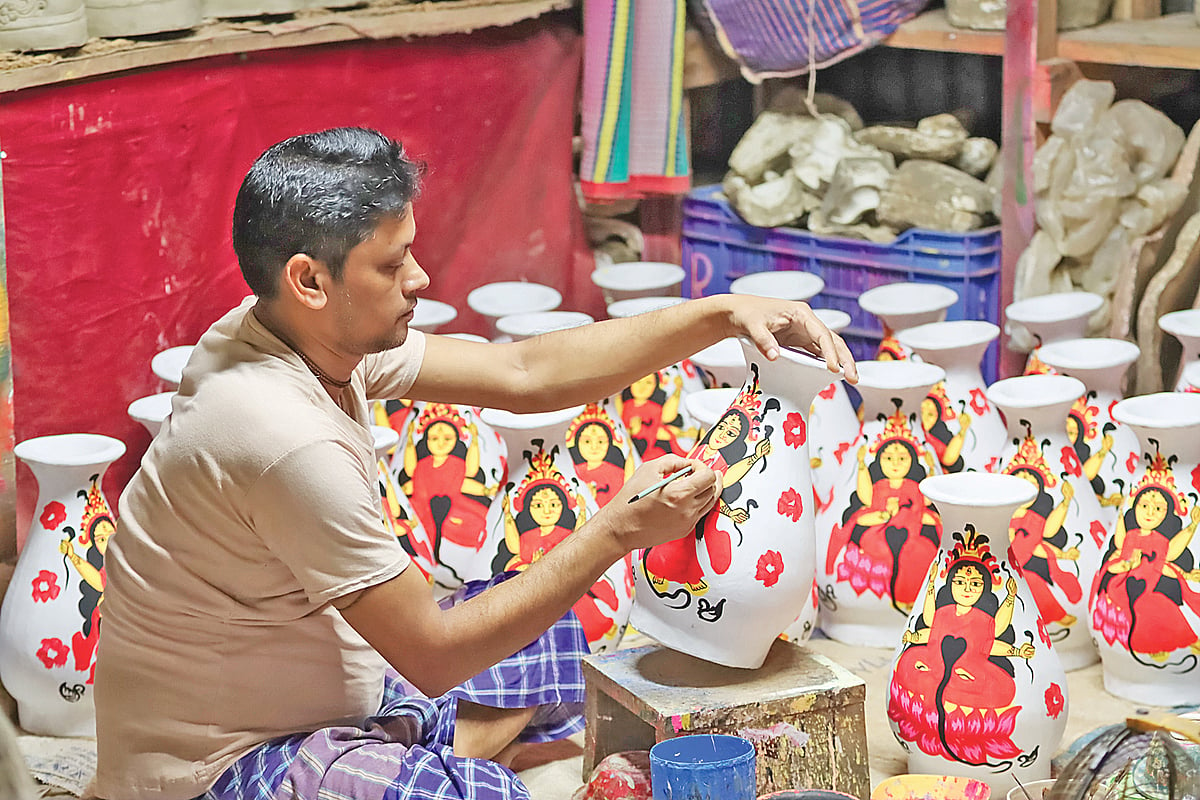
Photo Collected
As the monsoon season reaches its peak in Barishal, traditional potter Samir Pal is racing to complete a final batch of handcrafted clay pots, known as Mansaghat, in his small workshop in the Kalsakathi Palpara region of Bakerganj. With the festival of Mansa Puja approaching, Pal remains the sole artisan in a village that was once a thriving hub for this traditional craft.
Working under the dim light of a single bulb, Pal meticulously paints the visage of the serpent goddess Mansa, detailing her dark hair, crimson sari, and the iconic cobra hood rising above her head. These pots are essential ritual objects for the upcoming puja, held to invoke protection from snakes, ensure family prosperity, and pray for fertility during the rain-heavy month of Shravan.
The decline of the craft is evident in the quiet streets of Kalsakathi. While local records indicate that nearly 20 families of potters once resided in the area, only Pal continues to produce these specialized ritual vessels. The 35-year-old artisan learned the trade from his late father, Narayan Chandra Pal, and took over the family workshop nearly 15 years ago after completing his higher secondary education. He now sustains his mother, wife, and young daughter through this fading heritage.
The significance of Mansa Puja in this region is deeply intertwined with the Mansamangal Kavya, a legendary epic chronicling the conflict between the merchant Chand Sadagar and the goddess Mansa, and the tragic tale of Behula and Lakhinder. This lore serves as a cornerstone of local folk culture, music, and theater. The connection is further cemented in the Barishal region by the historic Mansa Temple in the Gaila area of Agailjhara, associated with the medieval poet Bijoy Gupta.
Sushanta Ghosh, an organizer with Barishal Charukala who documents regional pottery, noted that the Barishal-style Mansaghat is distinct in its design, blending artistic structure with deeply held concepts of sanctity and fertility. He emphasized that these objects are more than mere commodities; they are vessels of local faith and cultural identity.
Despite the cultural weight of his work, Pal faces a difficult economic reality. He is producing approximately 150 pots for the current season, which retail for 300 to 350 taka each against production costs of 100 to 150 taka. Pal acknowledges that demand has dwindled significantly, making it increasingly difficult to earn a living solely from his craft.
While the pots he creates will eventually disappear into private homes to serve their ritual purpose, the future of the tradition itself remains uncertain. As the last artisan in his community, Pal’s struggle to maintain his ancestral vocation highlights the broader challenge of preserving intangible cultural heritage in a changing economy.
0%
0%
0%
0%