

Experts Call for Decolonizing Bureaucracy from Political Influence to Ensure Governance Reform
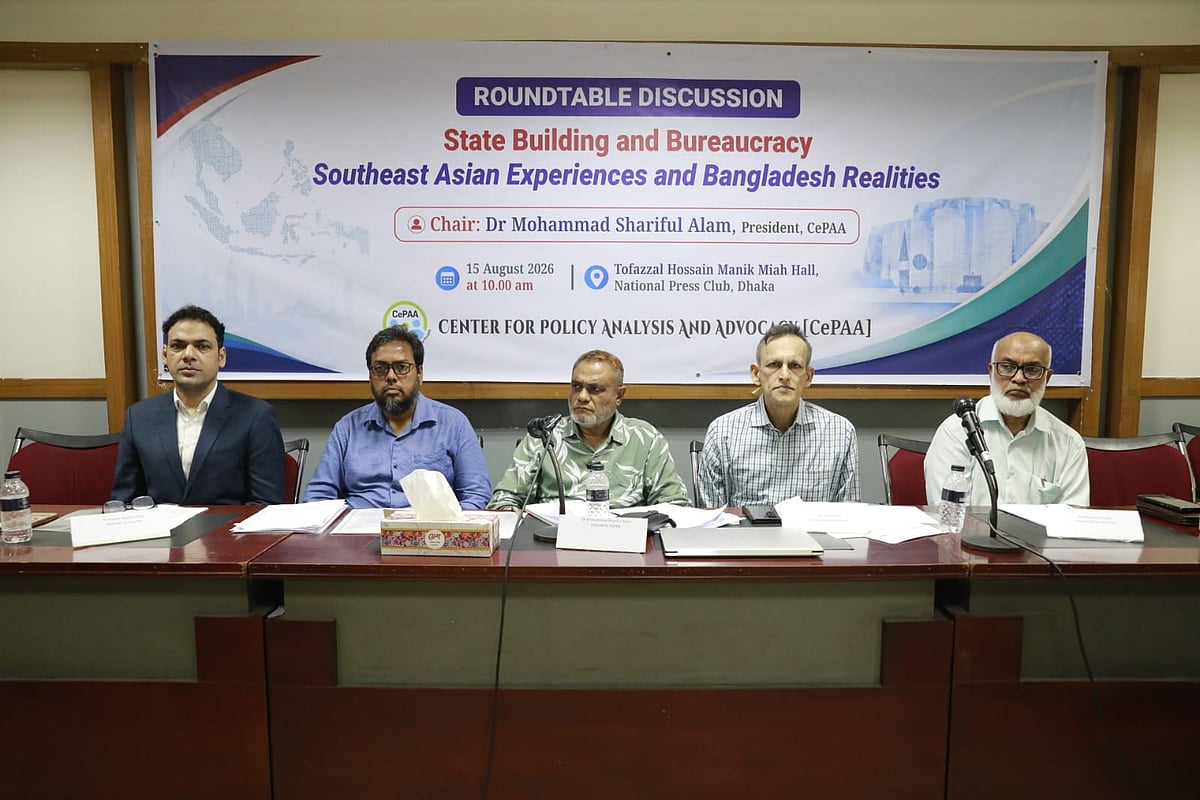
Photo Collected
Speakers at a roundtable discussion in Dhaka have urged for the de-politicization of the national bureaucracy, arguing that systemic political interference has undermined administrative efficiency and accountability in the decades following independence.
The event, titled “State Building and Bureaucracy: Southeast Asian Experience and Bangladesh’s Reality,” was organized by the Center for Policy Analysis and Advocacy at the National Press Club on Saturday. Participants, including former bureaucrats and academics, asserted that the country’s administrative structure has frequently acted as an enabler of political misconduct.
Professor Shafiul Islam of the Department of Public Administration at the University of Rajshahi presented a keynote paper written by governance researcher Yusuf Zarif. The report highlighted that state institutions have been systematically degraded over the past 50 years, with corruption and a lack of accountability becoming institutionalized. While noting that a modern state cannot function without a robust bureaucracy, speakers warned that an unprofessional, politicized civil service inevitably leads to governance failures.
The keynote address particularly criticized the period of authoritarian rule between 2009 and July 2024, while also scrutinizing the performance of the current interim government. The report stated that although the interim government pledged to undertake state reforms, it has struggled to achieve significant structural changes. Despite the formation of a public administration commission, critics noted that many high-ranking positions, including secretary-level appointments, remain driven by political favoritism rather than merit. The practice of relegating talented officers to the Ministry of Public Administration without clear justification was cited as evidence that the current administration continues to prioritize political considerations over professional efficacy.
To restore institutional integrity, panelists emphasized the need to dismantle the current political influence within the civil service. A primary recommendation offered during the session was the immediate removal of intelligence reports and police verification requirements from the processes of recruitment, posting, and promotion. Experts argued that eliminating these intelligence-based gatekeeping mechanisms is essential to curbing the politicization of the bureaucracy.
During the discussion, former secretary Aleya Akhtar noted that deliberate efforts have historically been made to prevent the bureaucracy from functioning within a stable institutional framework. Emeritus Professor Shahjahan Khan of the University of Southern Queensland, Australia, argued that mere reform is insufficient, calling instead for a complete reconstruction of the bureaucratic system.
The roundtable was chaired by former bureaucrat and Center for Policy Analysis and Advocacy President Mohammad Shariful Alam. Other notable attendees included former bureaucrats Mohammad Abdul Kaiyum and KM Kabirul Islam, former diplomat Sakib Ali, and Dhaka University Professor Md. Shariful Islam.
0%
0%
0%
0%
More News from Local