
Indigenous groups reject cabinet ministers comments on tribal identity and demand constitutional recognition
Photo Collected
A coalition of 25 indigenous student, youth, women’s, and cultural organizations has formally protested recent remarks made by Home Minister Salahuddin Ahmed and Information Minister Zahir Uddin Swapan regarding the status of indigenous communities in Bangladesh. In a joint statement, the groups labeled the ministers’ comments as offensive, ahistorical, and detached from reality, while reiterating a four-point demand for constitutional recognition and the protection of land and resource rights.
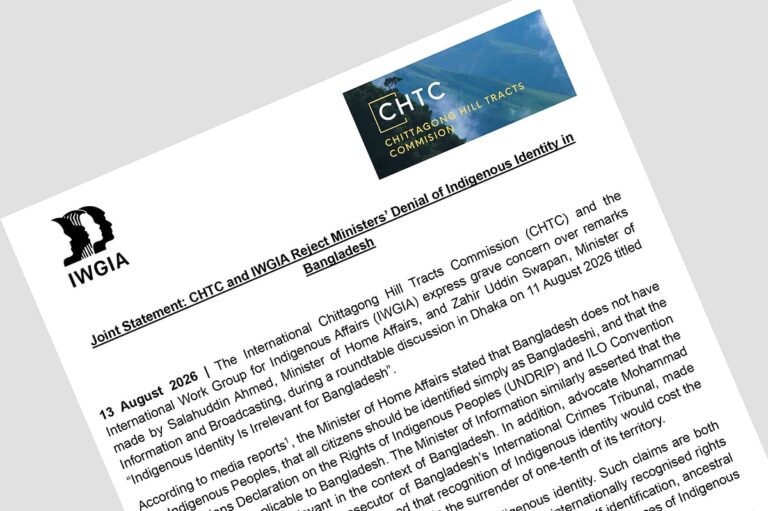
The controversy stems from a roundtable discussion titled “Indigenous Identity is Irrelevant for Bangladesh,” organized by the Chittagong Hill Tracts Research Foundation (CHTRF) in Dhaka last Tuesday. During the event, Home Minister Salahuddin Ahmed asserted that all inhabitants of Bangladesh are simply Bangladeshi citizens, arguing that no indigenous groups exist within the country’s geographical and constitutional framework. Information Minister Zahir Uddin Swapan echoed this sentiment, stating that the term “indigenous” is irrelevant in the context of Bangladesh.
The protesting organizations firmly rejected these claims, emphasizing that Bangladesh is a multi-ethnic, multi-lingual, and multicultural nation. They noted that alongside the majority Bengali population, more than 50 distinct indigenous groups have long resided in various regions, maintaining their own unique languages, traditions, and cultural heritage. The coalition criticized the ministers for ignoring the historical role of indigenous peoples in the 1971 Liberation War and subsequent democratic movements.
Furthermore, the statement addressed Minister Ahmed’s comments regarding state support for marginalized groups, arguing that his dismissal of indigenous identity contradicts the “Rainbow Nation” pledge outlined in the Bangladesh Nationalist Party’s (BNP) 31-point policy. The organizations called on the government to abandon its “unilateral perspective” and “security-focused lens” when assessing the identities of indigenous communities.
The coalition demanded that the state formally recognize indigenous peoples in the constitution, ensure their rights to land and natural resources, protect their cultural heritage, and fully implement the 2007 United Nations Declaration on the Rights of Indigenous Peoples.
The 25 signatory organizations include the Bangladesh Marma Students Council, Tripura Student Forum Bangladesh, Bangladesh Tanchangya Students Welfare Forum, Bawm Students Association, Bangladesh Mro Students Association, Bangladesh Khumi Students Association, Bangladesh Khiang Students Union, Bangladesh Garo Chhatra Sangathan (BAGACHAS), Bangladesh Garo Student Federation, Bangladesh Hajong Chhatra Sangathan, Bangladesh Mahato Adivasi Chhatra Sangathan, Hajong Student Council, Bangladesh Garo Student Union, Khasia Student Union, Hill Women’s Federation, Hill Students Council, Bangladesh Indigenous Students Struggle Council, Bangladesh Indigenous Youth Forum, Bangladesh Indigenous Women’s Network, Dhaka University Jum Literature and Cultural Council, ARFI, Jahangirnagar University Jum Students Family, Indigenous Students Union, Jagannath University Indigenous Students Association, and the Association of Indigenous Students.
0%
0%
0%
0%
More News from Local