
International Organizations Urge Ministers to Retract Statements Denying Indigenous Identity in Bangladesh
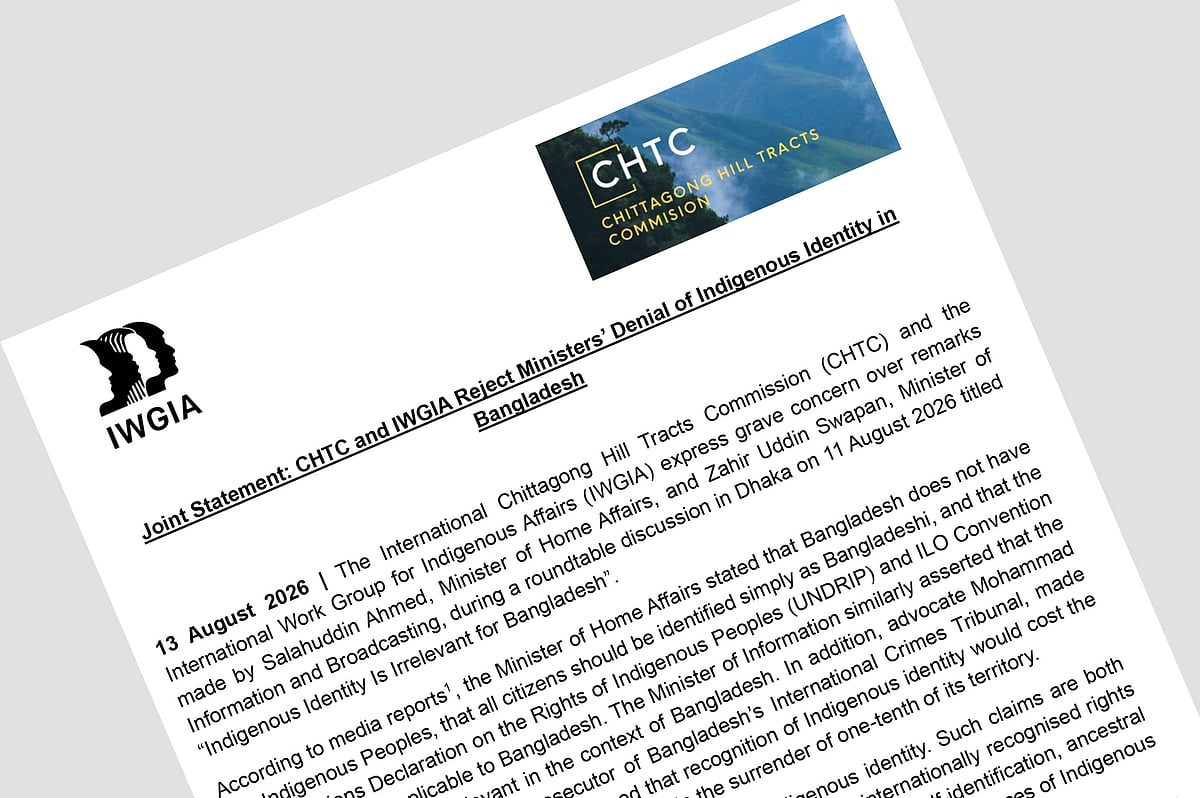
Photo Collected
Two international advocacy groups have demanded that Bangladesh’s Home Minister, Salahuddin Ahmed, and Information and Broadcasting Minister, Zahir Uddin Swapan, retract or clarify recent statements denying the existence and identity of indigenous populations in the country.
The International Chittagong Hill Tracts Commission (CHTC) and the International Work Group for Indigenous Affairs (IWGIA) issued a joint statement on Thursday, following comments made by the ministers at a roundtable discussion in Dhaka on August 11. The event, titled “Indigenous Identity is Irrelevant for Bangladesh,” was organized by the Chittagong Hill Tracts Research Foundation (CHRF).
According to reports cited in the statement, Home Minister Salahuddin Ahmed claimed that there are no indigenous groups in Bangladesh and suggested that all citizens should identify solely as Bangladeshi. Information and Broadcasting Minister Zahir Uddin Swapan similarly argued that the use of the term “indigenous” is irrelevant within the national context.
The CHTC and IWGIA rejected these assertions, stating that indigenous identity and Bangladeshi citizenship are not mutually exclusive. The organizations emphasized that the recognition of indigenous identity poses no threat to national unity, sovereignty, security, or territorial integrity.
The statement further noted that while Bangladesh has not ratified the ILO Convention 169, it is a signatory to the 1957 ILO Convention 107 concerning Indigenous and Tribal Populations. Consequently, the government maintains a legal obligation to protect the rights, cultures, and traditional lands of these communities.
The groups argued that denying indigenous identity contradicts Bangladesh’s constitution and legal framework. They pointed to Article 23A of the constitution, which acknowledges the existence of communities with distinct cultures and traditions, as well as various national policies that reference indigenous populations.
The joint statement also underscored the significance of the 1997 Chittagong Hill Tracts Peace Accord, which recognized the region as a unique area inhabited by tribal populations. The organizations warned that continued denial of indigenous identity undermines the spirit of the peace accord and erodes trust in the ongoing peace process.
Concluding the statement, the organizations called for a dialogue with indigenous representatives, the fulfillment of international commitments, and the establishment of a time-bound roadmap to fully implement the Chittagong Hill Tracts Accord. They maintained that recognizing indigenous communities would not divide the nation, but warned that persistent denial, discrimination, and suppression remain the true drivers of social division.
0%
0%
0%
0%
More News from Local