US Delegation Walks Out as Iranian President Defies Washington at UN General Assembly
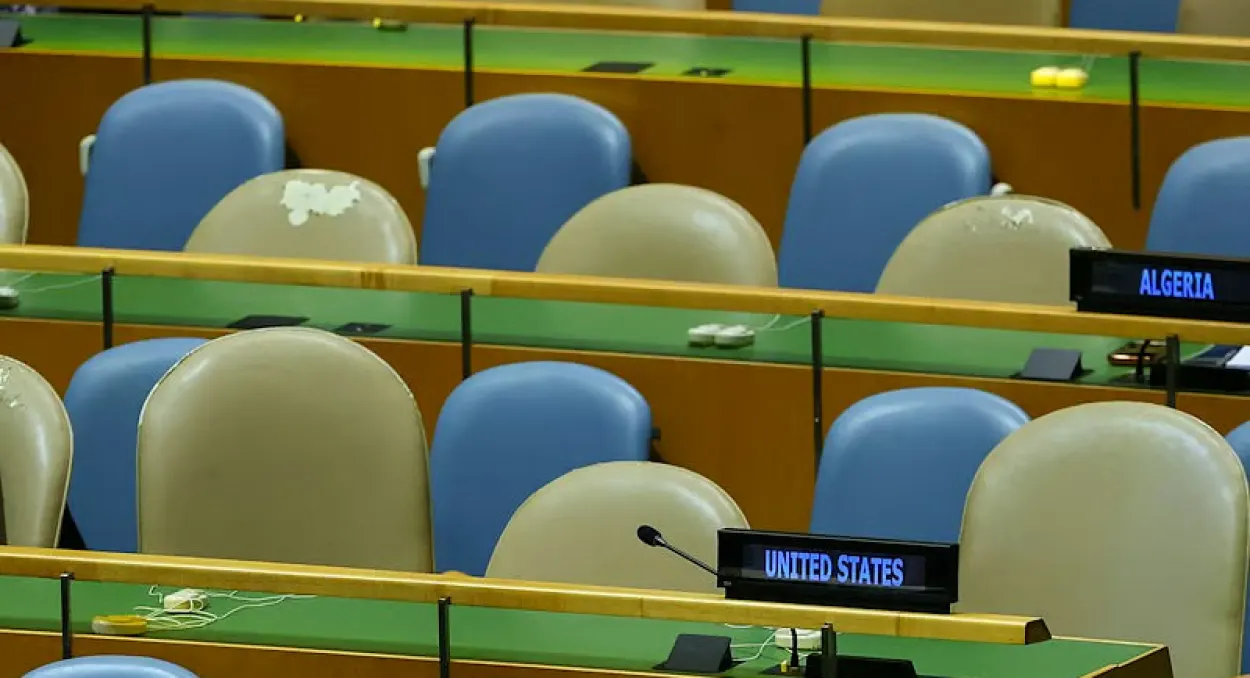
Photo: Collected
The United States delegation walked out of the United Nations General Assembly hall as Iran's President Masoud Pezeshkian took the podium to deliver his address on Wednesday during the second day of the 81st annual session. The diplomatic snub mirrors an incident from the previous day, when all but one Iranian delegate walked out during the opening address by United States President Donald Trump.
Addressing the international assembly, President Pezeshkian declared that Iran will not surrender to the United States in the ongoing conflict, though he maintained that Tehran believes in diplomacy to end hostilities.
Tensions between Washington and Tehran have increasingly centered on the strategic Strait of Hormuz, a vital shipping lane through which one-fifth of the world's crude oil and liquefied natural gas was transported prior to the war. The waterway has been rendered virtually inactive since the conflict began.
Criticizing the situation, President Pezeshkian stated that Iran will not accept being barred from navigating the strait while others benefit from it, adding that the permanent presence of hostile naval fleets and the expansion of war will not bring peace.
The walkouts follow an opening address on Tuesday by United States President Donald Trump, in which he threatened to obliterate Iran. President Trump stated that he faces a major decision over whether to pursue a deal allowing Tehran to rebuild into a much stronger nation or to destroy the Islamic Republic. As the United States President raised the subject of Iran during his speech, the Iranian delegation emptied their seats, leaving only a single representative behind.
Turning to the nuclear issue during Wednesday's address, President Pezeshkian asserted that Iran requires peaceful nuclear energy rather than nuclear weapons. When military strikes commenced on February 28, United States President Trump and Israeli Prime Minister Benjamin Netanyahu repeatedly cited the destruction of Iran's nuclear program as a primary objective.
President Pezeshkian countered that peaceful nuclear technology is part of national development, maintaining that Iran finds it unacceptable for nuclear technology to remain the exclusive monopoly of a select few countries.
The stockpile of enriched uranium held by Iran remains a major point of contention in discussions between Washington and Tehran aimed at halting the war. United States President Trump has consistently insisted that Iran must surrender this stockpile. While Iran maintains that its uranium enrichment program is intended for peaceful purposes, Western nations and Israel suspect the program is designed to build the capability to manufacture a nuclear weapon.
At the beginning of his speech, the Iranian President displayed a portrait of the late Supreme Leader Ayatollah Ali Khamenei, who was killed in a compound strike in Tehran on the first day of the United States-Israeli military campaign. President Pezeshkian subsequently displayed photographs of children killed during an airstrike on a school.
Earlier this month, a United Nations fact-finding mission on Iran stated it had reasonable grounds to believe the United States was involved in two military strikes targeting an Iranian school and a sports facility, concluding that the attacks constituted war crimes.
Addressing the remarks made by United States President Trump a day earlier, President Pezeshkian noted that he had originally prepared a different speech, but felt compelled to respond after being labeled as terrorists by the United States President, emphasizing that Iran is instead a victim of terrorism.