Sandwip residents reclaim ancestral land on newly emerged Dobachar as agricultural activity expands
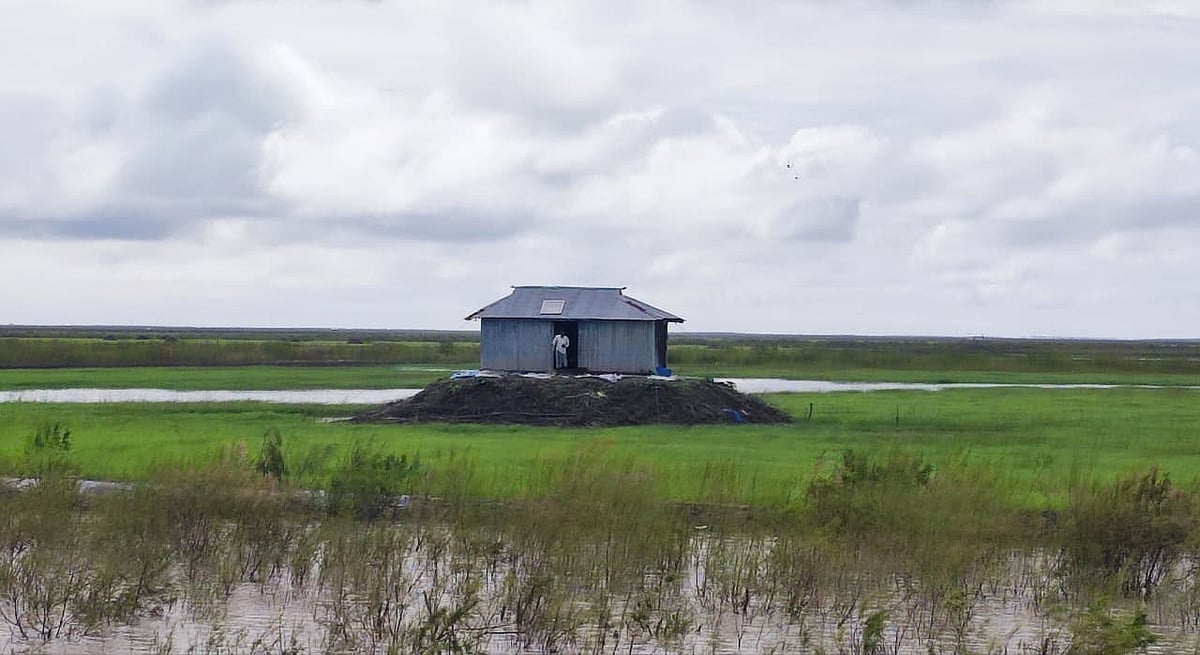
Photo Collected
SANDWIP, Bangladesh — Vast tracts of land off the coast of Sandwip that were swallowed by the Meghna River estuary half a century ago have re-emerged, drawing former residents back to their ancestral homes. The newly surfaced land, locally known as “Dobachar,” now supports Aman paddy cultivation, livestock grazing, and fishing, though the settlers remain vulnerable to natural disasters due to a lack of formal infrastructure.
Dobachar, which spans approximately 13 kilometers north to south and four kilometers east to west, encompasses areas formerly belonging to the now-submerged unions of Hudrakhali, Katgar, Batajora, Rohini, and Izzatpur. The land is part of a larger emerging landscape situated near the Swarnadwip island, located roughly 2.5 kilometers from the Subarnachar Upazila of Noakhali.
While the region was once uninhabitable, it has seen a surge in human activity over the past year. At least 15 families have constructed permanent dwellings on the silt, while others have demarcated their ancestral property for sharecropping or erected temporary shelters made of bamboo and jute.
For many, the return is deeply personal. Fifty-year-old Nur Uddin, who lost his family home as a child, returned to the land in March 2024. “At 50, I have returned to the land of my ancestors and the place of my birth,” Uddin said. Similarly, 96-year-old Bashir Ullah, who has relocated 11 times throughout his life, pointed to a patch of land on the emerging char, identifying it as his birthplace. Despite his desire to return, recurring trauma from the 1991 cyclone, which claimed two of his sons, and his advanced age keep him in the safer Kalapania union.
The economic viability of the land is growing. Local farmer Jamal Uddin noted that the soil quality is increasingly favorable for agriculture, with approximately 3,500 hectares of land currently under Aman rice cultivation. Residents are supplementing their income through fishing and poultry farming, while herds of cattle and buffalo graze on the southern plains of the char. To facilitate trade, small shops have been established at Char-Lakshmi Ghat, serving the growing population of farmers and laborers.
Despite the renewed activity, the settlers face significant challenges. The area remains largely unprotected against storm surges and tidal flooding. Essential services such as healthcare, formal education, and emergency safety infrastructure are currently nonexistent on the char.
Sandwip Executive Officer Amjad Hossain stated that his office was previously unaware of the extent of the settlements on Dobachar. He emphasized that residents should exercise caution given the environmental risks and noted that the administration would evaluate potential government initiatives to mitigate disaster threats for those living in the area.
For settlers like 53-year-old Helal Uddin, who lost his property in 1972, the return to the land is a matter of resilience. “The same sea that took everything is now giving it back with both hands,” he said. “I choose to trust the sea.”
0%
0%
0%
0%