
Mysterious Blast Shakes Riyadh Near Airport As US Extends Iran Sanctions For Five Years
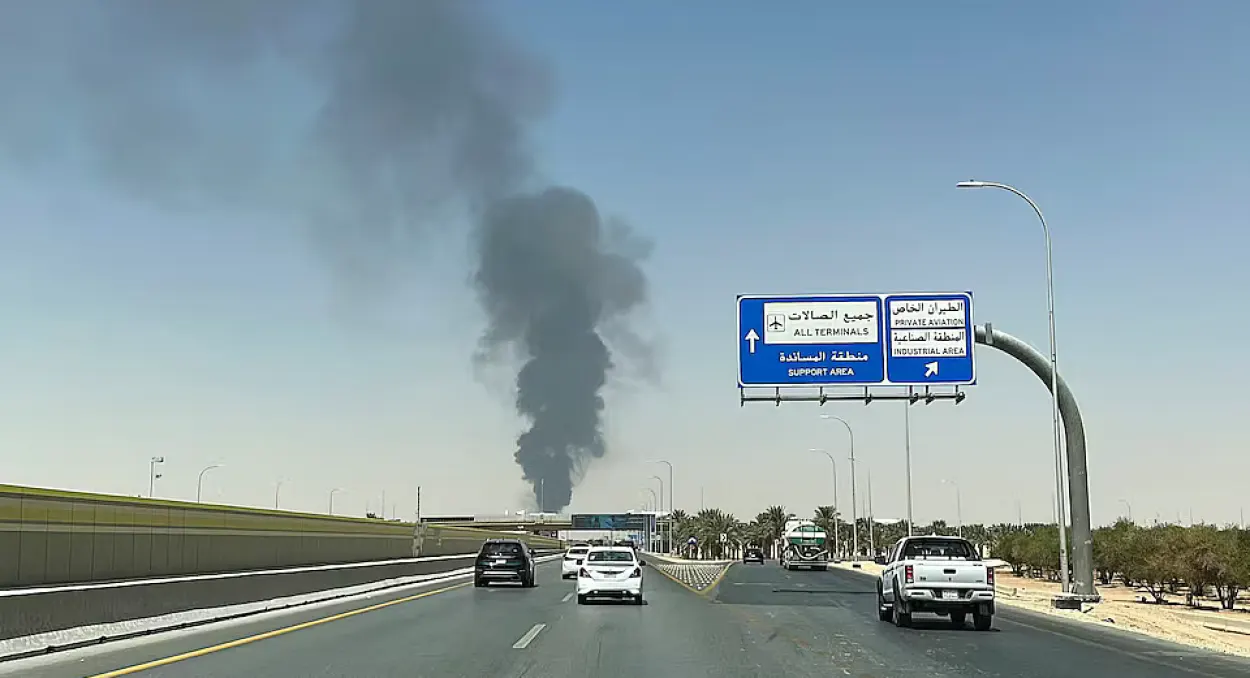
Photo: Collected
A loud explosion followed by a massive plume of smoke and fire was observed near the main airport in the Saudi Arabian capital of Riyadh early Saturday morning. The incident occurred following air raid alerts issued for Riyadh and surrounding regions after midnight on Friday, amid escalating attacks by Houthi rebels targeting Saudi energy infrastructure and military installations.
While no group immediately claimed responsibility for the Riyadh blast and Saudi authorities had not commented by late Saturday, local residents reported hearing explosion sounds and seeing flames and black smoke near the airport after the alerts were lifted. Flight tracking website Flightradar24 noted that several flights at Riyadh's King Khalid International Airport were cancelled or delayed. Saudi authorities had earlier sent mobile alerts to residents in Riyadh and the eastern city of Al-Kharj just before 3:00 AM local time on Friday, warning of potential aerial attacks and advising people to stay indoors before lifting the warning about half an hour later.
The heightened security environment coincides with intensifying conflict in Yemen, where a new wave of clashes erupted in July after the Iran-backed Houthi movement imposed restrictions on Saudi shipping through the Bab el-Mandeb strait connecting the Red Sea and the Gulf of Aden. Following attacks on Saudi vessels and drone and missile launches toward the Saudi mainland, clashes escalated between the Houthis and the Saudi-backed Yemeni government forces. The Houthis seized control of nearly the entire Red Sea coast of Yemen, capturing the strategic Mocha port city and Mayun Island in the Bab el-Mandeb strait, and launched campaigns to take Taiz and Marib. The Saudi air force has been conducting airstrikes in support of government forces.
Yasmin Al-Eryani, an official at the Sanaa Center think tank, told Al Jazeera that tensions have escalated over the past several months through the conflict between Saudi Arabia, the Saudi-backed Yemeni government, and the Houthis, with the latter largely dictating the trajectory of the conflict. Meanwhile, maritime tracking firm Kpler reported that Saudi oil exports through the Bab el-Mandeb strait have declined since July, though five Saudi oil tankers managed to navigate the route over the past week.
In geopolitical developments, US President Donald Trump signed legislation on Friday extending existing US sanctions against Iran for another five years until 2031. Tehran has described Washington's move as economic terrorism. The White House stated that Trump signed House Resolution 5334, titled the Lindsay O. Graham Sanctioning Russia and Iran Act of 2026. The new law extends the 1996 Iran Sanctions Act, which was set to expire this year, allowing the US to continue taking measures against foreign nationals and entities linked to Iran's energy sector through 2031, while also providing a framework to extend sanctions and tariffs against Russia.
Despite the renewed sanctions, US Central Command posted on social media platform X that crude oil, cargo, and liquefied natural gas shipments through the Strait of Hormuz reached a six-month high over the past two weeks.
Addressing regional security, Iranian Foreign Minister Abbas Araghchi stated during a virtual address at the Global Town Hall 2026 event in Indonesia that sustainable security in the Middle East should not be imposed by external parties, emphasizing that lasting stability can only be established through dialogue, mutual trust, cooperation, and respect. Araghchi also discussed regional developments over the phone with Pakistani Foreign Minister Ishaq Dar, who underscored the importance of dialogue and diplomacy in ensuring regional peace and stability. Meanwhile, Iran's Ministry of Interior stated that diplomatic efforts and international mediation are underway regarding a return to memoranda of understanding.