
Study reveals poor release protocols turn Lawachara National Park into death trap for rescued slow lorises
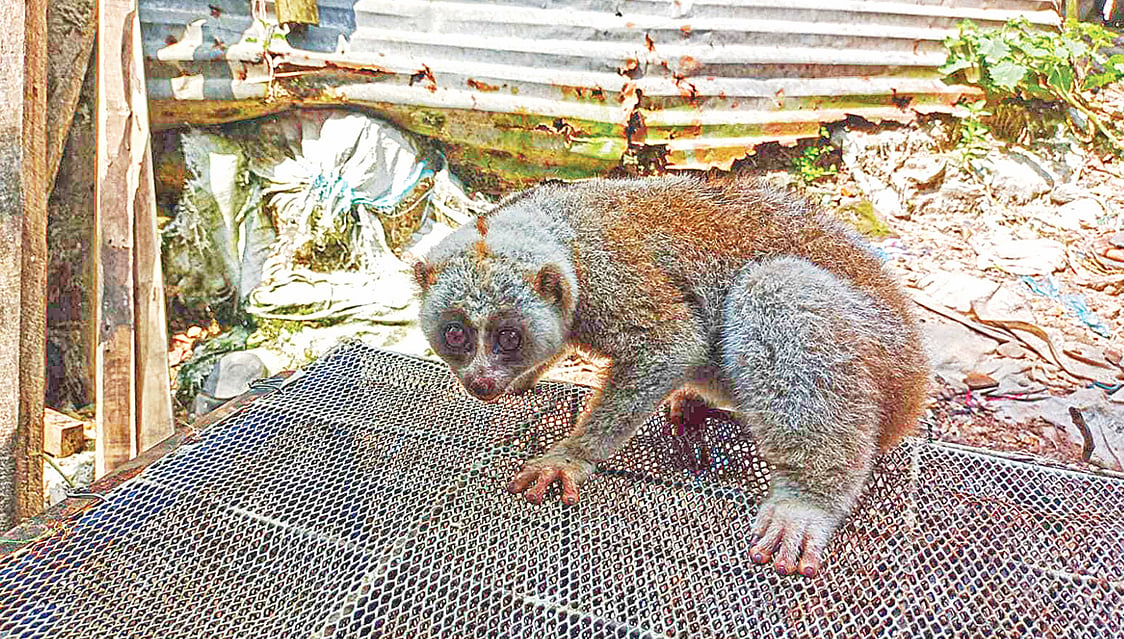
Photo Collected
A recent study on Bengal slow lorises released into Lawachara National Park has revealed that poor release strategies may be turning protected forests into death traps for rescued wildlife. According to the research, only two out of nine rescued lorises survived longer than six months after being reintroduced into the wild.
The findings, published this year in the international journal Global Ecology and Conservation, were led by Bangladeshi researcher Hasan Al-Razi, in collaboration with a team of 10 researchers from Bangladesh, Germany, Australia, and the United Kingdom, alongside the Forest Department.
The study tracked nine slow lorises released between July 2022 and September 2023. Researchers equipped each animal with a radio collar, monitoring their movements and behavior for a total of 138 nights over eight months. The results showed that three animals died within 10 days of release, and four others perished within a month. While two animals, named Darwin and Nishat, survived beyond six months, another, named Anu, died after 179 days following a territorial conflict.
Physical examinations of the carcasses revealed that at least four of the seven deceased animals bore signs of fatal attacks on their heads, faces, or digits, likely inflicted by other members of the same species. While the remaining three could not be autopsied due to decomposition, the high mortality rate highlights significant concerns regarding territorial competition.
Experts note that slow lorises, despite their docile appearance, are highly territorial. Dhaka University Zoology Professor Mohammad Firoz Zaman emphasized that releasing animals without adhering to specific protocols often leads to failure. He noted that the concentration of animals in areas like Jankichhara—where 19 lorises were released between July 2020 and March 2023—likely exacerbated competition for food and space.
The researchers observed that the animals that died displayed higher levels of alertness and aggression, which they believe were symptoms of chronic stress and an inability to adapt to the new environment. Hasan Al-Razi argued that wildlife rescue efforts have often become performative, lacking the necessary scientific rigor to ensure long-term survival.
The study recommends a shift in policy, urging authorities to conduct comprehensive surveys of animal density, food availability, and territorial usage before choosing release sites. Experts, including Jagannath University Professor Habibun Nahar, suggested the use of semi-natural enclosures for observation before full release, a practice currently absent in the country.
Md. Sanaullah Patwary, Conservator of Forests for the Wildlife and Nature Conservation Circle, acknowledged the deficiencies in current practices, citing a lack of manpower and resources. Meanwhile, officials like Deputy Chief Conservator of Forests Md. Zahidul Kabir stated that the research findings would serve as a vital guide for future wildlife conservation and rehabilitation efforts.
Ultimately, the researchers stressed that the success of a rescue mission should not be defined by the moment of release, but by the animal’s ability to thrive in its natural habitat.
0%
0%
0%
0%