
High Court Questions Legality of Barring Unaccompanied Women From Travelling Abroad
High Court issues a rule questioning the legality of barring adult women from traveling abroad without guardians or based on marital status
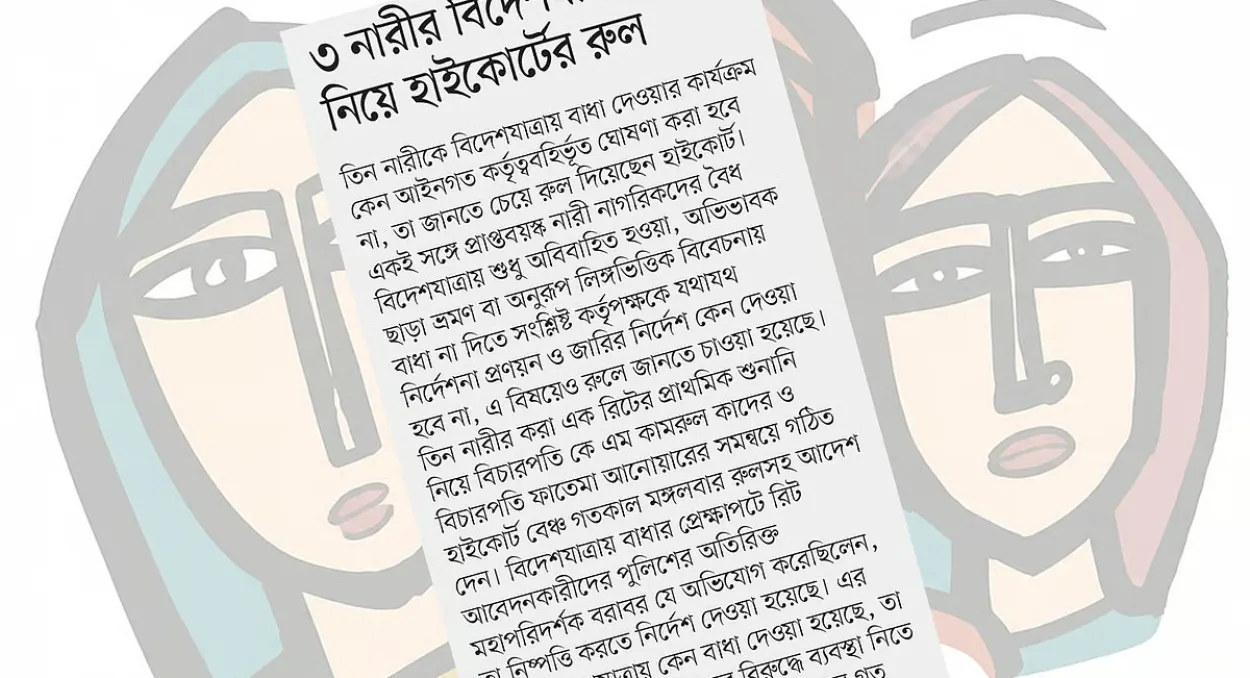
The High Court has issued a ruling questioning the legality of barring three adult women from traveling abroad despite possessing valid travel documents, bringing long-standing concerns regarding gender-based travel restrictions to the forefront of national discourse.
The legal challenge follows an incident on August 8, when three unmarried young women hailing from Dinajpur, Thakurgaon, and Naogaon arrived at Hazrat Shahjalal International Airport at 9:00 AM for a 10:05 AM flight to Nepal. Armed with valid passports, tickets, and necessary documentation, the trio was nonetheless denied exit clearance by the officer-in-charge (OC) of immigration police, identified as Abdullah, without any written notice or formal legal justification.
Following a primary hearing on a writ petition filed by the affected travelers, the High Court issued its rule on September 29, demanding to know why the action preventing the women from traveling should not be declared illegal and contrary to legal authority. Furthermore, the court sought an explanation as to why relevant authorities should not be directed to formulate and issue proper guidelines preventing immigration officials from restricting adult female citizens based solely on their marital status, lack of a guardian, or other gender-discriminatory criteria.
Advocate Ishrat Hasan, who represented the petitioners during the court proceedings, argued that the actions of the immigration officials infringe upon fundamental constitutional rights, including equality and non-discrimination guaranteed under Articles 27 and 28, the right to personal liberty and protection of law under Articles 31 and 32, and freedom of movement under Article 36. She noted that a prior legal notice sent to the Additional Inspector General of Police went unanswered, prompting the legal recourse.
The incident has amplified wider grievances shared by numerous female travelers who have historically faced intrusive questioning at immigration counters regarding their marital status, spousal permission, and the presence of male guardians, even when traveling for official workshops, family events, or award-sponsored trips. When contacted via the official mobile phone of the Special Superintendent of Police (Immigration Operations) under the Special Branch, an unidentified official defended the scrutiny by questioning why the women failed to produce hotel bookings or specify the exact seminar they were attending.
Meanwhile, other law enforcement officials, speaking on the condition of anonymity, explained that airport authorities maintain heightened vigilance due to official intelligence warnings indicating that Nepal is increasingly being utilized as a transit route for human trafficking from Bangladesh, compounded by the availability of on-arrival visas in the neighboring country.