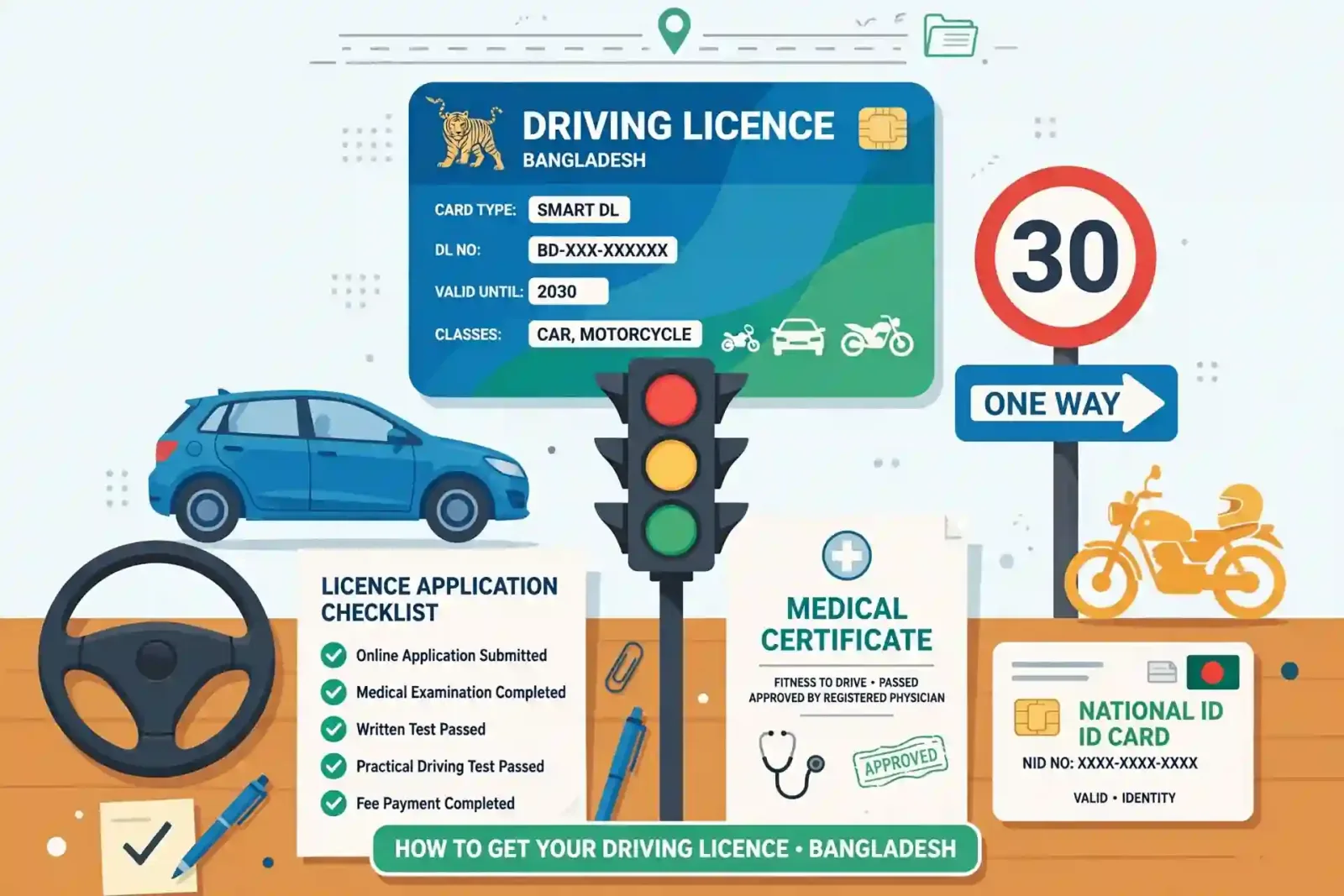
Knowing how to drive is only half the job. To drive legally on public roads, you need a driving licence in Bangladesh issued by the Bangladesh Road Transport Authority, known as BRTA. The process has two stages: first a learner licence, then — after you pass three tests — the full smart card licence. Most of the application now happens online through the BRTA Service Portal, so the days of depending on middlemen at the office gate are largely over.
This guide explains the whole route in order: who is eligible, which documents to prepare, how to apply for the learner licence, what happens in the written, oral and practical tests, how the smart card is issued, and what the fees are. Fees can be revised by government decision, so always confirm the exact amount on the portal's fee calculator before you pay.
Who can apply for a driving licence in Bangladesh
Eligibility is straightforward. You must be at least 18 years old for a non-professional licence, which covers private cars and motorcycles for personal use. Professional licences, which allow you to drive commercial vehicles for a living, start at a higher minimum age, and heavier vehicle classes carry higher age conditions again — check the condition for your exact category on the application form before you start.
You must also have passed at least Class Eight, and you must be physically and mentally fit to drive. Fitness is not self-declared: a registered doctor has to certify it on the prescribed medical form. If your present address is different from the address on your national identity card, keep a utility bill for the present address ready, because the portal asks for it.
The two licence types: non-professional and professional
A non-professional licence is for private vehicles only and is valid for 10 years. A professional licence covers commercial driving and is valid for 5 years. Within each type, you choose the vehicle category or categories you want — for example, motorcycle only, car only, or car and motorcycle together. The learner fee depends on whether you pick one category or two, so decide this before you apply rather than adding a category later, which costs extra.
Professional applicants have one additional requirement: a dope test certificate from an authorised hospital or laboratory, confirming they are free from drug use. The test fee is charged by the hospital and varies from place to place.
Documents to prepare before you apply
Gather these before you open the portal, because the online form asks you to upload scanned copies:
- National identity card (NID), scanned copy
- Medical certificate on the prescribed form, signed by a registered doctor — the form can be downloaded from the portal
- A recent passport-size photograph (the portal specifies a square image, 300 by 300 pixels, within a small file-size limit)
- Educational certificate showing at least Class Eight pass
- Utility bill for your present address, if it differs from your NID address
- A copy of any existing driving licence, if you already hold one
- For professional applicants: the dope test certificate
Scan everything clearly and keep the files within the size limits shown on the form. Blurry uploads are the most common reason applications bounce back.
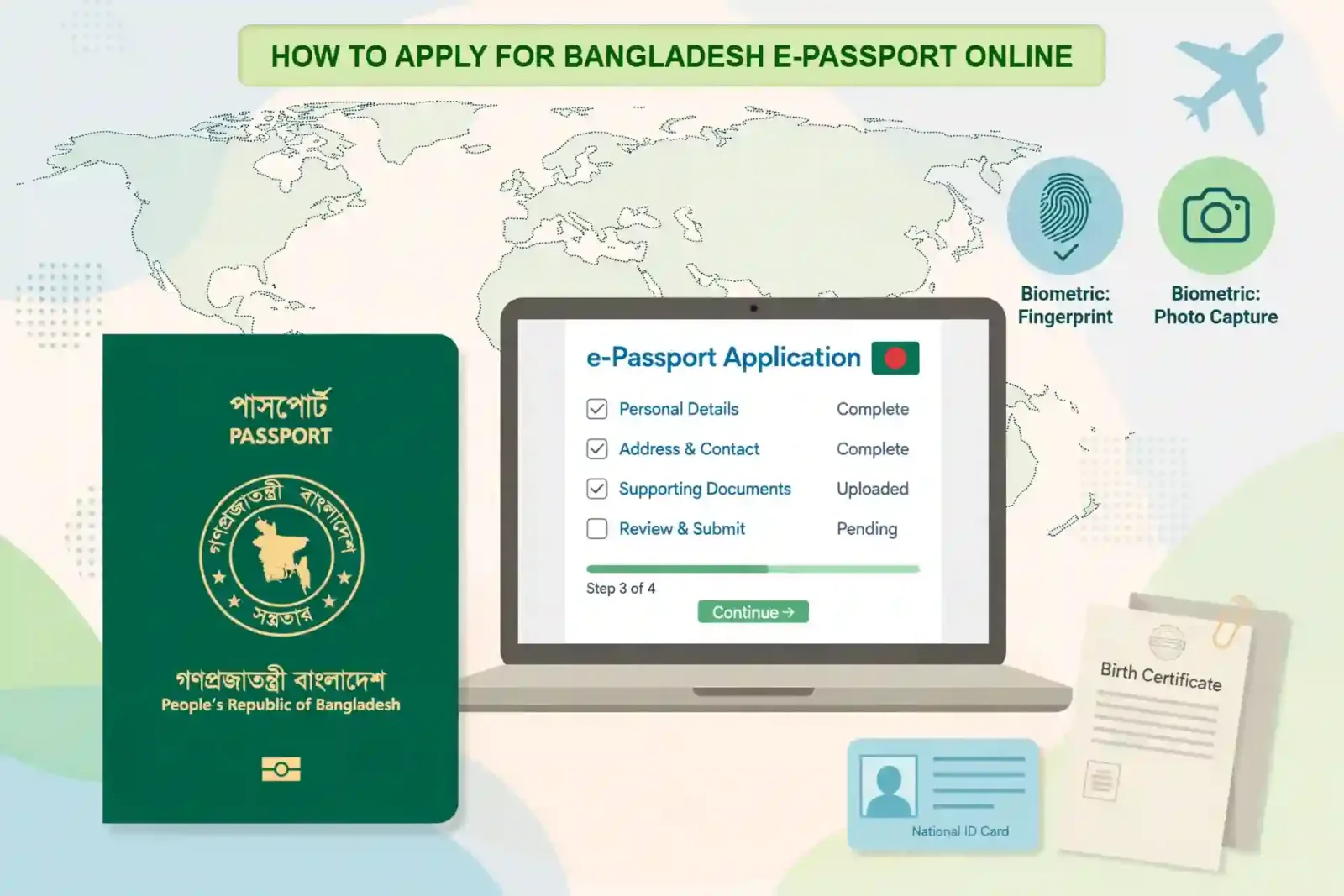
Step 1: Register on the BRTA Service Portal and apply for the learner licence
Every driving licence in Bangladesh now begins on the BRTA Service Portal at bsp.brta.gov.bd. Register as a service recipient using your NID number, date of birth and a mobile number — the mobile number should be the one linked to your NID, because verification messages go to it.
Once logged in, open the driving licence application section and fill in the form carefully in both Bangla and English as prompted. Upload your documents, choose your vehicle category or categories, and select your test venue. Then pay the learner fee online through the portal. The application moves forward only after payment, and once it is accepted you receive your learner licence, which you can download and print.
The learner licence is not a full licence. It allows you to learn and practise under supervision, in restricted areas and on permitted roads, with a licensed guide beside you. Carry it whenever you practise and whenever you attend the test.
Step 2: Practise properly — the learner stage matters
After the learner licence is issued, you get a practice period of roughly two to three months before your test date. Use it well. The practical test is where most candidates fail, usually on slow-speed control: riding or driving in a zigzag between cones, climbing a ramp without stalling, and stopping in a marked box without losing balance.
A driving school is not compulsory, but structured lessons help, especially for the test manoeuvres. Whatever route you choose, practise the exact skills the test measures, and also learn the traffic signs and road rules, because the written test comes first on test day.
Step 3: The three tests — written, oral and practical
On your scheduled date at the test centre, you face three examinations, and you must pass all three:
1. Written test — questions on traffic laws, road signs and basic vehicle knowledge. Candidates generally need to answer at least 12 out of 20 questions correctly to pass.
2. Oral (viva) test — an examiner asks about road rules, signs and safe driving practice.
3. Practical (field) test — you drive or ride through a marked course under observation, including zigzag, ramp and parking manoeuvres.
If you fail any part, follow the re-test instructions given by BRTA for the next slot rather than starting over blindly. Results are also conveyed to the mobile number you gave in the application, and you can check them on the portal dashboard.
Step 4: Apply for the smart card and give your biometrics
Passing the tests does not put a card in your hand by itself. Log in to the portal again and submit the smart card driving licence application, uploading the required documents (the ones from your learner application are largely carried over) and paying the smart card fee online.
You then attend for biometric enrolment: a digital photograph, fingerprints and a digital signature are taken. After enrolment, an interim or temporary licence allows you to drive legally while the card is produced. When printing is complete, BRTA sends an SMS to your registered mobile number, and the smart card is delivered or collected as instructed. Track your application status on the portal instead of visiting the office repeatedly.
Fees for a driving licence in Bangladesh
The commonly published government fees are:
Item: Fee
Learner licence — 1 category: Tk 518
Learner licence — 2 categories: Tk 748
Smart card, non-professional (10 years): Tk 4,557
Smart card, professional (5 years): Tk 2,832
Renewal, non-professional (10 years): Tk 4,212
Renewal, professional (5 years): Tk 2,487
Older fee tables with lower figures still circulate on social media, so treat any screenshot with suspicion. The portal's own fee calculator shows the amount for your exact application — confirm there before paying, and pay only through the portal or its designated channels. Driving school charges, the medical certificate and the dope test (for professional applicants) are separate costs paid to those providers.
Renewal, duplicate and corrections
A non-professional licence runs for 10 years and a professional licence for 5 years. Renewal is applied for through the same portal before expiry, with a fresh medical certificate; renewing late attracts an additional fee for each year of delay, so note your expiry date. If your card is lost or damaged, a duplicate can be issued on application and payment of the prescribed fee. Corrections such as an address change, and adding a vehicle category, are also handled through the portal for a fee.
Common mistakes to avoid
Most delays are self-inflicted. The first is uploading unclear scans or a photograph that ignores the size specification. The second is a mismatch between the name, date of birth or address in the form and the NID — copy details from the card, do not type from memory. The third is registering with a mobile number that is not linked to your NID, which breaks verification. The fourth is skipping practice and assuming the practical test is a formality; it is not. Finally, never hand your NID details and portal password to a middleman to "manage" the application for you — the whole point of the online system is that you can do it yourself, and errors made by someone else become your problem to fix.
Frequently asked questions
Can I apply for a driving licence in Bangladesh fully online? The application, document upload and fee payment are online through the BRTA Service Portal. The tests and biometric enrolment must be attended in person.
What is the minimum age? At least 18 for a non-professional licence. Professional categories require a higher minimum age — confirm your category's condition on the portal form.
How long is the licence valid? Ten years for non-professional, five years for professional.
Can I drive with only a learner licence? Only for learning and practice under supervision and within the permitted conditions. It is not a licence for independent driving.
What happens after I pass the tests? You apply for the smart card on the portal, pay the fee, give your biometrics, and receive the card after printing, with an SMS notification. An interim licence covers you in the meantime.
Getting a driving licence in Bangladesh takes a little patience, but the route is clear: check your eligibility, prepare clean documents, apply for the learner licence on the official portal, practise seriously, pass the three tests, and complete the smart card application. Do it yourself on bsp.brta.gov.bd, pay only the official fees, and the licence you receive will be genuinely yours — earned, legal and valid for years.