

What is the reason for so much rain in the hottest month, why such loss of crops this time?
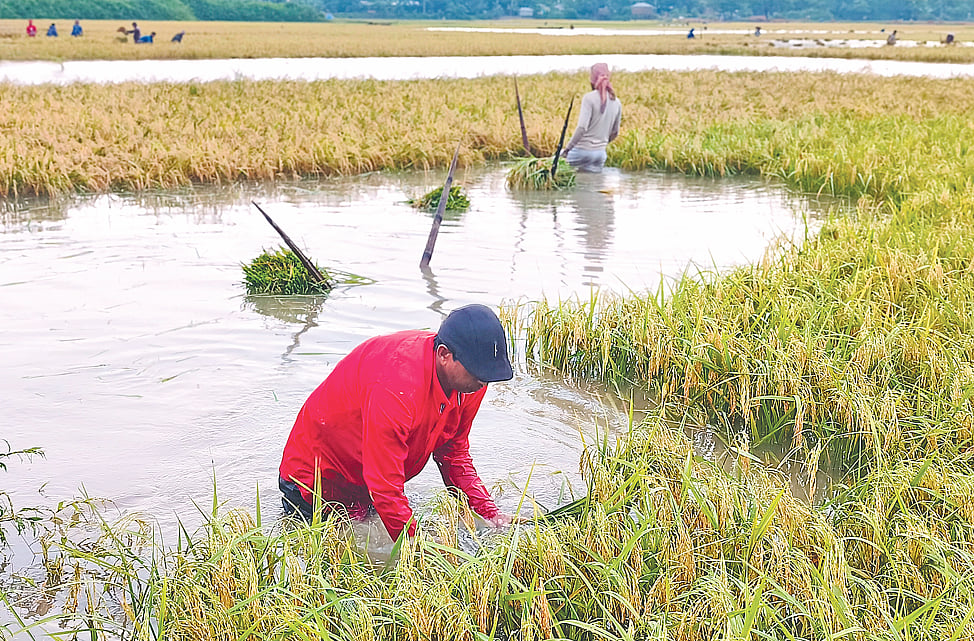
Photo Collected
Crops were destroyed three years ago by the waters of the Haor dam. This time the crops were destroyed due to sudden rain and flooding. Crop damage seems to be intertwined with Rafiqul Islam’s life. His house is in Lakshmipur village of Haor area of Jamalganj upazila of Sunamganj.
Rafiqul, a 50-year-old farmer, was saying, “The paddy of the people who built the dam Bhainga has gone, I have also lost my crops. Now the water of the clouds (rain) appeared inundated (flooding). There is no time before Ella. Now the dam is also broken, the logs are submerged and Haor’s paddy goes.’
Thousands of farmers like Rafiqul in Haor region rely heavily on Boro rice. Haor area is like that. A large part of the farmers live on this one crop in a season. This time the loss of that crop is unlimited. The entire year’s food supply depends on it. Heavy rains at the end of April, floods upstream, overflowing mountain rivers have flooded large areas of Haor. Many farmers were counting the time by ‘Katab Katab’ paddy. At such a time disaster came.
This rain did not stop at only damaging the paddy of Haor districts. Various crops including watermelon, mung bean, almond and sunflower have also been damaged in different parts of the country. The extent of damage has spread to the south, south-east and some northern districts.
Agronomists, meteorologists, hydrologists and climatologists blame the untimely rains in April for this crop damage. According to the information of the Meteorological Department, after 2017, there has not been so much rain in April in the country. April is the hottest month in the country. But no one was prepared for so much rain at this time.
April is the hottest month in the country. The average temperature in this month is 33.2 degrees Celsius. However, this time the maximum and average temperatures in April have remained below normal at 0.6 degrees Celsius and 0.1 degrees Celsius respectively.
At the beginning of the summer season this year, the Meteorological Department had predicted that the heat would not be as intense at least in April. It has been seen that the maximum temperature in Rajshahi was 40 degree Celsius on 22nd April only. In 2024, the entire month of April was a heat wave. In the recently departed April, isolated heat wave remained in different places. But it didn’t last. The heat wave started at the beginning of the month but subsided within two days. Then it started raining in the first week. After the second week, when the heat wave starts again, it lasts for about seven days. It was not everywhere in the country. Maximum 22 districts experienced heat wave. At the end of the month the rains started again. Now three days of this month of May have passed but the traces of that rain remain.
The Meteorological Department has issued a long-term weather forecast for Sunday. It has been said that 75 percent more rain than normal was received in April last month. Except for one Rajshahi division, all the divisions received heavy rains.
The senior meteorologist of the Department of Meteorology. Bajlur Rashid researches rainfall and climate-related data. According to the information given by him, last month’s rainfall was the highest in 9 years. He said, this year there was unusual rain in April. This has affected agriculture. An increase in rainfall during pre-monsoon and post-monsoon is a new trend. The main reason is climate change.
From the field level of the agriculture department, the information of this sudden rain and flood damage has started coming. The field wing of the Department of Agriculture assesses crop damage and advises the government. Director of Wing. Obaidur Rahman Mandal told Prothom Alo yesterday that 4 lakh 55 thousand 153 hectares of land were planted in the seven districts of Haor this season. 71 percent of this has been harvested. And of this land, 46,000 hectares of land has been submerged in water. Haor’s seven districts are Sunamganj, Kishoreganj, Netrakona, Habiganj, Sylhet, Moulvibazar and Brahmanbaria.
However, related persons of various organizations working with farmers in Howar say that the loss of paddy is actually much higher than the estimate given by the agriculture department.
A senior official of the Department of Agriculture Extension, on condition of anonymity, told Prothom Alo that they are being somewhat conservative in assessing the extent of the damage. Because the price of rice is different in each place. Prices of other crops also vary from region to region. It will take time to assess the damage.
According to the calculations of Sunamganj Agriculture Department alone, 18 thousand hectares of land has been damaged by the rain. And earlier, 2 thousand hectares of crops were damaged. Accordingly, at least 500 crores of rupees have been lost.
Eminent Agricultural Economist Prof. Abdus Sattar Mondal said, Haor’s topography has changed. Much of it is man-made. Sometimes roads, homesteads, paving structures etc. have changed due to various reasons. In the current situation, there should be a change in Haor’s traditional agriculture and traditional crop selection. Everyone concerned including researchers, agronomists have to decide how this agriculture and crops will be in the changed conditions. Hao’s economy should emphasize not only agriculture but also non-agricultural sector.
Dams are constructed and renovated every year to protect the haor crops of Sunamganj. Hundreds of crores of rupees are spent on it every year. But this time, none of the dams constructed or renovated by the Water Development Board (Paubo) to protect crops in Howre have broken. However, there was extensive crop damage.
Now the people of Sunamganj from different classes and professions are saying that it has been proved that Haor crops will not be protected by dam alone. Besides the dam, the question of what can be the alternative to protect the Haor crop has now come to the fore. This time the waterlogging, drainage crisis has put the farmers in trouble.
Executive Engineer of Sunamganj Water Development Board. Mamun Hawladar admitted that the bottom of Haor, the rivers and canals have been filled with silt. Again, due to the construction of many structures on these, there has been an obstruction in the drainage. That is why the water could not come down easily.
Barisal division received the highest rainfall in April, which was more than 169 percent. However, the Rajshahi division received slightly less rain than normal. About 80 percent more rain has been received in Dhaka division.
A profitable crop in Patuakhali of Barisal division is mung bean. Mohammad Amanul Islam, deputy director of the district agriculture extension department, told Prothom Alo that 51,000 hectares of mung bean cultivation has been done this year. 6 thousand 300 hectares of land have almonds and more than 3 thousand hectares of land have sunflowers.
Amanul Islam said, due to the sudden rain, the almonds of many farmers have rotted. Mung beans are harvested in several stages from the field. This work has been done since April 20. It has rained continuously since the 26th. According to him, some of the mung pods of all the crop fields have been destroyed.
Barguna representative said, according to the information of the Department of Agricultural Extension, a total of 70 thousand 279 hectares of land in the district have been planted with different types of crops in Rabi season. Out of this 48 thousand 760 hectares of mung dal, 801 hectares of groundnut, 1 thousand 360 hectares of chilli and 594 hectares of sweet potato. 5 thousand 260 hectares of mung dal, 102 hectares of chillies, 57 hectares of sweet potatoes and 122 hectares of ground nuts were destroyed due to heavy rains.
Apart from this, heavy rains have also damaged rice in Khagrachari, Gaibandha and Satkhira Sadar, Kalaroa and Tala upazilas, Prothom Alo representatives said. According to preliminary information from Khagrachari Agriculture Extension Department, about 221 hectares of boro ripe paddy, 63 hectares of vegetables and 548 hectares of orchards have been damaged due to continuous rains.
With the rains in Gaibandha, about 212 hectares of paddy in Kalboishakhi has fallen.
0%
0%
0%
0%