

Two ordinances to appoint ‘at-will’ judges are void
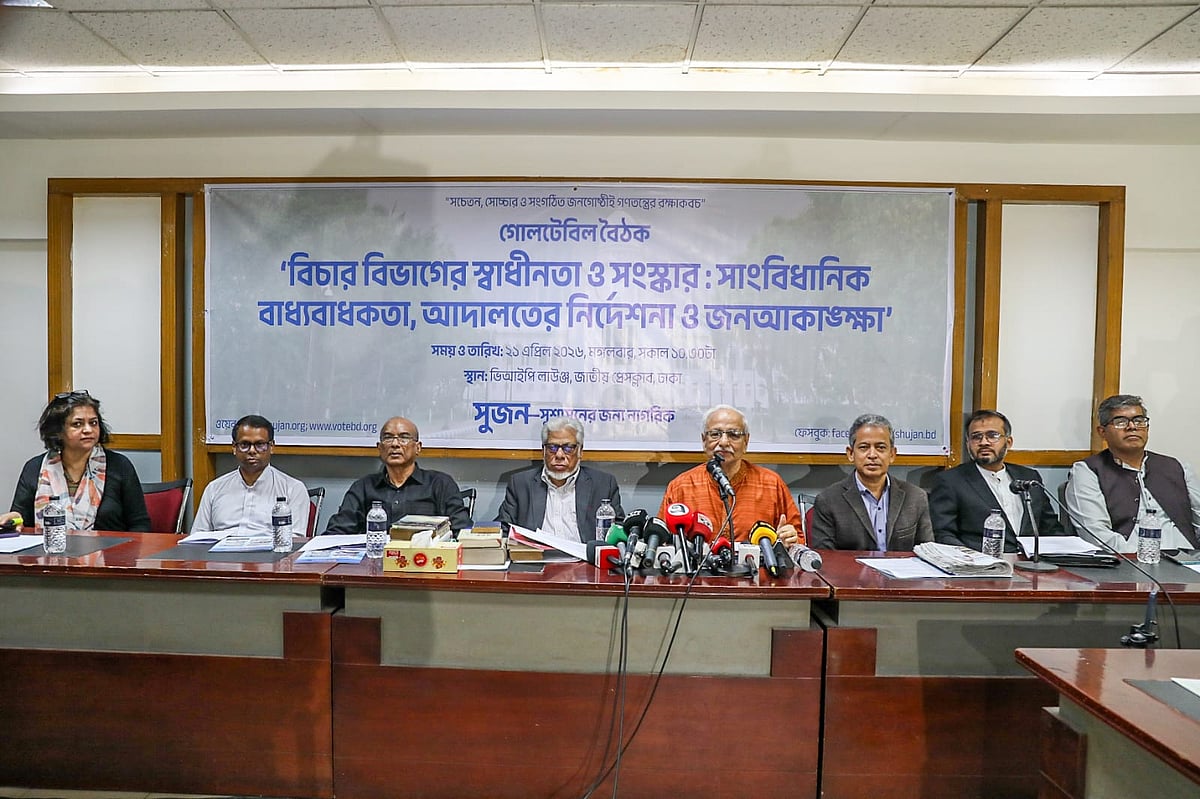
Photo Collected
As the Supreme Court Secretariat Ordinance and the Supreme Court Judge Appointment Ordinance are not passed by the National Parliament, the Judiciary will again ‘go into the pocket’ of the administration, said retired Judge MA Matin of the Appellate Division. According to him, the government took such a decision to appoint judges of their own ‘choice’. The nation will not accept the conspiracy of those who want to thwart reforms in the name of reforms.
Justice MA Matin presented the main article in a round table meeting titled ‘Independence and Reform of Judiciary: Constitutional Obligation, Court Guidelines and Public Desire’ at the National Press Club in Dhaka on Tuesday. The roundtable is organized by Citizens for Good Governance (Sujan).
বিজ্ঞাপন
In the original article, Justice MA Matin said that both the appointment of judges and the secretariat-related ordinances were made to protect the judiciary and to fulfill national aspirations. It is the duty of the present Parliament to make the two Judiciary-related Ordinances ‘Acts of Parliament’.
In the main article, it is said that in Article 22 of the Constitution of Bangladesh, the judicial department should be separated from the executive and legislative departments; But despite the constitutional provisions, no government has taken any action on it till 1995. In the case of ‘Masdar Hossain v. Bangladesh’, the Appellate Division of the Supreme Court gave a historic judgment in 1999 to make the judiciary independent by giving 12 directions; But that judgment was not fully implemented. Later the interim government took the initiative to appoint judges and establish the Supreme Court Secretariat through two ordinances; But as the BNP government did not pass the two ordinances into law through Parliament, they were repealed.
বিজ্ঞাপন
Justice MA Matin said that the judicial system consists of bar and bench. If the bar is not independent, if not wise, then the judgment of the judge is weak. Unfortunately the bar is now subjugated. The party that comes to government, they become the ‘spoon’ of that party. The government got the courage to cancel the two ordinances.
Moinul Islam Chowdhury, the former chairman of the National Human Rights Commission and retired judge commented in the round table discussion that the repeal of the two ordinances is undoubtedly a step backwards. He said such a decision is alarming and will not bring good results for the nation. Although the current law minister has promised to make better laws, he expressed doubts about how much confidence can be placed in the assurances of politicians.
Moinul Islam Chowdhury said that people’s opinion is very important in judicial independence. If the public perceives that the judiciary is not independent, then the judiciary has no standing. He said, “Let us build a judiciary where a garment worker in Rangpur, a hawker in Sylhet or a rickshaw puller in Khulna can say – we trust the court, we trust the judiciary.”
Sujan editor Badiul Alam Majumdar was the moderator of this round table discussion. He said, there was a lot of preparation, a lot of research behind making the ordinances. Someone suddenly woke up in the morning thinking about these things and said, that’s not the point.
Badiul Alam Majumdar said that the government has promised to make better laws; But the citizens are not reassured due to the government’s actions. He said that the government is saying that they will implement the July Charter letter by letter. If the government has the will, they should quickly set up a constitutional reform council.
Sara Hossain, senior lawyer of the Supreme Court, said that everyone is looking for positive change. Those in the executive branch will use the judiciary as a tool to suppress political rivals—no one wants that. Two laws were necessary for this fundamental change.
Sara Hossain said that the aspirants should get justice above political identity. Justice must be ensured to those who are considered as adversaries.
Sara Hossain commented in the round table discussion that the National Consensus Commission formed during the interim government cannot be called a democratic process in any way. He said, ‘It is a selective process. You have sat down and made a decision about some people. Where was the democracy here? What election, who is coming? Who can speak from outside? No one.’
The senior lawyer of the Supreme Court said that there was not a single woman member in the National Consensus Commission. No women lawyers or women judges were involved in the Judiciary Reform Commission either.
Professor AKM Waresul Karim, Dean of the School of Business and Economics of North South University, said that the government is telling a story about giving something ‘perfect’.
Supreme Court lawyer Tanim Hussain Shaon was involved in the drafting process of the two Judiciary-related Ordinances. In the discussion, he said, there were many important issues in the Supreme Court Secretariat Ordinance. But the government canceled it without saying where the law is weak.
Senior advocate Imran A Siddique, who served as a member of the Constitutional Reforms Commission, said the High Court in a September 2025 judgment directed the government to establish a separate secretariat for the Supreme Court. No appeal has yet been filed against this verdict. There is no scope for the government to ignore this judgment without filing an appeal and seeking a stay. He also commented that the government’s decision to abolish the secretariat and to put the funds of the secretariat under the Ministry of Law is contempt of court.
Co-coordinator of Citizen Coalition Fahim Mashroor, General Secretary of State Reform Movement Syed Hasib Uddin Hossain and others also spoke in the round table discussion.
Source: Prothom Alo Bangla
0%
0%
0%
0%